• Fri frakt över 249 kr
  • •
  • Snabba leveranser
  • •
  • Billiga böcker
Kundservice

Du är på sajten för privatpersoner.

Företag, bibliotek eller offentlig verksamhet?

Du handlar på classic.bokus.com, där alla dina funktioner finns intakta.
Till classic.bokus.com
Bokus logotyp. Gå till startsidan.
  • Erbjudanden
  • Nyheter
  • Student
  • Topplistor
  • Barn & ungdom
  • Bokus Play
  • E-böcker
  • Pocketböcker
  • Spel & pussel

Må bättre, för mindre! Upp till 50% rabatt på hälsoböcker

Sidfot

Mina sidor

    Hjälp

    • Kundservice
    • Vanliga frågor och svar
    • Frakt och leverans
    • Retur vid ångerrätt
    • Reklamera vara
    • Betalning
    • Köpvillkor
    • Allmänna villkor
    • Information om webbplatsens tillgänglighet

    Om Bokus

    • Om oss
    • Pressrum
    • För studenter
    • För företag
    • För bibliotek och offentlig verksamhet
    • För leverantörer
    • Hållbarhet

    Populärt

    • Aktuella erbjudanden
    • Presentkort
    • Studentlitteratur
    • Nya böcker
    • Topplistor
    • Signerade böcker
    • Engelska böcker

    Inspiration

    • Boktips
    • BookTok
    • Populära bokserier
    • Barnbokskaraktärer
    • Populära författare
    Logotyp för Bokus
    Följ oss på Facebook (extern länk)Följ oss på Instagram (extern länk)Följ oss på YouTube (extern länk)Följ oss på TikTok (extern länk)
    bokus @ CookiesAnpassa cookiesIntegritetspolicyKöpvillkor
    Till Citymail hemsida (extern länk)Till Budbee hemsida (extern länk)Till Postnord hemsida (extern länk)Till Schenker hemsida (extern länk)Till Early Bird hemsida (extern länk)Till Walleys hemsida (extern länk)
    1. Samhälle och politik
    2. Politik och statsskick

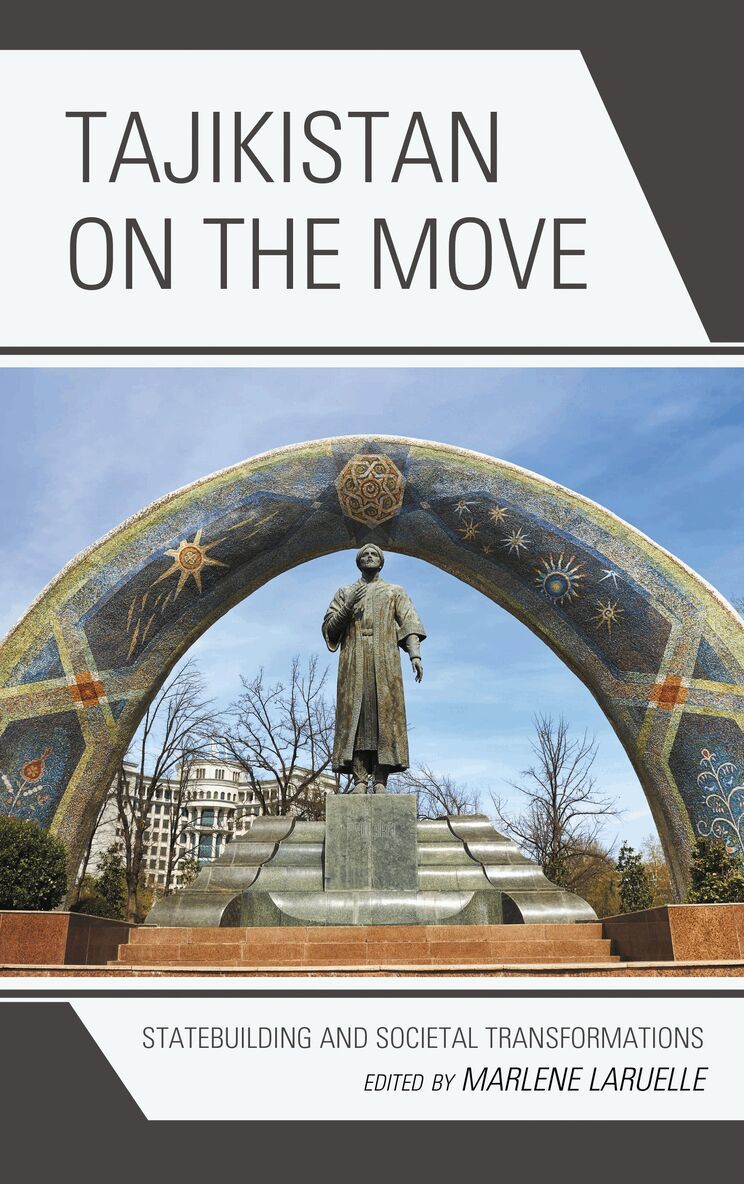
    Tajikistan on the Move

    Statebuilding and Societal Transformations

    AvMarlene Laruelle

    Inbunden, Engelska, 2018

    Del i serien Contemporary Central Asia: Societies, Politics, and Cultures

    1 533 kr

    Beställningsvara. Skickas inom 10-15 vardagar. Fri frakt över 249 kr.

    Beskrivning

    The southernmost and poorest state of the Eurasian space, Tajikistan collapsed immediately upon the fall of the Soviet Union and plunged into a bloody five-year civil war (1992–1997) that left more than 50,000 people dead and more than half a million displaced. After the 1997 Peace Agreements, Tajikistan stood out for being the only post-Soviet country to recognize an Islamic party—the Islamic Renaissance Party of Tajikistan (IRPT)—as a key actor in the civil war as well as in postwar reconstruction and democratization. Tajikistan’s linguistic and cultural proximity to Iran notwithstanding, the balance of external powers over the country remains fairly typical of Central Asia, with Russia as the major security provider and China as its principal investor.Another specificity of Tajikistan is its massive labor migration flows toward Russia. Out of a population of eight million, about one million work abroad seasonally—one of the highest rates of departure in the world. Migration trends have impacted Tajikistan’s economy and rent mechanisms: half of the country’s GDP comes from migrant remittances, a higher share than anywhere else in the world. However, it is in the societal and cultural realms that migration has had the most transformative effect. Migrants’ cultural and societal identities are on the move, with a growing role given to Islam as a normative tool for regulating the cultural shock of migration. Islam, and especially a globalized fundamentalist pietist movement, regulates both physical and moral security in workplace and other settings, and brings migrants together to make their interactions meaningful and socio-politically relevant. It offers a new social prestige to those who work in an environment seen as threatening to their Islamic identity.The first section of this volume investigates the critical question of the nature of the Tajik political regime, its stability, legitimacy mechanisms, and patterns of centralization. In the volume’s second part, we move away from studying the state to delve into the societal fabric of Tajikistan, shaped by local rural specificities and social vulnerabilities in the health sector and gender relationships. The third section of the volume is devoted to identity narratives and changes. While the Tajik regime works hard to control the national narrative and the interpretation of the civil war, society is literally and figuratively on the move, as migration profoundly reshapes societal structures and cultural values.

    Produktinformation

    • Utgivningsdatum:2018-05-25
    • Mått:160 x 229 x 26 mm
    • Vikt:717 g
    • Format:Inbunden
    • Språk:Engelska
    • Serie:Contemporary Central Asia: Societies, Politics, and Cultures
    • Antal sidor:336
    • Förlag:Bloomsbury Publishing Plc
    • ISBN:9781498546515

    Utforska kategorier

    • Politik och statsskick inom Samhälle och politik

    Mer om författaren

    Marlene Laruelle is research professor, director of the Central Asia Program, and associate director of the Institute for European, Russian, and Eurasian Studies (IERES) at the Elliott School of International Affairs of George Washington University.

    Recensioner i media

    The book features a uniquely cohesive collection of essays by well-known scholars of Tajikistan. . . The frank description of government dependence on Chinese investment, Russian security support, significant labour migrant remittances and drug trafficking sets the tone for a thorough and forthright presentation of the country. . . . In sum, the rich and detailed descriptions in this book give it general appeal as well as academic value. As a coherent set of perspectives, each offering high levels of expertise, deep knowledge and astute analysis, this book belongs in every university library. Students of sociology, anthropology and development economics can learn a great deal from these examples. Scholars of comparative politics, conflict analysis and politics will see here a substantive development of their fields.

    Innehållsförteckning

    • Introduction, Marlene LaruellePart I: State Dynamics. Policies, their Actors and their SpacesChapter 1: Hobbesian Neopatrimonialism, Jesse DriscollChapter 2: Rebels without a Cause? Authoritarian Conflict Management in Tajikistan, 2008-2015, John Heathershaw and Parviz MullojonovChapter 3: From Moscow to Madrid: Governing Security Threats Beyond Tajikistan’s Borders, Edward LemonChapter 4: Tajikistan’s Multi-Vector Foreign Policy: Constructing Relations with Russia, China, and the United States, Kirill NourzhanovPart II: Tajik Society: Local Developments and Social VulnerabilitiesChapter 5: Dushanbe Is Quite Far: Deconcentrated Agrarian Reform in Rural Tajikistan, Brent HiermanChapter 6: Local Governance in Khatlon, Tajikistan, Suzanne Levi-SanchezChapter 7: Development Practices, Insecurity, and Risks: Injectable Drug Users in Gorno-Badakhshan, Sophie HohmannChapter 8: “A Woman Without a Man is a Kazan Without a Lid”: Polygyny in Tajikistan, Michele CommercioPart III: State Memory and M