• Fri frakt över 249 kr
  • •
  • Snabba leveranser
  • •
  • Billiga böcker
Kundservice

Du är på sajten för privatpersoner.

Företag, bibliotek eller offentlig verksamhet?

Du handlar på classic.bokus.com, där alla dina funktioner finns intakta.
Till classic.bokus.com
Bokus logotyp. Gå till startsidan.
  • Erbjudanden
  • Student
  • Topplistor
  • Barn & ungdom
  • Bokus Play
  • E-böcker
  • Ljudböcker
  • Pocketböcker
  • Spel & pussel

Upp till 25% på utvalda nyheter →

Sidfot

Mina sidor

    Hjälp

    • Kundservice
    • Vanliga frågor och svar
    • Frakt och leverans
    • Retur vid ångerrätt
    • Reklamera vara
    • Betalning
    • Köpvillkor
    • Allmänna villkor
    • Information om webbplatsens tillgänglighet

    Om Bokus

    • Om oss
    • Pressrum
    • För studenter
    • För företag
    • För bibliotek och offentlig verksamhet
    • För leverantörer
    • Hållbarhet

    Populärt

    • Aktuella erbjudanden
    • Presentkort
    • Studentlitteratur
    • Nya böcker
    • Topplistor
    • Signerade böcker
    • Engelska böcker

    Inspiration

    • Boktips
    • BookTok
    • Populära bokserier
    • Barnbokskaraktärer
    • Populära författare
    Logotyp för Bokus
    Följ oss på Facebook (extern länk)Följ oss på Instagram (extern länk)Följ oss på YouTube (extern länk)Följ oss på TikTok (extern länk)
    bokus @ CookiesAnpassa cookiesIntegritetspolicyKöpvillkor
    Till Citymail hemsida (extern länk)Till Budbee hemsida (extern länk)Till Postnord hemsida (extern länk)Till Schenker hemsida (extern länk)Till Early Bird hemsida (extern länk)Till Walleys hemsida (extern länk)
    1. Naturvetenskap och teknik
    2. Teknik och industri
    3. Elektronik och kommunikationer

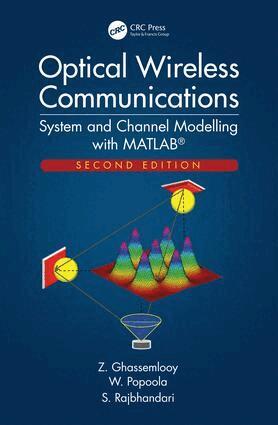
    Optical Wireless Communications

    System and Channel Modelling with MATLAB®, Second Edition

    AvZ. Ghassemlooy,W. Popoola

    Inbunden, Engelska, 2019

    2 422 kr

    Beställningsvara. Skickas inom 10-15 vardagar. Fri frakt över 249 kr.

    Fler format och utgåvor

    Häftad

    Tillf. slut

    Beskrivning

    The 2nd Edition of Optical Wireless Communications: System and Channel Modelling with MATLAB® with additional new materials, is a self-contained volume that provides a concise and comprehensive coverage of the theory and technology of optical wireless communication systems (OWC). The delivery method makes the book appropriate for students studying at undergraduate and graduate levels as well as researchers and professional engineers working in the field of OWC.The book gives a detailed description of OWC, focusing mainly on the infrared and visible bands, for indoor and outdoor applications. A major attraction of the book is the inclusion of Matlab codes and simulations results as well as experimental test-beds for free space optics and visible light communication systems. This valuable resource will aid the readers in understanding the concept, carrying out extensive analysis, simulations, implementation and evaluation of OWC links. This 2nd edition is structured into nine compact chapters that cover the main aspects of OWC systems: History, current state of the art and challenges Fundamental principles Optical source and detector and noise sources Modulation, equalization, diversity techniques Channel models and system performance analysis Visible light communications Terrestrial free space optics communications Relay-based free space optics communications Matlab codes.A number of Matlab based simulation codes are included in this 2nd edition to assist the readers in mastering the subject and most importantly to encourage them to write their own simulation codes and enhance their knowledge.

    Produktinformation

    • Utgivningsdatum:2019-05-02
    • Mått:178 x 254 x 30 mm
    • Vikt:1 260 g
    • Format:Inbunden
    • Språk:Engelska
    • Antal sidor:502
    • Upplaga:2
    • Förlag:Taylor & Francis Inc
    • ISBN:9781498742696

    Utforska kategorier

    • Elektronik och kommunikationer inom Naturvetenskap och teknik
    • Övrig teknik och tillämpad vetenskap inom Naturvetenskap och teknik

    Mer om författaren

    Professor Zabih Ghassemlooy, CEng, Fellow of IET, Senior Member of IEEE: Received his BSc (Hons) degree in Electrical and Electronics Engineering from the Manchester Metropolitan University in 1981, and his MSc and PhD in Optical Communications from the University of Manchester Institute of Science and Technology (UMIST), in 1984 and 1987, respectively with Scholarships from the Engineering and Physical Science Research Council, UK. From 1986-87 worked in UMIST and from 1987 to 1988 was a Post-doctoral Research Fellow at the City University, London. In 1988 he joined Sheffield Hallam University as a Lecturer, becoming a Reader in 1995 and a Professor in Optical Communications in 1997. From 2004 until 2012 was an Associate Dean for Research in the School of Computing, Engineering and in 2012 he became Associate Dean for Research and Innovation in the Faculty of Engineering and Environment, at Northumbria University at Newcastle, UK. He also heads the Northumbria Communications Research Laboratories within the Faculty. In 2001 he was a recipient of the Tan Chin Tuan Fellowship in Engineering from the Nanyang Technological University in Singapore to work on the photonic technology. He is the Editor-in-Chief of the International Journal of Optics and Applications The Mediterranean Journal Electronics and Communications. He currently serves on the Editorial Committees of number international journals. From 2004-06 he was the IEEE UK/IR Communications Chapter Secretary, the Vice-Chairman (2004-2008), the Chairman (2008-2011), and Chairman of the IET Northumbria Network (Oct 2011-).Wasiu O. Popoola holds a National Diploma in Electrical Engineering from The Federal Polytechnic, Ilaro, Nigeria, a First Class (Hons.) in Electronic and Electrical Engineering from Obafemi Awolowo University, Nigeria and an MSc with Distinction in Optoelectronic and Communication Systems from Northumbria University at Newcastle upon Tyne, UK. He was awarded his PhD degree in 2009 at the same Northumbria University for his research work in Free-Space Optical Communications. During his PhD, he was awarded the ‘Xcel Best Engineering and Technology Student of the year 2009’.Dr. S. Rajbhandari obtained his bachelor degree in electronics and communication engineering from the Institute of Engineering, Pulchowk Campus (Tribhuvan University), Nepal in 2004 He obtained an MSc in optoelectronic and communication systems with distinction in 2006 and was awarded the P O Byrne prize for most innovative project He then joined the Optical Communications Research Group (OCRG) at Northumbria University as a PhD candidate and was awarded a PhD degree in 2010 His PhD thesis was on mitigating channel effect on indoor optical wireless communications using wavelet transform and a neural network Since 2009 he has been with the OCRG at Northumbria University working as a postdoctorate researcher.

    Recensioner i media

    'As the radio frequency spectrum becomes crowded for local and personal area networks, optical wireless communications becomes a more and more necessary technology to meet increasing bandwidth needs. With this second, updated version, this book—which is in a field with only a handful of similar titles—continues to provide a wide and deep coverage of the topic.The book starts with the very basics of device and channel issues, and moves on to modulation technologies for both indoor and outdoor applications. In terms of updates, a new final chapter on relay-assisted free-space optics has been added in this edition. As in the earlier edition, the book includes mathematical formulas, charts (some in color), and extensive, clearly updated references at the end of each chapter.Although otherwise suitable as a textbook, the book lacks problems and exercises. Much of the book’s attraction is in its use of MATLAB simulations, with the source code published in the print edition, but not readily available for downloading. Considering both pros and cons, this is a well-written, updated book, useful primarily for professionals, and possibly as a textbook if supplemented with suitable assignments.' - Bogdan Hoanca, University of Alaska Anchorage

    Innehållsförteckning

    • Introduction: Optical Wireless Communication Systems. Optical Sources and Detectors. Channel Modelling. Modulation Techniques. System Performance Analysis: Indoor. FSO Link Performance under the Effect of Atmospheric Turbulence. Outdoor OWC Links with Diversity Techniques. Visible Light Communications. Ultraviolet OWC & Underwater OWC