• Fri frakt över 249 kr
  • •
  • Snabba leveranser
  • •
  • Billiga böcker
Kundservice

Du är på sajten för privatpersoner.

Företag, bibliotek eller offentlig verksamhet?

Du handlar på classic.bokus.com, där alla dina funktioner finns intakta.
Till classic.bokus.com
Bokus logotyp. Gå till startsidan.
  • Erbjudanden
  • Nyheter
  • Student
  • Topplistor
  • Barn & ungdom
  • Bokus Play
  • E-böcker
  • Pocketböcker
  • Spel & pussel

10% rabatt på allt med kod NYSTART10 →

Sidfot

Mina sidor

    Hjälp

    • Kundservice
    • Vanliga frågor och svar
    • Frakt och leverans
    • Retur vid ångerrätt
    • Reklamera vara
    • Betalning
    • Köpvillkor
    • Allmänna villkor
    • Information om webbplatsens tillgänglighet

    Om Bokus

    • Om oss
    • Pressrum
    • För studenter
    • För företag
    • För bibliotek och offentlig verksamhet
    • För leverantörer
    • Hållbarhet

    Populärt

    • Aktuella erbjudanden
    • Presentkort
    • Studentlitteratur
    • Nya böcker
    • Topplistor
    • Signerade böcker
    • Engelska böcker

    Inspiration

    • Boktips
    • BookTok
    • Populära bokserier
    • Barnbokskaraktärer
    • Populära författare
    Logotyp för Bokus
    Följ oss på Facebook (extern länk)Följ oss på Instagram (extern länk)Följ oss på YouTube (extern länk)Följ oss på TikTok (extern länk)
    bokus @ CookiesAnpassa cookiesIntegritetspolicyKöpvillkor
    Till Citymail hemsida (extern länk)Till Budbee hemsida (extern länk)Till Postnord hemsida (extern länk)Till Schenker hemsida (extern länk)Till Early Bird hemsida (extern länk)Till Walleys hemsida (extern länk)
    1. Skönlitteratur
    2. Litteraturvetenskap
    3. Litteraturvetenskap

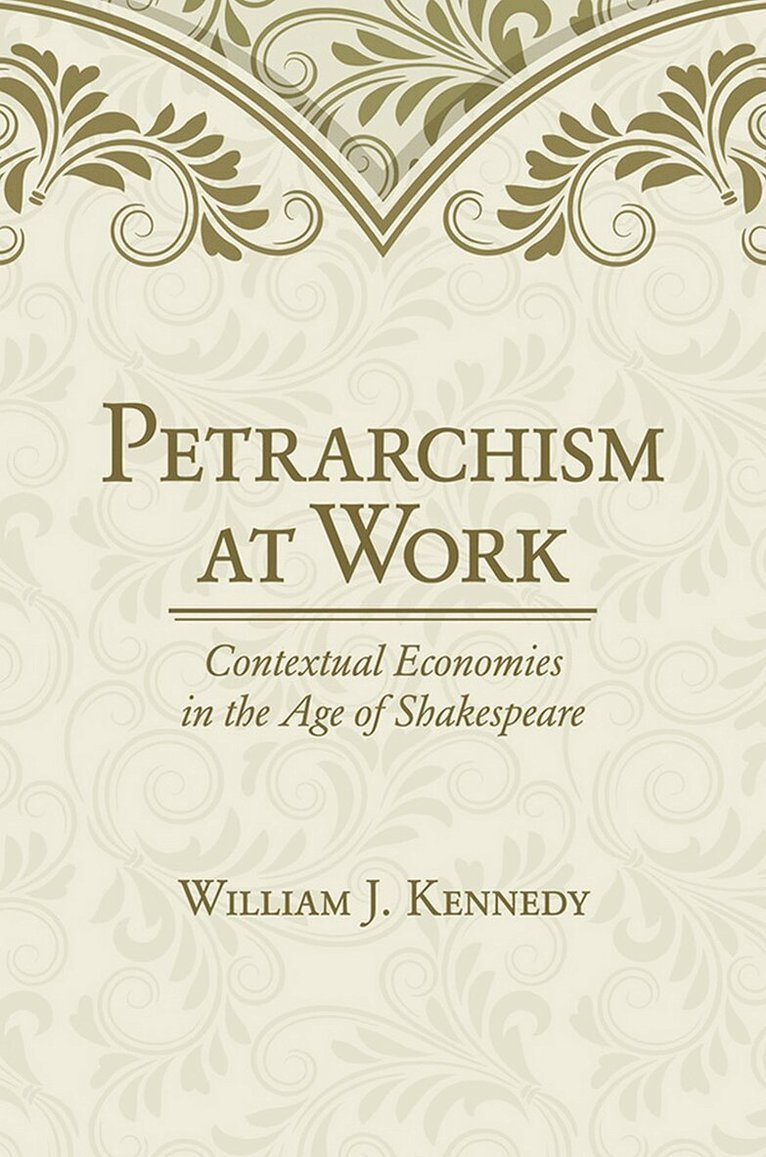
    Petrarchism at Work

    Contextual Economies in the Age of Shakespeare

    AvWilliam J. Kennedy

    Inbunden, Engelska, 2016

    842 kr

    Beställningsvara. Skickas inom 5-8 vardagar. Fri frakt över 249 kr.

    Beskrivning

    The Italian scholar and poet Francesco Petrarch (1304–1374) is best remembered today for vibrant and impassioned love poetry that helped to establish Italian as a literary language. Petrarch inspired later Renaissance writers, who produced an extraordinary body of work regarded today as perhaps the high-water mark of poetic productivity in the European West. These "Petrarchan" poets were self-consciously aware of themselves as poets—as craftsmen, revisers, and professionals. As William J. Kennedy shows in Petrarchism at Work, this commitment to professionalism and the mastery of poetic craft is essential to understanding Petrarch's legacy.Petrarchism at Work contributes to recent scholarship that explores relationships between poetics and economic history in early-modern European literature. Kennedy traces the development of a Renaissance aesthetics from one based upon Platonic intuition and visionary furor to one grounded in Aristotelian craftsmanship and technique. Their polarities harbor economic consequences, the first privileging the poet's divinely endowed talent, rewarded by the autocratic largess of patrons, the other emphasizing the poet's acquired skill and hard work. Petrarch was the first to exploit the tensions between these polarities, followed by his poetic successors. These include Gaspara Stampa in the emergent salon society of Venice, Michelangelo Buonarroti in the "gift" economy of Medici Florence and papal Rome, Pierre de Ronsard and the poets of his Pléiade brigade in the fluctuant Valois court, and William Shakespeare and his contemporaries in the commercial world of Elizabethan and early Stuart London. As Kennedy shows, the poetic practices of revision and redaction by Petrarch and his successors exemplify the transition from a premodern economy of patronage to an early modern economy dominated by unstable market forces.

    Produktinformation

    • Utgivningsdatum:2016-04-19
    • Mått:152 x 229 x undefined mm
    • Vikt:907 g
    • Format:Inbunden
    • Språk:Engelska
    • Antal sidor:352
    • Förlag:Cornell University Press
    • ISBN:9781501700019
    • Utmärkelser:Runner-up for Aldo and Jeanne Scaglione Prize for Italian Studies 2016 (United States)

    Utforska kategorier

    • Litteraturvetenskap inom Skönlitteratur

    Mer om författaren

    William J. Kennedy is Avalon Foundation Professor in the Humanities in the Department of Comparative Literature at Cornell University. He is the author of several books, including The Site of Petrarchism: Early Modern National Sentiment in Italy, France, and England and Authorizing Petrarch.

    Recensioner i media

    Kennedy's command of the source materials and close readings of poetic variants are exceptional. With Petrarchism at Work he has written another authoritative and original study of Petrarch's legacy that will greatly impact theeld.(Renaissance Quarterly) Invites debate, reflection, and further contributions on a widening variety of textual corpora. This fine book has much to recommend it, especially to English-language students of Renaissance literature and history who seek to weigh the importance of one of Renaissance Europe's principal literary idioms as its distinctive forms appear in a representative variety of national contexts.(Renaissance and Reformation)

    Innehållsförteckning

    • Introduction: The Marketplace of Mercury Part One: Petrarch and Italian Poetry1. Petrarch as Homo Economicus 2. Making Petrarch Matter: The Parts and Labor of Textual Revision 3. Jeweler's Daughter Sings for Doge: Gaspara Stampa’s Entrepreneurial Poetics 4. Incommensurate Gifts: Michelangelo and the Economy of Revision Part Two: Pierre De Ronsard and Pléiade Aesthetics1. Polished to Perfection: Ronsard’s Investment in Les Amours 2. Ronsard Furieux: Interest in Ariosto 3. Passions and Privations: Writing Sonnets like a Pro in Les Amours de Marie4. The Smirched Muse: Commercializing Sonnets pour Hélène Part Three: Shakespeare’s Sonnets and the Economy of Petrarchan Aesthetics1. To Possess Is Not to Own: The Cost of the Dark Lady and the Young Man 2. Polish and Skill: Will’s Interest and Self-Interest in Sonnets 61–99 3. Owning Up to Furor: The "Poets’ War" and Its Aftermath in Sonnets 100–1264. Shakespeare as Professional: The Economy of Revision in Sonnets 1–60 Conclusion: Mercurial Economies