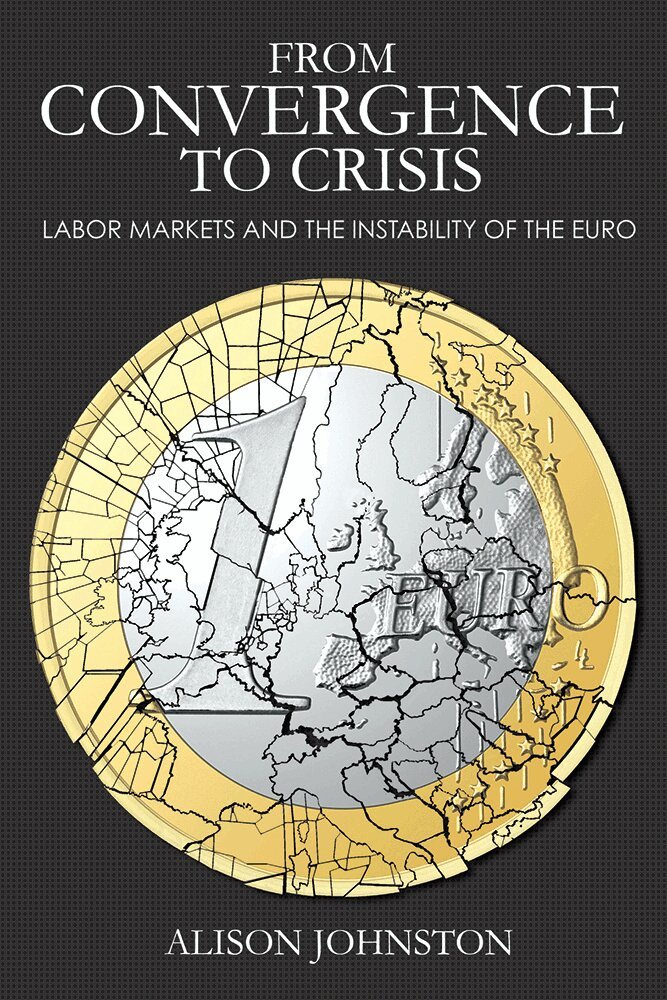
Inbunden, Engelska, 2016
From Convergence to Crisis
Labor Markets and the Instability of the Euro
Del i serien Cornell Studies in Money
567 kr
Beställningsvara. Skickas inom 7-10 vardagar. Fri frakt över 249 kr.
Beskrivning
Produktinformation
- Utgivningsdatum: 2016-06-16
- Mått: 152 x 229 x undefined mm
- Vikt: 454 g
- Format: Inbunden
- Språk: Engelska
- Serie: Cornell Studies in Money
- Antal sidor: 248
- Förlag: Cornell University Press
- ISBN: 9781501702655
- Utmärkelser: Winner of European Union Studies Association Book Prize 2017
Utforska kategorier
Mer om författaren
Alison Johnston is Assistant Professor of Political Science and Public Policy at Oregon State University.
Recensioner i media
Johnston uses theory, statistical analysis, and case studies to argue that each country's relative wage moderation compared to other European Monetary Union (EMU) members determines how susceptible the country has been to the debt crisis. The case studies analyze wage negotiation changes in Denmark, the Netherlands, Germany, Italy, Ireland, and Spain, mostly focusing on 1979 to 2008. Finally, Johnston argues, post-2008 austerity conditions for loans to countries on the verge of default have tended to exacerbate declines. She suggests supranational wage coordination and wage increases in creditor EMU nations to promote recovery. Summing Up: Recommended. Upper-division undergraduates through faculty.- E. J. Peterson (Choice) [This book] examines the European debt crisis, the effects of labor-market politics before the 2008 global financial crisis, and how the European Economic and Monetary Union (EMU) created circumstances that economically advantaged low-inflation northwest European member economies over high-inflation peripheral economies. [Johnston] presents a labor-market approach that views the euro crisis as a holistic problem and delineates the role of the EMU North in crisis recovery and in providing a solidaristic approach to EU recovery.(Journal of Economic Literature) Johnston's book traces the development of wage rate bargaining institutions over time and across member states of the European Economic and Monetary Union (EMU). Her argument is as intuitive as it is compelling.- Ari Ray, University of Zurich (EuropeNow)
Betyg & recensioner
0 recensioner
Inga recensioner tillgängliga.