• Fri frakt över 249 kr
  • •
  • Snabba leveranser
  • •
  • Billiga böcker
Kundservice

Du är på sajten för privatpersoner.

Företag, bibliotek eller offentlig verksamhet?

Du handlar på classic.bokus.com, där alla dina funktioner finns intakta.
Till classic.bokus.com
Bokus logotyp. Gå till startsidan.
  • Erbjudanden
  • Student
  • Topplistor
  • Barn & ungdom
  • Bokus Play
  • E-böcker
  • Ljudböcker
  • Pocketböcker
  • Spel och pussel

Skapa nya rutiner – hälsoböcker upp till 50% →

Sidfot

Mina sidor

    Hjälp

    • Kundservice
    • Vanliga frågor och svar
    • Frakt och leverans
    • Retur vid ångerrätt
    • Reklamera vara
    • Betalning
    • Köpvillkor
    • Allmänna villkor
    • Information om webbplatsens tillgänglighet

    Om Bokus

    • Om oss
    • Pressrum
    • För studenter
    • För företag
    • För bibliotek och offentlig verksamhet
    • För leverantörer
    • Hållbarhet

    Populärt

    • Aktuella erbjudanden
    • Presentkort
    • Studentlitteratur
    • Nya böcker
    • Topplistor
    • Signerade böcker
    • Engelska böcker

    Inspiration

    • Boktips
    • BookTok
    • Barnbokskaraktärer
    • Populära författare
    Logotyp för Bokus
    Följ oss på Facebook (extern länk)Följ oss på Instagram (extern länk)Följ oss på YouTube (extern länk)Följ oss på TikTok (extern länk)
    bokus @ CookiesAnpassa cookiesIntegritetspolicyKöpvillkor
    Till Citymail hemsida (extern länk)Till Budbee hemsida (extern länk)Till Postnord hemsida (extern länk)Till Schenker hemsida (extern länk)Till Early Bird hemsida (extern länk)Till Walleys hemsida (extern länk)
    1. Ekonomi och Ledarskap
    2. Nationalekonomi

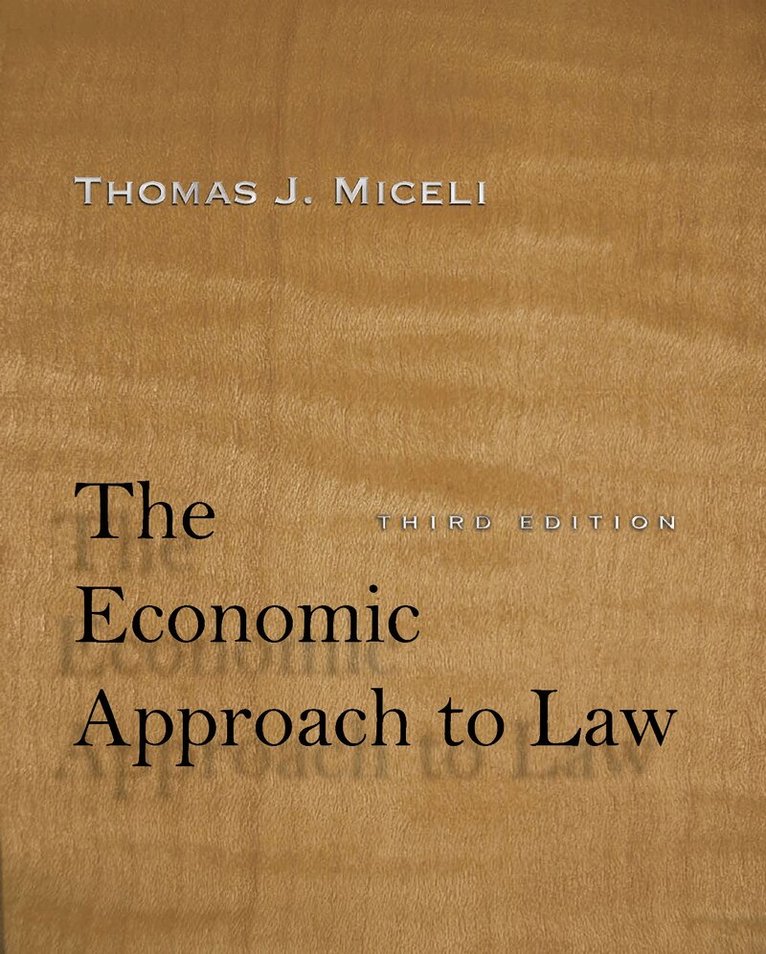
    Economic Approach to Law, Third Edition

    AvThomas J. Miceli

    Inbunden, Engelska, 2017

    1 187 kr

    Beställningsvara. Skickas inom 5-8 vardagar. Fri frakt över 249 kr.

    Fler format och utgåvor

    E-bok

    1 203 kr

    Beskrivning

    Master teacher Thomas J. Miceli provides an introduction to law and economics that reveals how economic principles can explain the structure of the law and make it more efficient.The third edition of this seminal textbook is thoroughly updated to include recent cases and the latest scholarship, with particular attention paid to torts, contracts, property rights, and the economics of crime. A new chapter organization, ideal for quarter- or semester-long courses, strengthens the book's focus on unifying themes in the field. As Miceli tells a cohesive, analytical "story" about law from a distinctly economic perspective, exercises and problems encourage students to deepen their knowledge.A companion website is available at http://www.sup.org/economiclaw. It offers a full suite of resources for both students and professors. Key pedagogical features include cases; discussion points that provide additional analysis of topics in the book; graduate notes, which enrich the text for more advanced readers; and relevant links. Professors have access to sample syllabi for undergraduate and graduate courses and an instructor's manual, which provides answers to all of the end-of-chapter questions and problems in the book.

    Produktinformation

    • Utgivningsdatum:2017-10-17
    • Mått:187 x 235 x 33 mm
    • Vikt:1 018 g
    • Format:Inbunden
    • Språk:Engelska
    • Antal sidor:448
    • Upplaga:3
    • Förlag:Stanford University Press
    • ISBN:9781503600065

    Utforska kategorier

    • Nationalekonomi inom Ekonomi och Ledarskap

    Mer om författaren

    Thomas J. Miceli is Professor of Economics at the University of Connecticut.

    Recensioner i media

    "Thomas Miceli's book offers a thorough presentation that is both clear and challenging. It provides students with more than an introduction, indeed a broad and deep understanding of the application of economics to law." - Fred Foldvary (San Jose State University) "Miceli's Economic Approach to Law, now in its third edition, provides a systematic and well-organized presentation of the economic approach to law. Written by a leading economist in the field, this book is rich of content—yet accessible—as an entry-level textbook in law and economics." - Francesco Parisi (University of Minnesota) "Now in its third edition, Miceli's carefully written text is rich with many well-selected examples. It covers the basic areas of law––torts (accidents), contracts, crime, property, and litigation—as well as the subject of antitrust, and furnishes a valuable guide to students for further reading. I know of no better book for its intended audience." - Steven Shavell (Harvard Law School) "We live in a complex and global world. Law is everywhere. Legal institutions rule our daily lives. This book challenges students and instructors, economists and lawyers, scholars and policymakers to think about the law in new ways. The author does a wonderful job in explaining important concepts in law and economics to anyone who wants to understand the relationship between rational behavior, economic reasoning, and the law." - Nuno Garoupa (Texas A&M University)

    Innehållsförteckning

    • Contents and Abstracts1Introductory Concepts chapter abstractThis chapter introduces the reader to the basic concepts of law and economics, including the distinction between positive and normative analysis, the justification for using efficiency as a norm for evaluating law, the specific notion of efficiency that will be used throughout the book (namely, Kaldor Hicks efficiency), and the Coase Theorem. The chapter also gives an overview of the legal system in the United States.2An Economic Model of Tort Law chapter abstractThis chapter develops the economic model of tort law, called the "model of precaution." The model is based on the proposition that the rules of tort law are designed to give parties engaged in risky activities an incentive to undertake all cost-justified precautions. The analysis compares the principal liability rules—strict liability and negligence—with respect to this objective and argues that, as regards cost minimization, negligence is the superior rule. The chapter then examines the famous Hand rule, the legal test for negligence, in light of the economic analysis. Finally, the chapter examines various extensions of the basic model, including variations on the simple negligence rule, sequential accidents, the role of causation rules, the function of punitive damages, the judgment proof problem, and the impact of liability insurance, litigation costs, and legal error on the functioning of the tort system.3Applying the Economic Model of Tort Law chapter abstractThis chapter applies the economic model of tort law to the following specific areas: products liability, workplace accidents, environmental accidents, and medical malpractice. In addition to reviewing the specific doctrines that apply to each area, the analysis raises an important new conceptual issue—namely, the difference between accidents involving "strangers" and accidents involving parties already in a contractual relationship. This distinction has important implications for the optimal design of the law, and for the relationship between markets and legal rules in allocating responsibility for legal wrongs. This is a theme that runs throughout the book.4The Economics of Contract Law I: The Elements of a Valid Contract chapter abstractThis chapter is the first of two on the economics of contract law, which is the legal means by which people enforce promises that they make to one another. This chapter focuses on the question of what makes a valid contract. From an economic perspective, the answer is based on the objective of maximizing the gains from trade, and so the guiding principles are the defining features of a competitive market. The specific focus is on how the law deals with departures from those ideal features in actual contract settings. In particular, it answers the question: when can a party get out of his or her obligation to perform as specified in the contract? Several justifications can be advanced: mental incapacity or incompetence, coercion or duress, mistake about a material aspect of the contract, and gross unfairness in the terms of the contract (unconscionability).5The Economics of Contract Law II: Remedies for Breach chapter abstractThis chapter examines the second fundamental question of contract law— what should the remedy be when a party breaks an enforceable contract? The chapter first describes the conditions under which breach of contract may be efficient, and then shows that expectation damages achieves this outcome. However, it also induces excessive reliance on performance by promisees. This problem is corrected by limiting to the amount that promisor's could have reasonably foreseen. The chapter then turns to risk-sharing considerations in contract law, as embodied in the doctrine of impossibility and related excuses. The discussion then considers the specific performance remedy, which is an order by the court for the promisor to perform the contract as written, and an argument is made for wider use of this remedy. The last section of the chapter discusses self-enforcement of contracts, including liquidated damage clauses, product warranties, long term contracts, and vertical integration.6The Economics of Property Law I: Property Rights and Consensual Exchange chapter abstractThe first part of this chapter describes the nature and function of property rights, how rights are defined, how they emerge, how they are legally protected, and how they influence economic behavior. The analysis then turns to a discussion of how the rules of property law facilitate the consensual exchange of property, and concludes with a brief overview of the economics of intellectual property law. The defining feature of ideas as economic assets is that they have public good attributes, meaning that once produced, they can be profitably used by many people without diminishing their quantity or quality. This characteristic suggests that ideas should be widely shared, but public ownership of ideas potentially creates a trade-off between wide dissemination of ideas, and the need to encourage people to discover or create them in the first place.7The Economics of Property Law II: Involuntary Transfers and Regulation of Property chapter abstractThis chapter examines the role of property law in correcting market failure, or externalities. It begins by reviewing the economic theory of externalities and various mechanisms for internalizing them, including the Pigovian approach and the Coasian critique of that approach. The chapter also introduces the distinction between property rules and liability rules, and applies the analysis to trespass and nuisance law, as well as other responses to externalities. Other topics include various forms of non-consensual transfer of property rights, or limitations on such transfers. Subsequent sections turn to transactions between the government and private property owners, including eminent domain, and the related issue of regulatory takings. The chapter concludes with a discussion of the General Transaction Structure, which is a general framework for understanding the relationship between markets and the law.8The Economics of Crime and Law Enforcement chapter abstractThis chapter provides an introduction to the economic analysis of crime and law enforcement. It begins by asking why there is a separate category of harms called crimes that are treated differently from accidental harms. The remainder of the chapter reviews the economic model of crime as it has developed since the seminal paper by Gary Becker. The theory is based on two principles: first, that offenders are rational calculators who take account of the expected punishment costs when making their crime choices, and second, that society chooses the structure of criminal penalties to minimize the overall costs of crime. Specific topics include the choice between fines and imprisonment, the impact of the magnitude versus the probability of punishment, the optimal treatment of repeat offenders, the death penalty, the ongoing controversy over the link between guns and crime, free speech laws, and blackmail.9The Economics of Legal Procedure chapter abstractThis chapter undertakes an analysis of legal procedure, both civil and criminal. The discussion of civil procedure focuses on the settlement-trial decision, and also examines various procedural rules, including the burden of proof, pre-trial discovery, and the allocating of trial costs. It also examines the lawmaking function of trials. The discussion of criminal procedure emphasizes the practice of plea bargaining, which is the criminal counterpart to out-of-court settlements. Although many of the same considerations apply, plea bargaining raises concerns not generally present in the civil context, notably the question of whether it induces innocent defendants to plead guilty. The chapter examines several other aspects of criminal procedure, including the bail system and judicial discretion in sentencing, and concludes with a discussion of constitutional protections against self-incrimination and unreasonable searches and seizures.10The Economics of Antitrust Law chapter abstractThis chapter examines the economic justification for antitrust laws, which constitute the body of statutes and judicial rulings whose objective is to prevent anticompetitive business practices. The competitive market paradigm provides the benchmark for efficient markets, but the conditions for perfect competition are rarely if ever met in practice. When significant departures arise, whether through the efforts of a single firm or a group of firms acting in concert, the resulting misallocation of resources may justify government intervention. The chapter offers an overview of some of the key issues related to antitrust law, beginning with the Sherman Act. The discussion focuses on the manner of enforcement and available remedies. The chapter concludes by examining the "new" economics of antitrust, which interprets many business practice once thought to be anti-competitive as possibly being responses some form of market failure.
    Hoppa över listan

    Mer från samma författare

    Thomas J. Miceli - Economics of the Law, Inbunden

    Economics of the Law

    Thomas J. Miceli

    Inbunden, 1997

    1 810 kr

    Thomas J. Miceli - Economics of the Law, E-bok

    Economics of the Law

    Thomas J. Miceli

    E-bok
    1997

    784 kr

    Thomas J. Miceli - The Economic Theory of Eminent Domain, Häftad

    The Economic Theory of Eminent Domain

    Thomas J. Miceli

    Häftad, 2011

    390 kr

    Thomas J. Miceli - The Economic Theory of Eminent Domain, Inbunden

    The Economic Theory of Eminent Domain

    Thomas J. Miceli

    Inbunden, 2011

    1 319 kr

    Thomas J. Miceli - Contemporary Issues in Law and Economics, Inbunden

    Contemporary Issues in Law and Economics

    Thomas J. Miceli

    Inbunden, 2018

    2 220 kr

    Thomas J. Miceli - Contemporary Issues in Law and Economics, Häftad

    Contemporary Issues in Law and Economics

    Thomas J. Miceli

    Häftad, 2018

    560 kr

    Thomas J. Miceli - Contemporary Issues in Law and Economics, E-bok

    Contemporary Issues in Law and Economics

    Thomas J. Miceli

    E-bok
    2018

    665 kr

    Thomas J. Miceli - Contemporary Issues in Law and Economics, E-bok

    Contemporary Issues in Law and Economics

    Thomas J. Miceli

    E-bok
    2018

    663 kr

    Thomas J. Miceli, Matthew J. Baker - Research Handbook on Economic Models of Law, Inbunden

    Research Handbook on Economic Models of Law

    Thomas J. Miceli, Matthew J. Baker

    Inbunden, 2013

    2 754 kr

    Thomas J. Miceli, Matthew J. Baker - Research Handbook on Economic Models of Law, Häftad

    Research Handbook on Economic Models of Law

    Thomas J. Miceli, Matthew J. Baker

    Häftad, 2015

    627 kr

    Hoppa över listan

    Du kanske också är intresserad av

    Thomas J. Miceli - Economic Approach to Law, Third Edition, E-bok

    Economic Approach to Law, Third Edition

    Thomas J. Miceli

    E-bok
    2017

    1 203 kr

    Thomas J. Miceli - Contemporary Issues in Law and Economics, E-bok

    Contemporary Issues in Law and Economics

    Thomas J. Miceli

    E-bok
    2018

    665 kr

    Thomas J. Miceli - Contemporary Issues in Law and Economics, Häftad

    Contemporary Issues in Law and Economics

    Thomas J. Miceli

    Häftad, 2018

    560 kr

    Thomas J. Miceli - Economics of the Law, E-bok

    Economics of the Law

    Thomas J. Miceli

    E-bok
    1997

    784 kr

    Thomas J. Miceli, Matthew J. Baker - Economic Models of Law, Inbunden
    Del 44

    Economic Models of Law

    Thomas J. Miceli, Matthew J. Baker

    Inbunden, 2014

    4 591 kr

    Thomas J. Miceli - Economics of the Law, Inbunden

    Economics of the Law

    Thomas J. Miceli

    Inbunden, 1997

    1 810 kr

    Thomas J. Miceli - Paradox of Punishment, Inbunden

    Paradox of Punishment

    Thomas J. Miceli

    Inbunden, 2019

    1 090 kr

    Thomas J. Miceli - Paradox of Punishment, Häftad

    Paradox of Punishment

    Thomas J. Miceli

    Häftad, 2020

    884 kr

    Thomas J. Miceli - The Economic Theory of Eminent Domain, Häftad

    The Economic Theory of Eminent Domain

    Thomas J. Miceli

    Häftad, 2011

    390 kr

    Thomas J. Miceli - Harm and Responsibility, Inbunden

    Harm and Responsibility

    Thomas J. Miceli

    Inbunden, 2024

    1 189 kr