• Fri frakt över 249 kr
  • •
  • Snabba leveranser
  • •
  • Billiga böcker
Kundservice

Du är på sajten för privatpersoner.

Företag, bibliotek eller offentlig verksamhet?

Du handlar på classic.bokus.com, där alla dina funktioner finns intakta.
Till classic.bokus.com
Bokus logotyp. Gå till startsidan.
  • Erbjudanden
  • Nyheter
  • Student
  • Topplistor
  • Barn & ungdom
  • Bokus Play
  • E-böcker
  • Pocketböcker
  • Spel & pussel

10% rabatt på allt med kod NYSTART10 →

Sidfot

Mina sidor

    Hjälp

    • Kundservice
    • Vanliga frågor och svar
    • Frakt och leverans
    • Retur vid ångerrätt
    • Reklamera vara
    • Betalning
    • Köpvillkor
    • Allmänna villkor
    • Information om webbplatsens tillgänglighet

    Om Bokus

    • Om oss
    • Pressrum
    • För studenter
    • För företag
    • För bibliotek och offentlig verksamhet
    • För leverantörer
    • Hållbarhet

    Populärt

    • Aktuella erbjudanden
    • Presentkort
    • Studentlitteratur
    • Nya böcker
    • Topplistor
    • Signerade böcker
    • Engelska böcker

    Inspiration

    • Boktips
    • BookTok
    • Populära bokserier
    • Barnbokskaraktärer
    • Populära författare
    Logotyp för Bokus
    Följ oss på Facebook (extern länk)Följ oss på Instagram (extern länk)Följ oss på YouTube (extern länk)Följ oss på TikTok (extern länk)
    bokus @ CookiesAnpassa cookiesIntegritetspolicyKöpvillkor
    Till Citymail hemsida (extern länk)Till Budbee hemsida (extern länk)Till Postnord hemsida (extern länk)Till Schenker hemsida (extern länk)Till Early Bird hemsida (extern länk)Till Walleys hemsida (extern länk)
    1. Samhälle och politik
    2. Krig och försvar

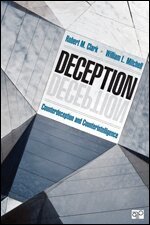
    Deception

    Counterdeception and Counterintelligence

    AvRobert M. Clark,William L. Mitchell

    Häftad, Engelska, 2018

    1 747 kr

    Beställningsvara. Skickas inom 3-6 vardagar. Fri frakt över 249 kr.

    Beskrivning

    “The chapters on the exercises are a treasure chest of material to work with, covering a whole array of scenarios. . . . I think virtually every page and topic could spark robust and spirited classroom discussion starting with the text title itself.”

    —Ronald W. Vardy, University of Houston

    “Most students have very little or no background [in this subject area], so Clark’s work is great to introduce students to intelligence and the analytical disciplines . . . a really excellent book that fills a gaping hole in the public literature and is of genuinely great value to both students and practitioners.”

    —Carl A. Wege, Professor Emeritus, College of Coastal Georgia

    Bridging the divide between theory and practice, Deception: Counterdeception and Counterintelligence provides a thorough overview of the principles of deception and its uses in intelligence operations. This masterful guide focuses on practical training in deception for both operational planners and intelligence analysts using a case-based approach. Authors Robert M. Clark and William L. Mitchell draw from years of professional experience to offer a fresh approach to the roles played by information technologies such as social media. By reading and working through the exercises in this text, operations planners will learn how to build and conduct a deception campaign, and intelligence analysts will develop the ability to recognize deception and support deception campaigns. 

    Key Features

    • New channels for deception, such as social media, are explored to show readers how to conduct and detect deception activities through information technology.
    • Multichannel deception across the political, military, economic, social, infrastructure, and information domains provides readers with insight into the variety of ways deception can be used as an instrument for gaining advantage in conflict.
    • Contemporary and historical cases simulate real-world raw intelligence and provide readers with opportunities to use theory to create a successful deception operation.
    • A series of practical exercises encourages students to think critically about each situation. The exercises have several possible answers, and conflicting raw material is designed to lead readers to different answers depending on how the reader evaluates the material.
    • Individual and team assignments offer instructors the flexibility to proceed through the exercises in any order and assign exercises based on what works best for the classroom setup.

    Produktinformation

    • Utgivningsdatum:2018-04-19
    • Mått:152 x 228 x 20 mm
    • Vikt:460 g
    • Format:Häftad
    • Språk:Engelska
    • Antal sidor:312
    • Upplaga:1
    • Förlag:SAGE Publications
    • ISBN:9781506375236

    Utforska kategorier

    • Krig och försvar inom Samhälle och politik
    • Internationella relationer inom Samhälle och politik

    Mer om författaren

    Robert M. Clark has more than five decades of U.S. intelligence community experience. A USAF lieutenant colonel (retired), Dr. Clark served as an electronics warfare officer and intelligence officer. At the CIA, he was a senior analyst and group chief responsible for developing analytic methodologies. He was cofounder and CEO of the Scientific and Technical Analysis Corporation, a privately held company serving the U.S. intelligence community. Clark holds an SB from MIT, a PhD in electrical engineering from the University of Illinois, and a JD from George Washington University. Beyond analyzing wicked intelligence issues, his passion is writing on the topic of intelligence. His books include Intelligence Analysis: A Target-Centric Approach (5th edition, 2016), The Technical Collection of Intelligence (2010), and Intelligence Collection (2014). He is coauthor, with Dr. William Mitchell, of Target-Centric Network Modeling (2015) and Deception: Counterdeception and Counterintelligence (2019); and coeditor, with Dr. Mark Lowenthal, of Intelligence Collection: The Five Disciplines (2015). Dr. Clark also develops and teaches courses for audiences in academia, national intelligence, and the military. He currently serves as an adjunct professor at the Johns Hopkins University teaching graduate courses.  William L. Mitchell’s military and intelligence career spans three decades including operations in Afghanistan, the Balkans, Iraq, Africa, and French Guyana. Dr. Mitchell is currently an active member of Danish Defence and an all-source specialist, researcher, instructor, and lecturer. At the Royal Danish Defence College (RDDC) he is responsible for the synchronization of theory, practice, and education regarding intelligence and joint operations. He is a member of the RDDC Research Board and supports NATO and US Department of Defense research, education, and doctrine development programs. He has several publications on intelligence and battlespace agility, and was part of the NATO Science & Technology Organization group awarded the 2014 NATO Scientific Achievement Award. Dr. Mitchell has a BA, an MA with Distinction from Kent University, and a PhD from Aarhus University in Political Science. He is a decorated war veteran of two countries, with one citation and several medals, including the French Croix de Combatant and the Danish Defence medal.

    Recensioner i media

    "The chapters on the exercises are a treasure chest of material to work with, covering a whole array of scenarios. . . . I think virtually every page and topic could spark robust and spirited classroom discussion starting with the text title itself."

    Innehållsförteckning

    • List of Tables, Figures, and BoxesPrefaceAbout the AuthorsPART I: FUNDAMENTALS OF DECEPTION AND COUNTERDECEPTIONChatper 1: Deception: The BasicsWhy Deception?DefinitionsThe Deception TargetBasic PrinciplesRoles of Operations and IntelligenceChapter 2: The MethodologyThe OODA LoopOODA Loop PerspectivesPlanning Deception: The Inverse OODA LoopExecuting Deception: The Forward OODA LoopChapter 3: The Outcome ScenarioOutcome Scenarios - The PMESII ViewPoliticalMilitaryEconomicSocialInformationInfrastructureChapter 4: The TargetIndividual Decision ModelingCollective Decision ModelingCultural ModelingChapter 5: The StoryWhat Makes a Good Story?Characteristics of a Good Deception StoryPlausibilityReinforcementInfluence NetsChapter 6: The ChannelsUnderstanding the ChannelsSensor MappingChannel CharacterizationChannel ExploitationChapter 7: The Traditional Intelligence ChannelsOSINTCOMINTHUMINTIMINTTechnical CollectionChapter 8: The Cyberspace ChannelDeception in CyberspaceWeb-Based DeceptionWeb-Based CNE/CNAStandalone Computers and IntranetsCyber DeceptionChapter 9: Planning and Executing DeceptionChecking the Decision/Action Model: Red Team AnalysisChecking for Unfavorable Outcomes: Alternative AnalysisDeconflictionOverview of the Execution ProcessAchieving SurpriseOperating Inside the Opponent′s OODA LoopAttending to Details and TimingManaging the Developing ScenarioChapter 10: Preparing to Counter DeceptionAssessing VulnerabilityAssessing the ThreatChapter 11: Identifying DeceptionDeception Detection via Channel ManagementEvaluating the SourceEvaluating the ChannelEvaluating the EvidencePART II: EXERCISESChapter 12: Sensor Mapping and Channel Tracking ExercisesSensor Mapping ExercisesChannel Management Exercises - Deception ProjectionChapter 13: General Deception Planning ExercisesExercise 1: Derailing a Trade NegotiationExercise 2: Protecting Drug Cartel ShipmentsExercise 3: Taking Down the Fordow Uranium Enrichment FacilityExercise 4: Countering Israeli Efforts to Take Down FordowExercise 5: Supporting a NEO EvacuationExercise 6: Disrupting Boko Haram OperationsChapter 14: Military Deception Planning ExercisesMILDEC CONOP Example: Operation BulldozerExercise 1: Operation Lights OutExercise 2: Operation Timber FloatExercise 3: Operation Closing TimeChapter 15: Deception Detection ExercisesExercise 1 - The Valley of DoubtExercise 2 - The YUTA GhostBibliographyIndex