• Fri frakt över 249 kr
  • •
  • Snabba leveranser
  • •
  • Billiga böcker
Kundservice

Du är på sajten för privatpersoner.

Företag, bibliotek eller offentlig verksamhet?

Du handlar på classic.bokus.com, där alla dina funktioner finns intakta.
Till classic.bokus.com
Bokus logotyp. Gå till startsidan.
  • Erbjudanden
  • Nyheter
  • Student
  • Topplistor
  • Barn & ungdom
  • Bokus Play
  • E-böcker
  • Pocketböcker
  • Spel & pussel

10% rabatt på allt med kod: NYSTART10 →

Sidfot

Mina sidor

    Hjälp

    • Kundservice
    • Vanliga frågor och svar
    • Frakt och leverans
    • Retur vid ångerrätt
    • Reklamera vara
    • Betalning
    • Köpvillkor
    • Allmänna villkor
    • Information om webbplatsens tillgänglighet

    Om Bokus

    • Om oss
    • Pressrum
    • För studenter
    • För företag
    • För bibliotek och offentlig verksamhet
    • För leverantörer
    • Hållbarhet

    Populärt

    • Aktuella erbjudanden
    • Presentkort
    • Studentlitteratur
    • Nya böcker
    • Topplistor
    • Signerade böcker
    • Engelska böcker

    Inspiration

    • Boktips
    • BookTok
    • Populära bokserier
    • Barnbokskaraktärer
    • Populära författare
    Logotyp för Bokus
    Följ oss på Facebook (extern länk)Följ oss på Instagram (extern länk)Följ oss på YouTube (extern länk)Följ oss på TikTok (extern länk)
    bokus @ CookiesAnpassa cookiesIntegritetspolicyKöpvillkor
    Till Citymail hemsida (extern länk)Till Budbee hemsida (extern länk)Till Postnord hemsida (extern länk)Till Schenker hemsida (extern länk)Till Early Bird hemsida (extern länk)Till Walleys hemsida (extern länk)
    1. Samhälle och politik
    2. Sociologi och antropologi
    3. Sociologi

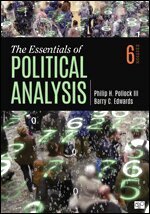
    The Essentials of Political Analysis

    AvPhilip H. Pollock,Barry Clayton Edwards

    Häftad, Engelska, 2019

    648 kr

    Beställningsvara. Skickas inom 10-15 vardagar. Fri frakt över 249 kr.

    Fler format och utgåvor

    Häftad

    1 610 kr

    Beskrivning

    “Pollock and Edwards explain the nuts-and-bolts of research design and data analysis in a clear and concise style. The Essential of Political Analysis is an intuitive introduction to complex material, replete with examples from the political science literature that add relevance to statistical concepts. This text offers students an excellent balance between the technical and the practical.”
    —Francis Neely, San Francisco State University

    Gain the skills you need to conduct political analysis and critically assess statistical research. 

    In this Sixth Edition of The Essentials of Political Science, bestselling authors Philip H. Pollock III and Barry C. Edwards build students’ analytic abilities and develop their statistical reasoning with new data, fresh exercises, and accessible examples. This brief, accessible guide walks students through the essentials—measuring concepts, formulating and testing hypotheses, describing variables—while using key terms, chapter-opening objectives, over 80 tables and figures, and practical exercises to get them using and applying their new skills.

    Using SPSS, STATA or R?  Discounted package deals available with Philip H. Pollock’s companion workbooks. . 

    Give your students the SAGE edge!

    SAGE edge offers a robust online environment featuring an impressive array of free tools and resources for review, study, and further exploration, keeping both instructors and students on the cutting edge of teaching and learning.

    Produktinformation

    • Utgivningsdatum:2019-11-07
    • Mått:177 x 254 x 18 mm
    • Vikt:660 g
    • Format:Häftad
    • Språk:Engelska
    • Antal sidor:368
    • Upplaga:6
    • Förlag:SAGE Publications
    • ISBN:9781506379616

    Utforska kategorier

    • Sociologi inom Samhälle och politik
    • Politik och statsskick inom Samhälle och politik

    Mer om författaren

    Philip H. Pollock III is a professor of political science at the University of Central Florida. He has taught courses in research methods at the undergraduate and graduate levels for more than thirty years. His main research interests are American public opinion, voting behavior, techniques of quantitative analysis, and the scholarship of teaching and learning. His recent research has been on the effectiveness of Internet-based instruction. Pollock’s research has appeared in the American Journal of Political Science, Social Science Quarterly, and the British Journal of Political Science. Recent scholarly publications include articles in Political Research Quarterly, the Journal of Political Science Education, and PS: Political Science and Politics.Barry C. Edwards writes textbooks and works for Fair Trial Analysis, LLC, a company that conducts research on juries and jurors for civil and criminal litigation. He received his B.A. from Stanford University, a J.D. from New York University, and a Ph.D. from the University of Georgia. He taught survey design and analysis, research methods, and prelaw courses at the University of Central Florida and continues to teach occasional courses for the University of Georgia. His political science interests include American politics, public law, and research methods. He founded the Political Science Data Group and created the PoliSciData.com website. His research has been published in American Politics Research, Congress & the Presidency, Election Law Journal, Emory Law Journal, Georgia Bar Journal, Harvard Negotiation Law Review, Journal of Politics, NYU Journal of Legislation and Public Policy, Political Research Quarterly, Presidential Studies Quarterly, Public Management Review, State Politics and Policy Quarterly, and UCLA Criminal Justice Law Review.

    Recensioner i media

    "A great resource to get students up and running on statistical analysis in politics. I recommend this book to all my colleagues. The accompanying workbook for R is also excellent."

    Innehållsförteckning

    • Tables, Figures, and BoxesPrefaceAcknowledgmentsAbout the AuthorsIntroductionFacts and Values in PerspectiveThe Scientific ApproachWhat This Book Is AboutConclusionKey TermsNotesCHAPTER 1 • The Definition and Measurement of ConceptsLearning ObjectivesConceptual DefinitionsOperational DefinitionsMeasurement ErrorReliability and ValidityWorking with Datasets, Codebooks, and SoftwareSummaryKey TermsExercisesNotesCHAPTER 2 • Measuring and Describing VariablesLearning ObjectivesEssential FeaturesLevels of MeasurementDescribing VariablesTransforming VariablesSummaryKey TermsExercisesNotesCHAPTER 3 • Proposing Explanations, Framing Hypotheses, and Making ComparisonsLearning Objectives“All Models Are Wrong, But Some Are Useful”Proposing ExplanationsFraming HypothesesCommon Mistakes in Hypothesis WritingMaking ComparisonsGraphing Relationships and Describing PatternsSummaryKey TermsExercisesNotesCHAPTER 4 • Research Design, Research Ethics, and Evidence of CausationLearning ObjectivesEstablishing CausationExperimental DesignsSelecting Cases for AnalysisConducting Research EthicallySummaryKey TermsExercisesNotesCHAPTER 5 • Making Controlled ComparisonsLearning ObjectivesThe Logic of Controlled ComparisonsEssential Terms and ConceptsEffect of Partisanship on Gun Control Vote, Controlling for Gender: An Illustrative ExampleControlled Mean ComparisonsIdentifying PatternsAdvanced Methods of Making Controlled ComparisonsSummaryKey TermsExercisesNotesCHAPTER 6 • Foundations of Statistical InferenceLearning ObjectivesPopulation Parameters and Sample StatisticsThe Central Limit Theorem and the Normal DistributionQuantifying Standard ErrorsConfidence IntervalsSample Size and the Margin of Error of a PollInferences with Small Batches: The Student’s t-DistributionSummaryKey TermsExercisesNotesCHAPTER 7 • Tests of Significance and Measures of AssociationLearning ObjectivesStatistical Significance and Null Hypothesis TestingOne-Sample Significance TestsTwo-Sample Significance TestsThe Chi-square TestMeasures of AssociationCriticisms of Null Hypothesis TestingSummaryKey TermsExercisesNotesCHAPTER 8 • Correlation and Linear RegressionLearning ObjectivesCorrelationBivariate RegressionEducational Attainment and Voter Turnout in States ExampleR-squareMultiple RegressionSome Practical Issues: Multicollinearity, Parsimony, and Missing DataAnalyzing Residuals to Evaluate Linear Regression ModelsSummaryKey TermsExercisesNotesCHAPTER 9 • Logistic RegressionLearning ObjectivesThe Logistic Regression ApproachLogistic Regression Approach to Vote Choice in the 2016 Presidential ElectionFinding the Best Fit: Maximum Likelihood EstimationLogistic Regression with Multiple Independent VariablesGraphing Predicted Probabilities with Multiple Independent VariablesSummaryKey TermsExercisesNotesCHAPTER 10 • Conducting Your Own Political AnalysisPicking a Good TopicGetting Focused and Staying MotivatedReviewing Prior LiteratureCollecting DataWriting It UpMaintain a Scientific MindsetKey TermsExercisesNotesIndex