• Fri frakt över 249 kr
  • •
  • Snabba leveranser
  • •
  • Billiga böcker
Kundservice

Du är på sajten för privatpersoner.

Företag, bibliotek eller offentlig verksamhet?

Du handlar på classic.bokus.com, där alla dina funktioner finns intakta.
Till classic.bokus.com
Bokus logotyp. Gå till startsidan.
  • Erbjudanden
  • Nyheter
  • Student
  • Topplistor
  • Barn & ungdom
  • Bokus Play
  • E-böcker
  • Pocketböcker
  • Spel & pussel

10% rabatt på allt med kod NYSTART10 →

Sidfot

Mina sidor

    Hjälp

    • Kundservice
    • Vanliga frågor och svar
    • Frakt och leverans
    • Retur vid ångerrätt
    • Reklamera vara
    • Betalning
    • Köpvillkor
    • Allmänna villkor
    • Information om webbplatsens tillgänglighet

    Om Bokus

    • Om oss
    • Pressrum
    • För studenter
    • För företag
    • För bibliotek och offentlig verksamhet
    • För leverantörer
    • Hållbarhet

    Populärt

    • Aktuella erbjudanden
    • Presentkort
    • Studentlitteratur
    • Nya böcker
    • Topplistor
    • Signerade böcker
    • Engelska böcker

    Inspiration

    • Boktips
    • BookTok
    • Populära bokserier
    • Barnbokskaraktärer
    • Populära författare
    Logotyp för Bokus
    Följ oss på Facebook (extern länk)Följ oss på Instagram (extern länk)Följ oss på YouTube (extern länk)Följ oss på TikTok (extern länk)
    bokus @ CookiesAnpassa cookiesIntegritetspolicyKöpvillkor
    Till Citymail hemsida (extern länk)Till Budbee hemsida (extern länk)Till Postnord hemsida (extern länk)Till Schenker hemsida (extern länk)Till Early Bird hemsida (extern länk)Till Walleys hemsida (extern länk)
    1. Samhälle och politik
    2. Samhälle och kultur
    3. Sociala och etiska frågor
    4. Etiska frågor och debatter

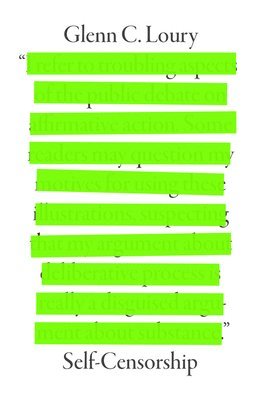
    Self-Censorship

    AvGlenn C. Loury

    Inbunden, Engelska, 2025

    112 kr

    Beställningsvara. Skickas inom 5-8 vardagar. Fri frakt över 249 kr.

    Fler format och utgåvor

    E-bok

    190 kr

    Beskrivning

    There is no such thing as free, unconstrained speech. Laws and constitutions may protect us from the state when we speak our minds. But the state is just one possible constraint. Glenn Loury, one of America's most outspoken and important intellectuals, provides a provocative and dazzling analysis of the powerful social forces that can prevent speakers from voicing unpopular views in public forums.Every society, Loury notes, has norms to enforce. That can be a good thing: There ought to be social sanctions for, say, compulsive liars. When, however, a society shows a low degree of tolerance for speech about matters of political importance, self-censorship proliferates and public discourse and policy suffer. The answer, Loury argues, is for as many of us as possible to be braver and more human – to take a risk and unapologetically live within the truth”.Loury first presented these ideas in the 1990s in a celebrated and prophetic essay about political correctness. In Self-Censorship he expands and updates the account, deploying his analytical powers and psychological acuity to diagnose our current political climate. The result illuminates prevailing social dynamics with the same brilliant and startling effect that made the paper an instant classic thirty years ago.Also available as an audiobook.

    Produktinformation

    • Utgivningsdatum:2025-05-30
    • Mått:127 x 193 x 20 mm
    • Vikt:204 g
    • Format:Inbunden
    • Språk:Engelska
    • Antal sidor:140
    • Förlag:Polity Press
    • ISBN:9781509567409

    Utforska kategorier

    • Etiska frågor och debatter inom Samhälle och politik

    Mer om författaren

    Glenn C. Loury is the Merton P. Stoltz Professor of the Social Sciences at Brown University. A distinguished economist, he is also a prominent social critic and public intellectual, writing mainly on the themes of racial inequality and social policy. He is the author of numerous books, including One by One from the Inside Out, The Anatomy of Racial Inequality, and the widely reviewed memoir Late Admissions.

    Recensioner i media

    “Glenn Loury is a brilliant and courageous public intellectual who usually says what he means and means what he says! In our grim and dim moment of ugly polarization, even he admits that self-censorship can operate in our hearts, minds, and souls. If Socrates, Jesus, or Martin Luther King, Jr. set the high standards, we all fail. But courage, compassion, and self-respect require us to be and do better!”Cornel West“Glenn Loury’s brilliant essay on self-censorship is as relevant today as when it was first written. It is published here with a new Afterword in which the author argues – through his own poignant example – that the preservation of social esteem through the maintenance of public silence is eventually paid for in the coin of self-respect.”Rajiv Sethi, Columbia University“Glenn Loury’s work on self-censorship merits commendation as being prophetic. It is brilliant and readable scholarship – what a concept! Really, I cannot commend the book highly enough.”Robert P. George, Princeton University“This is a brilliant and highly important work. It claims, in essence, that restrictive speech conventions arise whenever the signalling function of language crowds out its primary truth-stating function. It is the best close analysis I have read of what has come to be called ‘virtue signalling’ and related phenomena. It has the potential to be a classic.”Edward Skidelsky, University of Exeter“Statements by a speaker on a topic (e.g. recent events in Gaza) will lead a rational listener to update their beliefs both about the topic and about the character of the speaker (e.g. antisemitism). This book reprints Glenn Loury’s analysis of this mechanism, which will lead a rational speaker to self-censor in order to avoid the inevitable inferences about character.”Stephen Morris, Peter A. Diamond Professor of Economics, MIT“A modest treatise defending the right of untrammeled free speech in the face of efforts to silence unpopular opinions.”Kirkus Reviews

    Innehållsförteckning

    • Foreword Self-Censorship in Public Discourse: A Theory of “Political Correctness” and Related Phenomena Afterword: Self-Censorship in a Time of War