• Fri frakt över 249 kr
  • •
  • Snabba leveranser
  • •
  • Billiga böcker
Kundservice

Du är på sajten för privatpersoner.

Företag, bibliotek eller offentlig verksamhet?

Du handlar på classic.bokus.com, där alla dina funktioner finns intakta.
Till classic.bokus.com
Bokus logotyp. Gå till startsidan.
  • Erbjudanden
  • Nyheter
  • Student
  • Topplistor
  • Barn & ungdom
  • Bokus Play
  • E-böcker
  • Pocketböcker
  • Spel & pussel

Må bättre, för mindre! Upp till 50% rabatt på hälsoböcker

Sidfot

Mina sidor

    Hjälp

    • Kundservice
    • Vanliga frågor och svar
    • Frakt och leverans
    • Retur vid ångerrätt
    • Reklamera vara
    • Betalning
    • Köpvillkor
    • Allmänna villkor
    • Information om webbplatsens tillgänglighet

    Om Bokus

    • Om oss
    • Pressrum
    • För studenter
    • För företag
    • För bibliotek och offentlig verksamhet
    • För leverantörer
    • Hållbarhet

    Populärt

    • Aktuella erbjudanden
    • Presentkort
    • Studentlitteratur
    • Nya böcker
    • Topplistor
    • Signerade böcker
    • Engelska böcker

    Inspiration

    • Boktips
    • BookTok
    • Populära bokserier
    • Barnbokskaraktärer
    • Populära författare
    Logotyp för Bokus
    Följ oss på Facebook (extern länk)Följ oss på Instagram (extern länk)Följ oss på YouTube (extern länk)Följ oss på TikTok (extern länk)
    bokus @ CookiesAnpassa cookiesIntegritetspolicyKöpvillkor
    Till Citymail hemsida (extern länk)Till Budbee hemsida (extern länk)Till Postnord hemsida (extern länk)Till Schenker hemsida (extern länk)Till Early Bird hemsida (extern länk)Till Walleys hemsida (extern länk)
    1. Juridik
    2. Internationell rätt

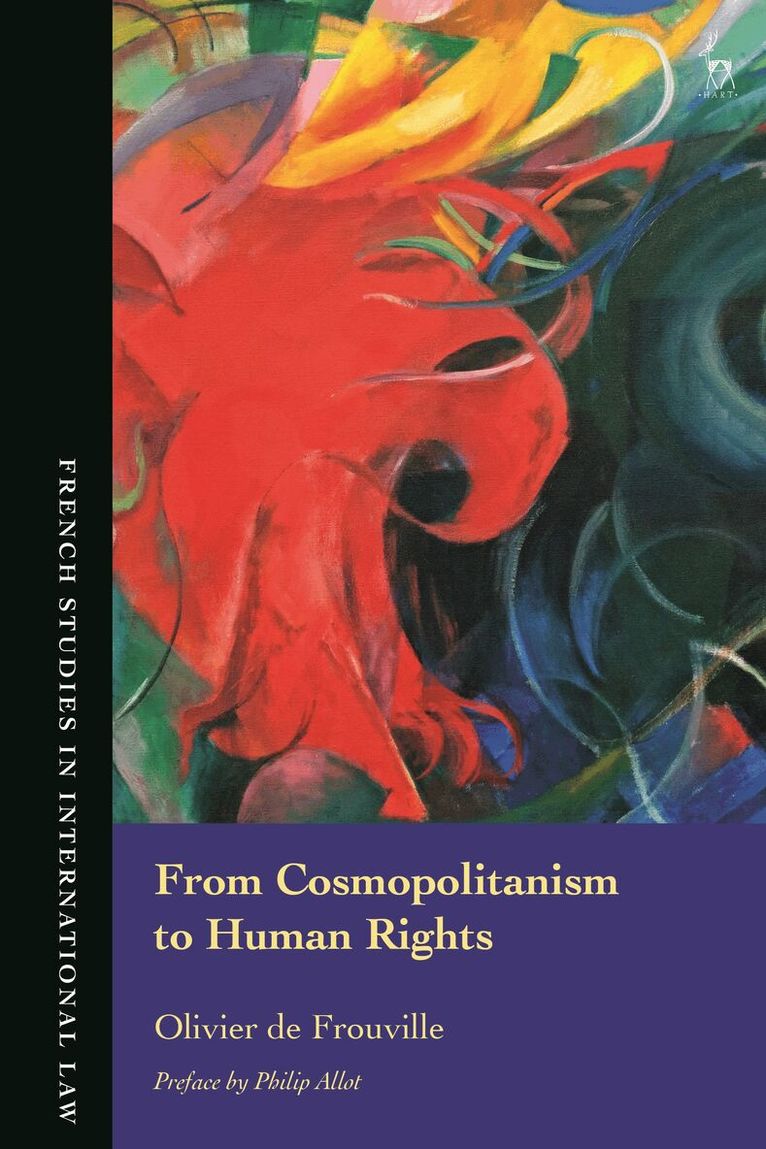
    From Cosmopolitanism to Human Rights

    AvOlivier de Frouville

    Häftad, Engelska, 2023

    Del i serien French Studies in International Law

    645 kr

    Beställningsvara. Skickas inom 10-15 vardagar. Fri frakt över 249 kr.

    Fler format och utgåvor

    Inbunden

    1 283 kr

    E-bok

    696 kr

    E-bok

    694 kr

    Beskrivning

    This book explores a democratic theory of international law. Characterised by a back-and-forth between theory and practice, it explores the question from two perspectives: a theoretical level which reflects and criticizes the categories, words and concepts through which international law is understood, and a more applied level focussing on ‘cosmopolitan building sites’ or the practical features of the law, such as the role of civil society in international organisations or reform of the UN Security Council. Though written for an academic audience, it will have a more general appeal and be of interest to all those concerned with how international governance is developing.

    Produktinformation

    • Utgivningsdatum:2023-06-29
    • Mått:154 x 232 x 20 mm
    • Vikt:460 g
    • Format:Häftad
    • Språk:Engelska
    • Serie:French Studies in International Law
    • Antal sidor:296
    • Förlag:Bloomsbury Publishing PLC
    • ISBN:9781509955510

    Utforska kategorier

    • Internationell rätt inom Juridik

    Mer om författaren

    Olivier de Frouville is Professor of Public Law at the University Panthéon-Assas (Paris II), France.

    Innehållsförteckning

    • Introduction PART IELEMENTS FOR A DEMOCRATIC THEORY OF INTERNATIONAL LAW1. What is Legal Cosmopolitanism? I. Cosmopolitan Sentiment and Phenomenology of the Relation to Others II. Relation to the Other and Society III. From Cosmopolitan Feeling to Legal Cosmopolitanism2. On the Theory of the International Constitution I. Georges Scelle’s Concept of the International Constitution II. A Theory of the International Constitution Based on a Democratic Theory of International Law III. An Overview of the Evolution of the International Constitution IV. Conclusion 3. A Cosmopolitan Perspective on the Responsibility to Protect I. Analysis of the Pivotal Concepts of R2P II. Outline Reconstruction of a Cosmopolitan Theory of Humanitarian Intervention 4. Justifying International Law, Defending Cosmopolitanism I. Cosmopolitanism as the Flip Side of Neoliberalism II. Cosmopolitanism as the Construction of a Rootless Individualist III. The Theoretical and Practical Impossibility of World Politics IV. A Few Seemingly Inconsequential Thoughts by Way of an Inconclusive Conclusion…5. A Critical Defence of Human RightsI. The Critical ‘Positivist’ Approach II. The External Critical Approach Contesting ‘Rights’ III. The External Critical Approach Defending Human Rights 6. Natural Law, Human Rights, the Law of Nature: Towards a Revived Modernity I. The Discourse of Sovereignty and Voluntarism II. The Discourse of Human Rights III. The Discourse of Nature 7. Towards a Democratic Theory of International Law I. The Theoretical Structure of Classical International Law II. Cosmopolitan Projects: A Democratic Conception of International Law III. The Bases for a Democratic Theory of International Law PART IITOWARDS WORLD CITIZENSHIP: ‘COSMOPOLITAN BUILDING SITES’8. Civil Society’s Role in International Organisations. Theory(ies) and Practice(s) I. The Obvious Point II. An Unthought-of Point 9. Building a Universal System for the Protection of Human Rights: The Way Forward I. Change or Continuity: Has the Establishment of the Council Really Changed Anything in the Universal Systemof Human Rights Protection? II. Is the UPR a Real Added Value to the System? III. Why the Council does not Represent a Real Progress for the Universal Human Rights Protection System IV. Towards Progress: How Could the System for the Protection of Human Rights Evolve in the Future? 10. Why Do We Need a United Nations Court of Human Rights?I. The Origins of the Idea of a Universal Court of Human RightsII. The Present Context Justifying the New Impetus Behind the Idea: The Necessary Reform of theUniversal System of Protection of Human Rights III. Responses to Some Objections on Principle IV. Realisation of the Idea of a United Nations Court of Human Rights 11. The Committee System: 2020 and Beyond 12. The Universal Declaration of Human Rights is 70 Years Old: What Challenges Await the United Nations? I. A Legal Basis for Action II. An Intellectual Challenge III. An Institutional Challenge IV. The Normative Challenge 13. Reforming the Security Council: What can be Done Without Amending the UN Charter?I. The Concepts II. The Processes III. The Outcomes IV. Conclusion 14. The Right to Veto in the United Nations: Towards the Abolition of a Privilege Universal System of Protection of Human Rights