• Fri frakt över 249 kr
  • •
  • Snabba leveranser
  • •
  • Billiga böcker
Kundservice

Du är på sajten för privatpersoner.

Företag, bibliotek eller offentlig verksamhet?

Du handlar på classic.bokus.com, där alla dina funktioner finns intakta.
Till classic.bokus.com
Bokus logotyp. Gå till startsidan.
  • Erbjudanden
  • Student
  • Topplistor
  • Barn & ungdom
  • Bokus Play
  • E-böcker
  • Ljudböcker
  • Pocketböcker
  • Spel och pussel

Pocketfynda! Hundratals böcker för 49 kr/st →

Sidfot

Mina sidor

    Hjälp

    • Kundservice
    • Vanliga frågor och svar
    • Frakt och leverans
    • Retur vid ångerrätt
    • Reklamera vara
    • Betalning
    • Köpvillkor
    • Allmänna villkor
    • Information om webbplatsens tillgänglighet

    Om Bokus

    • Om oss
    • Pressrum
    • För studenter
    • För företag
    • För bibliotek och offentlig verksamhet
    • För leverantörer
    • Hållbarhet

    Populärt

    • Aktuella erbjudanden
    • Presentkort
    • Studentlitteratur
    • Nya böcker
    • Topplistor
    • Signerade böcker
    • Engelska böcker

    Inspiration

    • Boktips
    • BookTok
    • Barnbokskaraktärer
    • Populära författare
    Logotyp för Bokus
    Följ oss på Facebook (extern länk)Följ oss på Instagram (extern länk)Följ oss på YouTube (extern länk)Följ oss på TikTok (extern länk)
    bokus @ CookiesAnpassa cookiesIntegritetspolicyKöpvillkor
    Till Citymail hemsida (extern länk)Till Budbee hemsida (extern länk)Till Postnord hemsida (extern länk)Till Schenker hemsida (extern länk)Till Early Bird hemsida (extern länk)Till Walleys hemsida (extern länk)
    1. Naturvetenskap och teknik
    2. Teknik och industri
    3. Elektronik och kommunikationer

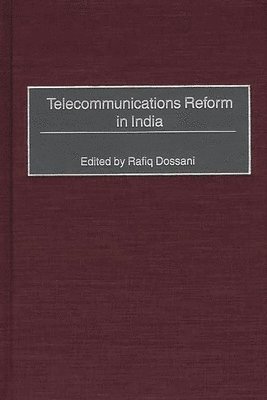
    Telecommunications Reform in India

    AvRafiq Dossani,Rafiq Dossani

    Inbunden, Engelska, 2002

    1 043 kr

    Beställningsvara. Skickas inom 10-15 vardagar. Fri frakt över 249 kr.

    Beskrivning

    Telecommunications reform in India is complete, according to policymakers there. They have done everything correctly in their efforts to transform a state-run monopoly into an independently regulated sector in which private companies compete with government-owned and operated providers. And yet, India lags behind nations whose telecom sectors provided comparable levels of service a decade ago. What went wrong? Dossani and his contributors argue that the classic textbook solutions are insufficient to produce a healthy telecom industry in India, which needs to improve regulatory design, introduce competition in a single phase instead of gradually, implement innovative funding models, and choose appropriate technologies in order to improve access to universal service. Containing valuable lessons for the telecommunications industries in Mexico, Indonesia, the Philippines, and other countries taking formerly state-run industries private, this book constitutes a valuable resource for policymakers, regulators, practitioners, scholars, and overseas investors.Policymakers and regulators will learn that cookie-cutter solutions derived from rich-country experience do not always work in countries that are poor, yet democratic and pro-market. Practitioners will be interested in the sections on universal service, technology convergence, and the implications for reducing costs and improving the quality of both basic telephone services and IT-enabled services. In particular, Indian technology workers in Silicon Valley should find this book indispensable. Investors will gain valuable knowledge about this potentially huge market. Scholars' preconceived ideas may be nudged aside as their knowledge base is enhanced and their research agenda expanded. Whereas some of the book's conclusions support current thinking, such as the need to begin a sequence of reform with a regulatory system in place and the need for dominant-carrier regulation, other conclusions challenge the conventional wisdom. Contributors make a cogent case for reformulating the balance of power between regulators and policymakers, introducing competition at the local level rather than through large franchises, and replacing public subsidies with cross-subsidies of universal service. Provides a multidisciplinary approach to understanding the problems of telecommunications reform in all their complexity.

    Produktinformation

    • Utgivningsdatum:2002-05-30
    • Mått:157 x 235 x 21 mm
    • Vikt:612 g
    • Format:Inbunden
    • Språk:Engelska
    • Antal sidor:280
    • Förlag:Bloomsbury Publishing Plc
    • ISBN:9781567205022

    Utforska kategorier

    • Elektronik och kommunikationer inom Naturvetenskap och teknik
    • Media och underhållning inom Ekonomi och Ledarskap

    Mer om författaren

    RAFIQ DOSSANI is Senior Research Scholar, Asia/Pacific Research Center, and Executive Director of the South Asia Initiative at Stanford University.

    Innehållsförteckning

    • Introduction The Policy Agenda by Shyamal Ghosh TRAI's Objectives and Policy Focus in a Changing Environment by M.S. Verma An Institutional View by Rafiq Dossani and S. Manikutty Unleashing Telecommunications and Internet in India by Ashok Jhunjhunwala The Institutional Environment and Effects of Telecommunication Privatization and Market Liberalization in Asia by J.P. Singh A New Approach to Service Provision by Vinod Khosla Toward an Indian Information Economy: Lessons in Telecommunications Policy and Practice by Heather E. Hudson Universal Service, Competition, and Economic Growth: The Case of the Hidden Subsidy by Gregory L. Rosston and Bradley S. Wimmer Regulation and the Opening of the Mexican Telecommunications Markets by Cristina Casanueva Pricing Interconnection and Universal Service in a Liberalized Network: Lessons for India by Yale M. Braunstein Provision of Universal Service for Telecommunications in Densely Populated Developing Countries by F. Gasmi, J.J. Laffont, and W.W. Sharkey Parvathagiri, Andhra Pradesh: A Case Study of Rural Telecom in India by Uday Kumar National Telecom Policy-1994 National Telecom Policy-1999 Index