• Fri frakt över 249 kr
  • •
  • Snabba leveranser
  • •
  • Billiga böcker
Kundservice

Du är på sajten för privatpersoner.

Företag, bibliotek eller offentlig verksamhet?

Du handlar på classic.bokus.com, där alla dina funktioner finns intakta.
Till classic.bokus.com
Bokus logotyp. Gå till startsidan.
  • Erbjudanden
  • Nyheter
  • Student
  • Topplistor
  • Barn & ungdom
  • Bokus Play
  • E-böcker
  • Pocketböcker
  • Spel & pussel

10% rabatt på allt med kod NYSTART10 →

Sidfot

Mina sidor

    Hjälp

    • Kundservice
    • Vanliga frågor och svar
    • Frakt och leverans
    • Retur vid ångerrätt
    • Reklamera vara
    • Betalning
    • Köpvillkor
    • Allmänna villkor
    • Information om webbplatsens tillgänglighet

    Om Bokus

    • Om oss
    • Pressrum
    • För studenter
    • För företag
    • För bibliotek och offentlig verksamhet
    • För leverantörer
    • Hållbarhet

    Populärt

    • Aktuella erbjudanden
    • Presentkort
    • Studentlitteratur
    • Nya böcker
    • Topplistor
    • Signerade böcker
    • Engelska böcker

    Inspiration

    • Boktips
    • BookTok
    • Populära bokserier
    • Barnbokskaraktärer
    • Populära författare
    Logotyp för Bokus
    Följ oss på Facebook (extern länk)Följ oss på Instagram (extern länk)Följ oss på YouTube (extern länk)Följ oss på TikTok (extern länk)
    bokus @ CookiesAnpassa cookiesIntegritetspolicyKöpvillkor
    Till Citymail hemsida (extern länk)Till Budbee hemsida (extern länk)Till Postnord hemsida (extern länk)Till Schenker hemsida (extern länk)Till Early Bird hemsida (extern länk)Till Walleys hemsida (extern länk)
    1. Språk och ordböcker
    2. Språkvetenskap och lingvistik

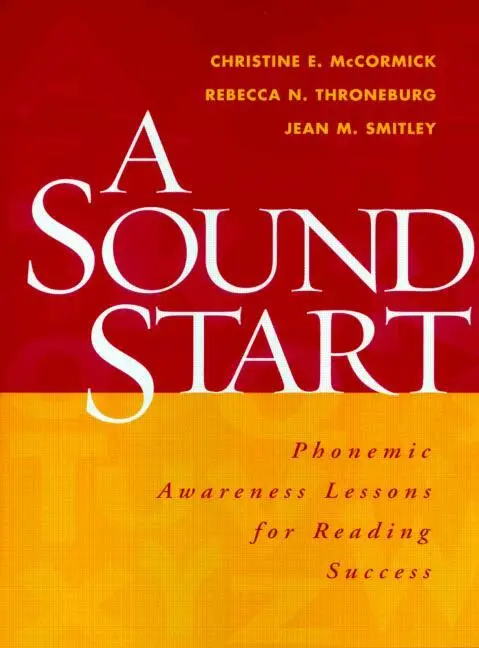
    Sound Start

    Phonemic Awareness Lessons for Reading Success

    AvChristine E. McCormick,Rebecca N. Throneburg

    Häftad, Engelska, 2002

    Del i serien Solving Problems in the Teaching of Literacy

    558 kr

    Beställningsvara. Skickas inom 3-6 vardagar. Fri frakt över 249 kr.

    Beskrivning

    This book is an ideal resource for any teacher who wants to include explicit phonemic awareness instruction in an early reading program. In one easy-to-use 8 1/2 x 11 volume, the authors present three separate sets of phonemic awareness lessons, complete with scripted directions and reproducible learning materials and assessment tools. Incorporating a variety of fun and engaging activities, each set of lessons is field-tested and research-based. Included are developmentally sequenced lessons for the whole class and small groups, more intensive lessons for children struggling with phonemic awareness, and class lessons on the consonant phonemes to help children hear and process the sounds of American English. The lesson sets can be used independently or in combination with each other, and can easily be adapted to meet the needs of specific classes.

    Produktinformation

    • Utgivningsdatum:2002-07-25
    • Mått:210 x 280 x 21 mm
    • Vikt:907 g
    • Format:Häftad
    • Språk:Engelska
    • Serie:Solving Problems in the Teaching of Literacy
    • Antal sidor:297
    • Förlag:Guilford Publications
    • ISBN:9781572307612

    Utforska kategorier

    • Språkvetenskap och lingvistik inom Språk och ordböcker
    • Undervisning i specifika ämnen inom Psykologi och pedagogik

    Mer om författaren

    Christine E. McCormick, PhD, is Professor of Psychology at Eastern Illinois University in Charleston, Illinois, where she teaches courses in developmental psychology, early childhood assessment, and early reading. She has a doctoral degree in educational psychology from the University of Minnesota and is a former Montessori teacher and school psychologist. Widely published, she brings to this book over 25 years of experience in developing early reading materials for young children.Rebecca N. Throneburg, PhD, is Associate Professor of Communication Disorders and Sciences Department at Eastern Illinois University, where she teaches courses in normal language development, phonological awareness, and language and literacy. Her doctoral degree in speech-language pathology is from the University of Illinois. She conducts research in the school setting regarding service delivery and collaboration among professionals.Jean M. Smitley, MS, is Associate Professor of Communication Disorders and Sciences Department at Eastern Illinois University, where she teaches a course in phonetics and phonological development. She has also collaborated with kindergarten teachers to provide phonological awareness training to kindergartners. Her master's degree is from Eastern Illinois University, and she has focused on reading development and disabilities in her postgraduate course work.

    Recensioner i media

    A particular strength of this well-organized book is the inclusion of materials for both whole-class and individual lessons. This makes it an ideal resource for speech-language pathologists (SLPs) and other special service providers working with general education teachers to provide early literacy instruction and intervention for typically developing children as well as those with language and literacy learning risks. Ideally, the shared use of this book will give teachers, graduate students, and SLPs a common way of talking about language and its sounds that they can embed in other reading and writing instruction within the general education curriculum.--Nickola Wolf Nelson, PhD, CCC-SLP, Department of Speech Pathology and Audiology, Western Michigan UniversityThe National Reading Panel, of which I am a member, strongly recommends phonemic awareness training as part of early instruction in reading. A Sound Start contains many excellent and useful ideas for those who want to start students on the road to high achievement in reading. This text should be of great value to teachers, teacher educators, and others concerned with the science of sound reading instruction.--S. Jay Samuels, EdD, Department of Educational Psychology, University of Minnesota, Twin Cities CampusFinally, completely scripted classroom lessons for helping children develop the phonemic awareness skills essential for successful reading acquisition! Empirically based and field-tested for effectiveness and usability, the lessons include step-by-step directions and all materials necessary for implementation, including pre- and posttests and reproducible student forms. Unique to this book is the provision of three types of lessons: whole-class/small-group phonemic awareness skills lessons, individualized lessons for children needing extra assistance, and whole-class lessons focusing on the acoustic features and production of phonemes to reinforce learning. Teachers, tutors, and reading specialists alike will find this book a wonderful resource.--Natalie Rathvon, PhD, Early Reading Initiative project director, Archdiocese of Washington Schools, Washington, DCMany want to develop phonemic awareness competencies in children but do not know where to start. This book provides systematic and sound guidance to teachers of beginning readers. The lessons it contains also provide a great start on phonics, developing deep understanding of letter-sound associations and phonemic blending as part of word recognition and production.--Michael Pressley, PhD, Michigan State University-

    Innehållsförteckning

    • 1. Phonemic Awareness: An Introduction-- Phonemic Awareness and Learning to Read-- Instruction in Phonemic Awareness-- Assessment of Phonemic Awareness-- General Instructional Issues-- The Lessons in This Book-- References2. Introduction to the Whole-Class and Small-Group Lessons-- General Guidelines-- Sequence of Skills-- Plan of the Lessons-- Data on Effectiveness-- Assessment-- References-- Phonemic Awareness Assessment3. The Whole-Class and Small-Group Lessons-- Lesson 1: Concept of Words-- Lesson 2: Rhyme Recognition and Discrimination-- Lesson 3: Rhyme Choice-- Lesson 4: Rhyme Production-- Lesson 5: Syllable Counting-- Lesson 6: Syllable Blending-- Lesson 7: Syllable DeletionLesson 8: Onset-Rime BlendingLesson 9: Onset-Rime BlendingLesson 10: Review of Rhyming and of Syllable and Onset-Rime BlendingLesson 11: Initial Phoneme IdentificationLesson 12: Initial Phoneme ProductionLesson 13: Final Phoneme IdentificationLesson 14: Final Phoneme ProductionLesson 15: Medial Phoneme IsolationLesson 16: Phoneme CountingLesson 17: Blending Two- and Three-Phoneme WordsLesson 18: Phoneme BlendingLesson 19: Phoneme SegmentationLesson 20: Review of Initial, Medial, and Final Sounds and of Phoneme Counting, Blending, and Segmenting4. Individualized Instruction in Phonemic AwarenessThe Individualized LessonsAssessment for the Individualized LessonsEffectiveness of the LessonsGetting StartedReferencesAssessment for Individualized LessonsProgress Chart5. The Individualized LessonsLesson 1: Beginning Sounds /m/ and /s/Lesson 2: Beginning Sounds /f/ and /n/Lesson 3: Beginning Sounds /p/ and /t/Lesson 4: Review of Beginning SoundsLesson 5: Letters m and s for Beginning SoundsLesson 6: Letters f and n for Beginning SoundsLesson 7: Letters p and t for Beginning SoundsLesson 8: Letters m, s, and t for Beginning SoundsLesson 9: Letters n, p, and t for Beginning SoundsLesson 10: Review of Letters for Beginning SoundsLesson 11: Letters for n, p, tLesson 12: Ending Sounds /n/, /p/, /t/Lesson 13: Ending Sounds /n/, /p/, /t/Lesson 14: Beginning Letters m, s, f and Ending Letters n, p, tLesson 15: Beginning letters n, p, t and Ending Letters n, p, tLesson 16: Letters for Beginning and Ending SoundsPosttest and Take-Home Tiny Books6. Phoneme Characteristics and LessonsImportance of Understanding Phoneme ProductionPhonemes in WordsSimilarities between PhonemesDescription of Phoneme ProductionReferencesLessons for Specific PhonemesPhoneme /b/ (letter b)Phoneme /k/ (letters c, k)Phoneme /d/ (letter d)Phoneme /f/ (letter f)Phoneme /g/ (letter g)Phoneme /h/ (letter h)Phoneme /?/ (letter j)Phoneme /l/ (letter l)Phoneme /m/ (letter m)Phoneme /n/ (letter n)Phoneme /p/ (letter p)Phoneme /r/ (letter r)Phoneme /s/ (letter s)Phoneme /t/ (letter t)Phoneme /v/ (letter v)Phoneme /w/ (letter w)Phoneme /j/ (letter y)Phoneme /z/ (letter z)Phoneme / / (digraph sh)Phoneme / / (digraph ch)Phoneme / /('sing') (digraph ng)Phonemes / ('thumb') /ð/ ('those') (digraph th)Appendix: Books, Materials, and Alternative Books for Each Class LessonIndex