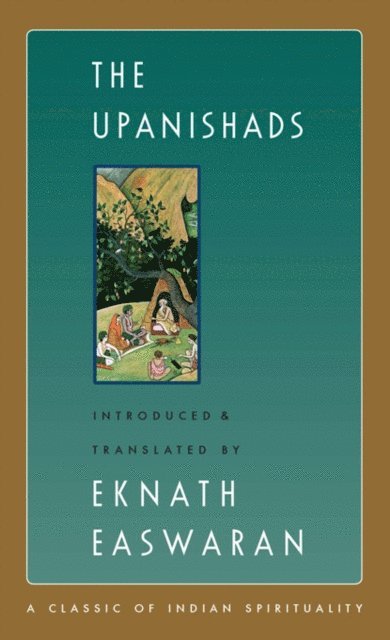
Upanishads
156 kr
Läs direkt i Bokus Reader – eller ladda ned till din enhet
Du är på sajten för privatpersoner.
156 kr
Läs direkt i Bokus Reader – eller ladda ned till din enhet
Eknath Easwaran (1910-1999) brings to this volume a rare combination of credentials. Trained from a young age in one of the purest Sanskrit traditions in India, he had a deep intuitive knowledge of his own Hindu legacy. He also had a great love of Western literature and was chairman of the English department at a major Indian university when he came to the United States on a Fulbright fellowship in 1959. From the 1960s onwards, Easwaran held classes on mysticism and practical spirituality for a primarily American audience. A gifted teacher, he was able to anticipate the problems that Western readers may have with the concepts underlying the classics of Indian spirituality, and to explain them in fresh and profoundly simple ways.In 1961 Easwaran founded the Blue Mountain Center of Meditation in California, and in 1967, at the University of California, Berkeley, he taught the first academic course on meditation ever offered for credit at a major American university. He continued to teach passage meditation and his Eight Point Program for spiritual living to an American and international audience for almost forty years. His twenty-seven books on meditation and the classics of world mysticism have been translated into twenty-six languages.Easwaran drew on the Upanishads and the other Classics of Indian Spirituality throughout his life for deep inspiration. As Huston Smith writes, it is impossible to get to the heart of those Classics unless you live them, and he did live them.”Through the Blue Mountain Center of Meditation and its publishing arm, Nilgiri Press, Easwaran continues to reach an ever-growing audience around the world through publications and retreats.Chapter introductions, notes, and the essay "Reading the Upanishads" are by Michael N. Nagler, PhD, who is professor emeritus of Classics and Comparative Literature at the University of California, Berkeley, where he founded and still teaches in the Peace and Conflict Studies Program. Prof. Nagler is the author of several books, including most recently Our Spiritual Crisis: Recovering Human Wisdom in a Time of Violence.
Du är på sajten för privatpersoner.
156 kr
Läs direkt i Bokus Reader – eller ladda ned till din enhet
Eknath Easwaran (1910-1999) brings to this volume a rare combination of credentials. Trained from a young age in one of the purest Sanskrit traditions in India, he had a deep intuitive knowledge of his own Hindu legacy. He also had a great love of Western literature and was chairman of the English department at a major Indian university when he came to the United States on a Fulbright fellowship in 1959. From the 1960s onwards, Easwaran held classes on mysticism and practical spirituality for a primarily American audience. A gifted teacher, he was able to anticipate the problems that Western readers may have with the concepts underlying the classics of Indian spirituality, and to explain them in fresh and profoundly simple ways.In 1961 Easwaran founded the Blue Mountain Center of Meditation in California, and in 1967, at the University of California, Berkeley, he taught the first academic course on meditation ever offered for credit at a major American university. He continued to teach passage meditation and his Eight Point Program for spiritual living to an American and international audience for almost forty years. His twenty-seven books on meditation and the classics of world mysticism have been translated into twenty-six languages.Easwaran drew on the Upanishads and the other Classics of Indian Spirituality throughout his life for deep inspiration. As Huston Smith writes, it is impossible to get to the heart of those Classics unless you live them, and he did live them.”Through the Blue Mountain Center of Meditation and its publishing arm, Nilgiri Press, Easwaran continues to reach an ever-growing audience around the world through publications and retreats.Chapter introductions, notes, and the essay "Reading the Upanishads" are by Michael N. Nagler, PhD, who is professor emeritus of Classics and Comparative Literature at the University of California, Berkeley, where he founded and still teaches in the Peace and Conflict Studies Program. Prof. Nagler is the author of several books, including most recently Our Spiritual Crisis: Recovering Human Wisdom in a Time of Violence.