• Fri frakt över 249 kr
  • •
  • Snabba leveranser
  • •
  • Billiga böcker
Kundservice

Du är på sajten för privatpersoner.

Företag, bibliotek eller offentlig verksamhet?

Du handlar på classic.bokus.com, där alla dina funktioner finns intakta.
Till classic.bokus.com
Bokus logotyp. Gå till startsidan.
  • Erbjudanden
  • Nyheter
  • Student
  • Topplistor
  • Barn & ungdom
  • Bokus Play
  • E-böcker
  • Pocketböcker
  • Spel & pussel

10% rabatt på allt med kod NYSTART10 →

Sidfot

Mina sidor

    Hjälp

    • Kundservice
    • Vanliga frågor och svar
    • Frakt och leverans
    • Retur vid ångerrätt
    • Reklamera vara
    • Betalning
    • Köpvillkor
    • Allmänna villkor
    • Information om webbplatsens tillgänglighet

    Om Bokus

    • Om oss
    • Pressrum
    • För studenter
    • För företag
    • För bibliotek och offentlig verksamhet
    • För leverantörer
    • Hållbarhet

    Populärt

    • Aktuella erbjudanden
    • Presentkort
    • Studentlitteratur
    • Nya böcker
    • Topplistor
    • Signerade böcker
    • Engelska böcker

    Inspiration

    • Boktips
    • BookTok
    • Populära bokserier
    • Barnbokskaraktärer
    • Populära författare
    Logotyp för Bokus
    Följ oss på Facebook (extern länk)Följ oss på Instagram (extern länk)Följ oss på YouTube (extern länk)Följ oss på TikTok (extern länk)
    bokus @ CookiesAnpassa cookiesIntegritetspolicyKöpvillkor
    Till Citymail hemsida (extern länk)Till Budbee hemsida (extern länk)Till Postnord hemsida (extern länk)Till Schenker hemsida (extern länk)Till Early Bird hemsida (extern länk)Till Walleys hemsida (extern länk)
    1. Data och IT
    2. It-certifieringar
    • 10% rabatt på allt

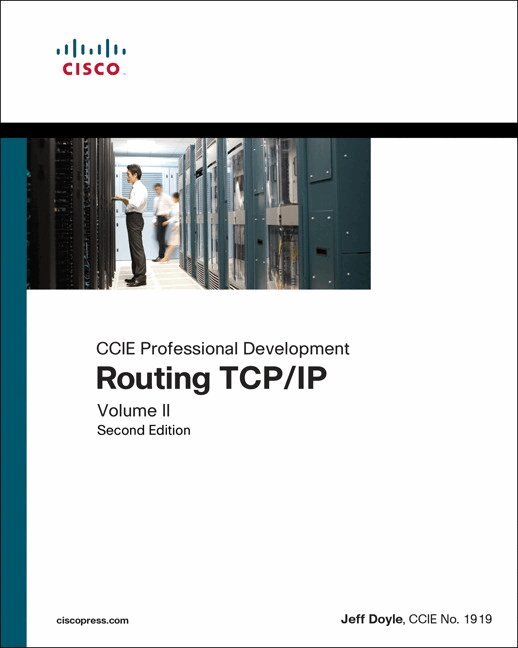
    Routing TCP/IP

    CCIE Professional Development, Volume 2

    AvJennifer Carroll,Jeff Doyle

    Inbunden, Engelska, 2016

    574 kr

    Beställningsvara. Skickas inom 7-10 vardagar. Fri frakt över 249 kr.

    Beskrivning

    Routing TCP/IP, Volume II: CCIE Professional Development, Second Edition

    The definitive guide to Cisco exterior routing protocols and advanced IP routing issues—now completely updated

    Praised in its first edition for its readability, breadth, and depth, Routing TCP/IP, Volume II, Second Edition will help you thoroughly understand modern exterior routing protocols and implement them with Cisco routers.

    Best-selling author Jeff Doyle offers crucial knowledge for every network professional who must manage routers to support growth and change. You’ll find configuration and troubleshooting lessons that would cost thousands to learn in a classroom, plus up-to-date case studies, examples, exercises, and solutions.

    Routing TCP/IP, Volume II, Second Edition covers routing and switching techniques that form the foundation of all Cisco CCIE tracks. Its expert content and CCIE structured review makes it invaluable for anyone pursuing this elite credential.

    While its examples focus on Cisco IOS, the book illuminates concepts that are fundamental to virtually all modern networks and routing platforms. Therefore, it serves as an exceptionally practical reference for network designers, administrators, and engineers in any environment.

    · Review core inter-domain routing concepts, and discover how exterior routing protocols have evolved

    · Master BGP’s modern operational components

    · Effectively configure and troubleshoot BGP

    · Control path attributes and selection to define better routes

    · Take full advantage of NLRI and routing policies

    · Provide for load balancing and improved network scalability

    · Extend BGP to multiprotocol environments via MP-BGP

    · Deploy, configure, manage, troubleshoot, and scale IP multicast routing

    · Implement Protocol Independent Multicast (PIM): Dense Mode, Sparse Mode, and Bidirectional

    · Operate, configure, and troubleshoot NAT in IPv4-IPv4 (NAT44) and IPv6-IPv4 (NAT64) environments

    · Avoid policy errors and other mistakes that damage network performance

    This book is part of the CCIE Professional Development series,which offers expert-level instruction on network design, deployment, and support methodologies to help networking professionals manage complex networks and prepare for the CCIE exams.

    Category: Networking

    Covers: BGP, Multicast, and NAT

    Produktinformation

    • Utgivningsdatum:2016-10-11
    • Mått:195 x 235 x 58 mm
    • Vikt:2 100 g
    • Format:Inbunden
    • Språk:Engelska
    • Antal sidor:1 152
    • Upplaga:2
    • Förlag:Pearson Education
    • ISBN:9781587054709

    Ingår i kampanjer

    10% rabatt på allt

    Utforska kategorier

    • It-certifieringar inom Data och IT

    Mer om författaren

    Jeff Doyle, CCIE No. 1919, is vice president of research at Fishtech Labs. Specializing in IP routing protocols, SDN/NFV, data center fabrics, MPLS, and IPv6, Jeff has designed or assisted in the design of large-scale IP service provider and enterprise networks in 26 countries over 6 continents. He worked with early IPv6 adopters in Japan, China, and South Korea, and has advised service providers, government agencies, military contractors, equipment manufacturers, and large enterprises on best-practice IPv6 deployment. He now advises large enterprises on evolving data center infrastructures, SDN, and SD-WAN.Jeff is the author of CCIE Professional Development: Routing TCP/IP, Volumes I and II and OSPF and IS-IS: Choosing an IGP for Large-Scale Networks; a co-author of Software Defined Networking: Anatomy of OpenFlow; and an editor and contributing author of Juniper Networks Routers: The Complete Reference. He also writes for Forbes and blogs for both Network World and Network Computing. Jeff is one of the founders of the Rocky Mountain IPv6 Task Force, is an IPv6 Forum Fellow, and serves on the executive board of the Colorado chapter of the Internet Society (ISOC).Jeff lives in Westminster, Colorado, with his wife Sara and a Sheltie named Max, the Forrest Gump of the dog world. Jeff and Sara count themselves especially fortunate that their four grown children and a growing herd of grandchildren all live within a few miles.

    Innehållsförteckning

    • Introduction xxiChapter 1 Inter-Domain Routing Concepts 1Early Inter-Domain Routing: The Exterior Gateway Protocol (EGP) 1Origins of EGP 2Operation of EGP 3EGP Topology Issues 3EGP Functions 5Neighbor Acquisition Protocol 6Neighbor Reachability Protocol 8Network Reachability Protocol 10Shortcomings of EGP 15The Advent of BGP 16BGP Basics 17Autonomous System Types 21External and Internal BGP 22Multihoming 29Transit AS Multihoming 30Stub AS Multihoming 31Multihoming and Routing Policies 36Multihoming Issues: Load Sharing and Load Balancing 36Multihoming Issues: Traffic Control 37Multihoming Issues: Provider-Assigned Addressing 40Classless Inter-Domain Routing 41A Summarization Summary 41Classless Routing 43Summarization: The Good, the Bad, and the Asymmetric 47CIDR: Reducing Class B Address Space Depletion 50CIDR: Reducing Routing Table Explosion 50Managing and Assigning IPv4 Address Blocks 54CIDR Issues: Multihoming and Provider-Assigned Addresses 56CIDR Issues: Address Portability 58CIDR Issues: Provider-Independent Addresses 59CIDR Issues: Traffic Engineering 60CIDR Approaches Its Limits 62IPv6 Comes of Age 66Routing Table Explosion, Again 66Looking Ahead 68Review Questions 69Chapter 2 Introduction to BGP 71Who Needs BGP? 71Connecting to Untrusted Domains 71Connecting to Multiple External Neighbors 74Setting Routing Policy 79BGP Hazards 82Operation of BGP 84BGP Message Types 85Open Message 85Keepalive Message 86Update Message 86Notification Message 87BGP Finite State Machine 87Idle State 88Connect State 89Active State 89OpenSent State 89OpenConfirm State 90Established State 90Path Attributes 90ORIGIN Attribute 92AS_PATH Attribute 92NEXT_HOP Attribute 97Weight 100BGP Decision Process 100BGP Message Formats 103Open Message 104Update Message 105Keepalive Message 108Notification Message 108Configuring and Troubleshooting BGP Peering 110Case Study: EBGP Peering 110Case Study: EBGP Peering over IPv6 114Case Study: IBGP Peering 118Case Study: Connected Check and EBGP Multihop 127Case Study: Managing and Securing BGP Connections 136Looking Ahead 142Review Questions 143Configuration Exercises 144Troubleshooting Exercises 145Chapter 3 BGP and NLRI 155Configuring and Troubleshooting NLRI in BGP 155Injecting Prefixes with the network Statement 156Using the network mask Statement 160Injecting Prefixes with Redistribution 162NLRI and IBGP 167Managing Prefixes in an IBGP Topology 168IBGP and IGP Synchronization 179Advertising BGP NLRI into the Local AS 182Redistributing BGP NLRI into the IGP 182Case Study: Distributing NLRI in a Stub AS with IBGP 184Distributing NLRI in a Stub AS with Static Routes 193Advertising a Default Route to a Neighboring AS 196Advertising Aggregate Routes with BGP 198Case Study: Aggregation Using Static Routes 199Aggregation Using the aggregate-address Statement 201ATOMIC_AGGREGATE and AGGREGATOR Attributes 207Using AS_SET with Aggregates 210Looking Ahead 218Review Questions 218Configuration Exercises 219Troubleshooting Exercises 223Chapter 4 BGP and Routing Policies 237Policy and the BGP Database 238IOS BGP Implementation 249InQ and OutQ 249IOS BGP Processes 251NHT, Event, and the Open Processes 256Table Versions 258Managing Policy Changes 267Clearing BGP Sessions 268Soft Reconfiguraton 269Route Refresh 274Route Filtering Techniques 279Filtering Routes by NLRI 280Case Study: Using Distribute Lists 280Route Filtering with Extended ACLs 292Case Study: Using Prefix Lists 293Filtering Routes by AS_PATH 304Regular Expressions 304Literals and Metacharacters 305Delineation: Matching the Start and End of Lines 306Bracketing: Matching a Set of Characters 306Negating: Matching Everything Except a Set of Characters 306Wildcard: Matching Any Single Character 307Alternation: Matching One of a Set of Characters 307Optional Characters: Matching a Character That May or May Not Be There 307Repetition: Matching a Number of Repeating Characters 307Boundaries: Delineating Literals 308Putting It All Together: A Complex Example 308Case Study: Using AS-Path Filters 309Case Study: Setting Policy with Route Maps 314Filter Processing 322Influencing the BGP Decision Process 323Case Study: Administrative Weights 325Case Study: Using the LOCAL_PREF Attribute 334Case Study: Using the MULTI_EXIT_DISC Attribute 343Case Study: Prepending the AS_PATH 366Case Study: Administrative Distances and Backdoor Routes 372Controlling Complex Route Maps 379Continue Clauses 380Policy Lists 383Looking Ahead 386Review Questions 386Configuration Exercises 388Troubleshooting Exercises 392Chapter 5 Scaling BGP 401Scaling the Configuration 402Peer Groups 403Peer Templates 413Session Templates 414Policy Templates 419Communities 425Well-Known Communities 426Arbitrary Communities 434Using the AA:NN Format 443Expanded Community Lists 445Adding and Deleting Communities 460Extended Community Lists 472Scaling BGP Functions 478Route Flap Dampening 479Outbound Route Filters (ORF) 486Next-Hop Tracking 496Fast External Fallover 509Bidirectional Forwarding Detection (BFD) 512BGP Prefix Independent Convergence (PIC) 523ADD-PATHS Capability 528Graceful Restart 538Maximum Prefixes 540Tuning BGP CPU 552Tuning BGP Memory 556BGP Transport Optimization 563Optimizing TCP 563Optimizing BGP Update Generation 568Optimizing TCP ACK Message Receipt 568Scaling the BGP Network 569Private AS Numbers 5694-Byte AS Numbers 574IBGP and the N-Squared Problem 575Confederations 576Route Reflectors 592Looking Ahead 606Review Questions 607Configuration Exercises 608Troubleshooting Exercises 612Chapter 6 Multiprotocol BGP 615Multiprotocol Extensions to BGP 616MBGP Support for the IPv6 Address Family 618Configuring MBGP for IPv6 619IPv4 and IPv6 Prefixes over an IPv4 TCP Session 620Upgrading IPv4 BGP Configurations to the Address Family Format 629IPv4 and IPv6 over an IPv6 TCP Connection 631Dual Stack MBGP Connection 642Multihop Dual Stack MBGP Connection 647Mixed IPv4 and IPv6 Sessions 650Multiprotocol IBGP 654Case Study: Multiprotocol Policy Configuration 666Looking Ahead 705Review Questions 705Configuration Exercises 706Question 1: 707Troubleshooting Exercises 709Chapter 7 Introduction to IP Multicast Routing 713Requirements for IP Multicast 716IPv4 Multicast Addresses 717IPv6 Multicast Addresses 721Group Membership Concepts 724Joining and Leaving a Group 726Join Latency 726Leave Latency 727Group Maintenance 728Multiple Routers on a Network 728Internet Group Management Protocol (IGMP) 729IGMPv2 Host Functions 730IGMPv2 Router Functions 731IGMPv1 733IGMPv3 735IGMP Message Format 736Multicast Listener Discovery (MLD) 742IGMP/MLD Snooping 745Cisco Group Management Protocol (CGMP) 749Multicast Routing Issues 753Multicast Forwarding 754Multicast Routing 756Sparse Versus Dense Topologies 757Implicit Joins Versus Explicit Joins 758Source-Based Trees Versus Shared Trees 760Source-Specific Multicast (SSM) 761Multicast Scoping 763TTL Scoping 763Administrative Scoping 765Looking Ahead 766Recommended Reading 766Review Questions 766Configuration Exercises 768Chapter 8 Protocol Independent Multicast 771Introduction to Protocol Independent Multicast (PIM) 771Operation of Protocol Independent Multicast-Dense Mode (PIM-DM) 773PIM-DM Basics 773Prune Overrides 779Unicast Route Changes 782PIM-DM Designated Routers 782PIM Forwarder Election 782Operation of Protocol Independent Multicast-Sparse Mode (PIM-SM) 785PIM-SM Basics 786Finding the Rendezvous Point 787Bootstrap Protocol 787Auto-RP Protocol 789Embedded RP Addresses 790PIM-SM and Shared Trees 793Source Registration 796PIM-SM and Shortest Path Trees 803PIMv2 Message Formats 808PIMv2 Message Header Format 809PIMv2 Hello Message Format 810PIMv2 Register Message Format 811PIMv2 Register Stop Message Format 812PIMv2 Join/Prune Message Format 812PIMv2 Bootstrap Message Format 814PIMv2 Assert Message Format 815PIMv2 Graft Message Format 816PIMv2 Graft-Ack Message Format 816Candidate-RP-Advertisement Message Format 817Configuring IP Multicast Routing 817Case Study: Configuring Protocol Independent Multicast-Dense Mode (PIM-DM) 819Configuring Protocol Independent Multicast-Sparse Mode (PIM-SM) 828Case Study: Statically Configuring the RP 829Case Study: Configuring Auto-RP 837Case Study: Configuring Sparse-Dense Mode 845Case Study: Configuring the Bootstrap Protocol 849Case Study: Multicast Load Sharing 856Troubleshooting IP Multicast Routing 863Using mrinfo 865Using mtrace and mstat 867Looking Ahead 872Recommended Reading 872Review Questions 873Configuration Exercises 873Troubleshooting Exercises 876Chapter 9 Scaling IP Multicast Routing 881Multicast Scoping 881Case Study: Multicasting Across Non-Multicast Domains 885Connecting to DVMRP Networks 888Inter-AS Multicasting 891Multiprotocol Extensions for BGP (MBGP) 894Operation of Multicast Source Discovery Protocol (MSDP) 896MSDP Message Formats 898Source Active TLV 898Source Active Request TLV 899Source Active Response TLV 900Keepalive TLV 900Notification TLV 900Case Study: Configuring MBGP 902Case Study: Configuring MSDP 908Case Study: MSDP Mesh Groups 913Case Study: Anycast RP 917Case Study: MSDP Default Peers 923Looking Ahead 926Review Questions 926Configuration Exercise 927Chapter 10 IPv4 to IPv4 Network Address Translation (NAT44) 931Operation of NAT44 932Basic NAT Concepts 932NAT and IP Address Conservation 934NAT and ISP Migration 937NAT and Multihomed Autonomous Systems 938Port Address Translation (PAT) 940NAT and TCP Load Distribution 942NAT and Virtual Servers 944NAT Issues 944Header Checksums 945Fragmentation 945Encryption 945Security 946Protocol-Specific Issues 946ICMP 947DNS 948FTP 951SMTP 953SNMP 953Routing Protocols 953Traceroute 953Configuring NAT44 955Case Study: Static NAT 955NAT44 and DNS 962Case Study: Dynamic NAT 964Case Study: A Network Merger 969Case Study: ISP Multihoming with NAT 975Port Address Translation 980Case Study: TCP Load Balancing 982Case Study: Service Distribution 984Troubleshooting NAT44 986Looking Ahead 988Review Questions 989Configuration Exercises 989Troubleshooting Exercises 991Chapter 11 IPv6 to IPv4 Network Address Translation (NAT64) 995Stateless IP/ICMP Translation (SIIT) 997IPv4/IPv6 Header Translation 999ICMP/ICMPv6 Translation 1002Fragmentation and PMTU 1005Upper-Layer Header Translation 1006Network Address Translation with Port Translation (NAT-PT) 1007Operation of NAT-PT 1008Configuring NAT-PT 1010Why Is NAT-PT Obsolete? 1029Stateless NAT64 1031Operation of Stateless NAT64 1031Configuration of Stateless NAT64 1036Limitations of NAT64 1038Stateful NAT64 1038Operation of Stateful NAT64 1038Configuration of Stateful NAT64 1041Limitations of Stateful NAT64 1043Looking Ahead 1043Review Questions 1044Configuration Exercise 1044Configuration Exercise Premise 1045Appendix A Answers to Review Questions 1047Appendix B (online) Answers to Configuration ExercisesAppendix C (online) Answers to Troubleshooting Exercises9781587054709 TOC 8/4/2016