• Fri frakt över 249 kr
  • •
  • Snabba leveranser
  • •
  • Billiga böcker
Kundservice

Du är på sajten för privatpersoner.

Företag, bibliotek eller offentlig verksamhet?

Du handlar på classic.bokus.com, där alla dina funktioner finns intakta.
Till classic.bokus.com
Bokus logotyp. Gå till startsidan.
  • Erbjudanden
  • Nyheter
  • Student
  • Topplistor
  • Barn & ungdom
  • Bokus Play
  • E-böcker
  • Pocketböcker
  • Spel & pussel

10% rabatt på allt med kod: NYSTART10 →

Sidfot

Mina sidor

    Hjälp

    • Kundservice
    • Vanliga frågor och svar
    • Frakt och leverans
    • Retur vid ångerrätt
    • Reklamera vara
    • Betalning
    • Köpvillkor
    • Allmänna villkor
    • Information om webbplatsens tillgänglighet

    Om Bokus

    • Om oss
    • Pressrum
    • För studenter
    • För företag
    • För bibliotek och offentlig verksamhet
    • För leverantörer
    • Hållbarhet

    Populärt

    • Aktuella erbjudanden
    • Presentkort
    • Studentlitteratur
    • Nya böcker
    • Topplistor
    • Signerade böcker
    • Engelska böcker

    Inspiration

    • Boktips
    • BookTok
    • Populära bokserier
    • Barnbokskaraktärer
    • Populära författare
    Logotyp för Bokus
    Följ oss på Facebook (extern länk)Följ oss på Instagram (extern länk)Följ oss på YouTube (extern länk)Följ oss på TikTok (extern länk)
    bokus @ CookiesAnpassa cookiesIntegritetspolicyKöpvillkor
    Till Citymail hemsida (extern länk)Till Budbee hemsida (extern länk)Till Postnord hemsida (extern länk)Till Schenker hemsida (extern länk)Till Early Bird hemsida (extern länk)Till Walleys hemsida (extern länk)
    1. Språk och ordböcker
    2. Språkvetenskap och lingvistik

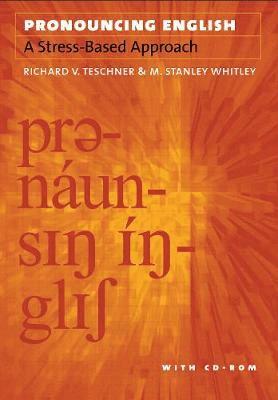
    Pronouncing English

    A Stress-Based Approach with CD-ROM

    AvRichard V. Teschner,M. Stanley Whitley

    Häftad, Engelska, 2004

    Del i serien Georgetown University Press

    483 kr

    Beställningsvara. Skickas inom 7-10 vardagar. Fri frakt över 249 kr.

    Beskrivning

    Pronouncing English is a textbook for teaching English phonetics and phonology, offering an original "stress-based" approach while incorporating all the standard course topics. Drawing on current linguistic theory, it uniquely analyzes prosody first, and then discusses its effects on pronunciation-emphasizing suprasegmental features such as meter, stress, and intonation, then the vowels and consonants themselves. Distinguished by being the first work of its kind to be based on an exhaustive statistical analysis of all the lexical entries of an entire dictionary, Pronouncing English is complemented by a list of symbols and a glossary. Richard Teschner and M. Stanley Whitley present an improved description of English pronunciation and conclude each chapter with suggestions on how to do a better job of teaching it. An appendix with a brief introduction to acoustic phonetics-the basis for the perception vs. the production of sounds-is also included. Revolutionary in its field, Pronouncing English declares that virtually all aspects of English pronunciation-from the vowel system to the articulation of syllables, words, and sentences-are determined by the presence or absence of stress.The accompanying CD-ROM carries audio recordings of many of the volume's exercises, more than 100 text and sound files, and data files on which the statistical observations were based.

    Produktinformation

    • Utgivningsdatum:2004-04-08
    • Mått:178 x 254 x 19 mm
    • Vikt:635 g
    • Format:Häftad
    • Språk:Engelska
    • Serie:Georgetown University Press
    • Antal sidor:296
    • Förlag:Georgetown University Press
    • ISBN:9781589010024

    Utforska kategorier

    • Språkvetenskap och lingvistik inom Språk och ordböcker

    Mer om författaren

    Richard V. Teschner is a professor in the Department of Languages and Linguistics at the University of Texas, El Paso. M. Stanley Whitley is professor of Spanish and Linguistics in the Department of Romance Languages at Wake Forest University.

    Recensioner i media

    "Teschner and Whitley have produced a fascinating book which will be an invaluable resource to all interested in the study and teaching of English pronunciation." - Grant Goodall, professor and director of the linguistics language program at the University of California, San Diego; "Teschner and Whitley succeed in their goals of providing a methodical, thorough, and engaging treatment of stress in English pronunciation and writing, as well as providing an essential pedagogical guide for teachers of English. Material in the appendix and the accompanying CD-ROM provide useful background and support for teachers and beginning students. Clearly written and superbly exemplified, this is an outstanding textbook for undergraduates and graduate students in English, linguistics and language pedagogy." - Kamil Ud Deen, assistant professor of linguistics, University of Hawai'i at Manoa; "Pronouncing English provides a comprehensive introduction to English phonetics that is innovatively structured, theoretically sound, and exceedingly practical. Teschner and Whitley have written a lively and informative text that will be rewarding and entertaining for students-and their instructors-in any field concerned with the English language." - Garland D. Bills, professor emeritus of linguistics and of Spanish & Portuguese, University of New Mexico"

    Innehållsförteckning

    • Preface 1. The Metric Foot 1.1 The notion of stress: Present stress and absent/null stress1.2 Metricalism1.3 The five major metric feet: Spondees, trochees, iambs, dactyls, and anapests1.4 Weak stress, null stress, and vowels1.5 The English drive toward monosyllabicity1.6 Teaching topics of chapter 1 to students of ESOLNotesWrap-Up exercises 2. Strong Stresses and Weak: How to Know Where They Go 2.1 Strong stress moves leftward, but only so far2.2 Three main factors in strong-stress position2.3 Strong-stress retention on the same base vowel2.4 Word families with shifting stress2.5 The effect of suffixation on strong-stress position2.6 The shiftless, stress-free life of the prefix2.7 Applying strong-stress rules to bisyllabic words2.8 Applying strong-stress rules to trisyllabic words2.9 Strong-stressing words of four, five, and more syllables2.10 Weak stress: Placing the strong, locating the weak2.11 Weak stress on bisyllabic words2.12 Weak-stressing trisyllabic words2.13 Weak-stressing "four-plus" words2.14 Vowel reduction: The price we pay for shifting stress2.15 Teaching the topics of chapter 2 to students of ESOLNotes 3. Intonation-The Melodic Line 3.1 "Peak" stress for contrast and emphasis3.2 Some analogies with music3.3 Stressing compound words and phrases3.4 Peak stresses and info units3.5 Melodic lines long and short, falling and rising, and so on3.6 Melodic lines and compound melodies3.7 Approaches to intonation3.8 Teaching the topics of chapter 3 to students of ESOLNotesWrap-Up Exercises 4. From Orthography to Pronunciation 4.1 Even English spelling can be reduced to rules4.2 Consonants: The (somewhat) easy part4.3 Vowels: Which are easy and which are tough to spell4.4 Vowel reduction redux4.5 Teaching the topics of chapter 4 to students of ESOLNotesWrap-Up Exercises 5. Vowels 5.1 Vowels, broadly and narrowly5.2 How to make vowels: Tongue and lip position5.3 Other vowels, other languages5.4 Stressed vowels5.5 Unstressed vowels: the schwa zone5.6 Shifting vowels make the dialect5.7 Rules and regularities5.8 Other analyses of English vowels5.9 Teaching pronunciation: Vowels and consonantsNotesWrap-Up Exercises 6. Consonants 6.1 Consonants and syllable position6.2 Types of consonants6.3 English consonant phonemes6.4 Consonants that behave like vowels6.5 Stops6.6 All those sibilants6.7 Slits up front6.8 /h/: A sound that can get lost6.9 Glides /j/ and /w/6.10 Syllable reprise: How to build an English word6.11 Teaching pronunciation: Error analysisNotesWrap-Up Exercises 7. Sounds and Forms That Change and Merge 7.1 English phonemes in (con)text7.2 When words change their pronunciation7.3 Changes due to work linkage7.4 Changes due to stress7.5 Changes due to grammar: Morphemes and allomorphs7.6 Phonology in grammar7.7 The phoneme exchange7.8 English spelling revised7.9 Teaching pronunciation: Sounds in contextNotesWrap-Up Exercises 8. Appendix 8.1 Acoustic phonetics8.2 The International Phonetic Alphabet8.3 PEASBA's CD: Recordings and CorpusNotes Glossary References Index