• Fri frakt över 249 kr
  • •
  • Snabba leveranser
  • •
  • Billiga böcker
Kundservice

Du är på sajten för privatpersoner.

Företag, bibliotek eller offentlig verksamhet?

Du handlar på classic.bokus.com, där alla dina funktioner finns intakta.
Till classic.bokus.com
Bokus logotyp. Gå till startsidan.
  • Erbjudanden
  • Student
  • Topplistor
  • Barn & ungdom
  • Bokus Play
  • E-böcker
  • Ljudböcker
  • Pocketböcker
  • Spel och pussel

5% studentrabatt – använd koden KURSBOK27 →

Sidfot

Mina sidor

    Hjälp

    • Kundservice
    • Vanliga frågor och svar
    • Frakt och leverans
    • Retur vid ångerrätt
    • Reklamera vara
    • Betalning
    • Köpvillkor
    • Allmänna villkor
    • Information om webbplatsens tillgänglighet

    Om Bokus

    • Om oss
    • Pressrum
    • För studenter
    • För företag
    • För bibliotek och offentlig verksamhet
    • För leverantörer
    • Hållbarhet

    Populärt

    • Aktuella erbjudanden
    • Presentkort
    • Studentlitteratur
    • Nya böcker
    • Topplistor
    • Signerade böcker
    • Engelska böcker

    Inspiration

    • Boktips
    • BookTok
    • Barnbokskaraktärer
    • Populära författare
    Logotyp för Bokus
    Följ oss på Facebook (extern länk)Följ oss på Instagram (extern länk)Följ oss på YouTube (extern länk)Följ oss på TikTok (extern länk)
    bokus @ CookiesAnpassa cookiesIntegritetspolicyKöpvillkor
    Till Citymail hemsida (extern länk)Till Budbee hemsida (extern länk)Till Postnord hemsida (extern länk)Till Schenker hemsida (extern länk)Till Early Bird hemsida (extern länk)Till Walleys hemsida (extern länk)
    1. Data och IT
    2. Systemvetenskap och AI

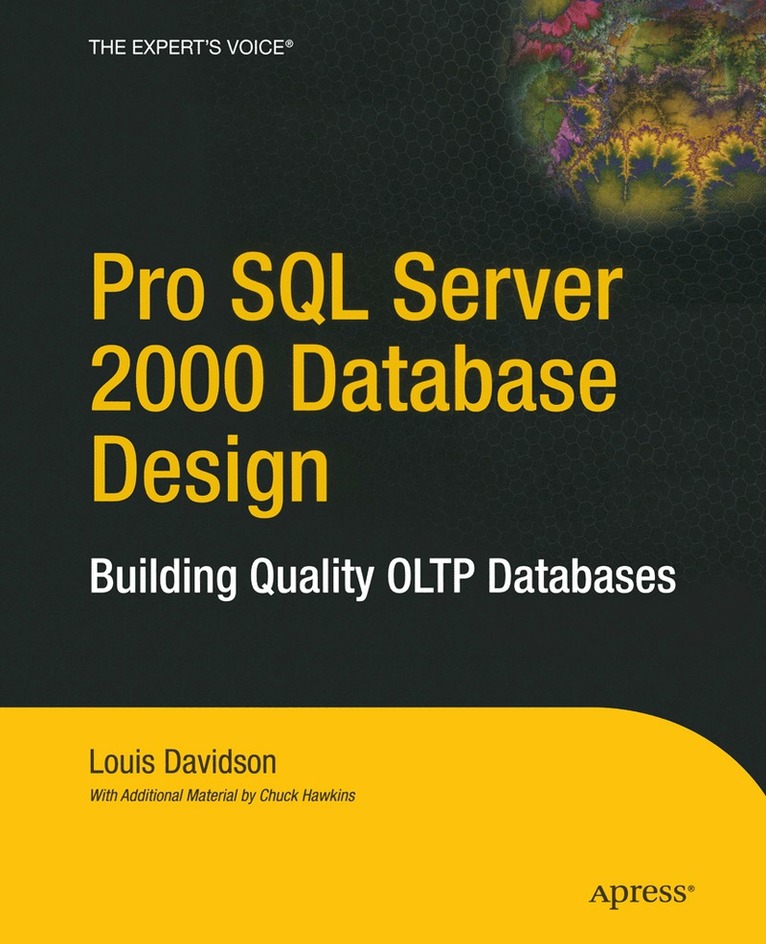
    Pro SQL Server 2000 Database Design

    Building Quality OLTP Databases

    AvLouis Davidson

    Häftad, Engelska, 2004

    449 kr

    Beställningsvara. Skickas inom 10-15 vardagar. Fri frakt över 249 kr.

    Fler format och utgåvor

    E-bok

    569 kr

    Beskrivning

    Database design is one of the most contentious issues in computer science. There is always a delicate balance to be struck between the strict academic rules that govern the design of relational databases and the real-world techniques that programmers apply to get the job done in a certain time frame. This book's goal is to coverfrom a "real-world" point of viewall of the essential elements in designing, modeling, and building efficient relational databases, while avoiding a dry, theoretical approach. Author Louis Davidson explains the process of implementing a database—from generating tables and allowing access to these tables using Microsoft SQL Server 2000. This includes tackling data modeling (focusing on the IDEF1X notation), requirements gathering, normalization (beyond the Third Normal Form), and implementing tables, constraints, triggers, procedures, user-defined functions, and so on. Davidson provides a full and realistic case study that clearly illustrates the entire process, from the initial discussions of a client's needs, through development of a logical model, to a complete implementation of the system.

    Produktinformation

    • Utgivningsdatum:2004-01-22
    • Mått:178 x 235 x 34 mm
    • Vikt:945 g
    • Format:Häftad
    • Språk:Engelska
    • Antal sidor:592
    • Förlag:APress
    • ISBN:9781590593028

    Utforska kategorier

    • Systemvetenskap och AI inom Data och IT

    Mer om författaren

    Louis Davidson has been in the IT industry for more than 15 years as a corporate database developer and architect. He has spent the majority of his career working with Microsoft SQL Server, beginning from the early days of version 1.0. He has a bachelor s degree from the University of Tennessee at Chattanooga in computer science, with a minor in mathematics. Louis is the data architect for Compass Technology (Compass.net) in Chesapeake, Virginia, leading database development on their suite of nonprofit oriented CRM products, built on the Microsoft CRM platform and SQL Server technologies.

    Innehållsförteckning

    • Chapter 1: Introduction to Database Concepts 1 Chapter 2: Gathering Information for a Database Project 13 Chapter 3: Fundamental Database Concepts 27 Chapter 4: Entities, Attributes, Relationships, and Business Rules 55 Chapter 5: Data Modeling 91 Chapter 6: Normalization Techniques 129 Chapter 7: Advanced Normalization Topics 165 Chapter 8: Ending the Logical Design Phase 191 Chapter 9: Planning the Physical Architecture 219 Chapter 10: Building the Basic Table Structures 245 Chapter 11: Declarative Data Protection 315 Chapter 12: Programmatic Data Protection 341 Chapter 13: Advanced Data Access and Modification 367 Chapter 14: Determining Hardware Requirements 459 Chapter 15: Completing the Project 511