• Fri frakt över 249 kr
  • •
  • Snabba leveranser
  • •
  • Billiga böcker
Kundservice

Du är på sajten för privatpersoner.

Företag, bibliotek eller offentlig verksamhet?

Du handlar på classic.bokus.com, där alla dina funktioner finns intakta.
Till classic.bokus.com
Bokus logotyp. Gå till startsidan.
  • Erbjudanden
  • Nyheter
  • Student
  • Topplistor
  • Barn & ungdom
  • Bokus Play
  • E-böcker
  • Pocketböcker
  • Spel & pussel

10% rabatt på allt med kod: NYSTART10 →

Sidfot

Mina sidor

    Hjälp

    • Kundservice
    • Vanliga frågor och svar
    • Frakt och leverans
    • Retur vid ångerrätt
    • Reklamera vara
    • Betalning
    • Köpvillkor
    • Allmänna villkor
    • Information om webbplatsens tillgänglighet

    Om Bokus

    • Om oss
    • Pressrum
    • För studenter
    • För företag
    • För bibliotek och offentlig verksamhet
    • För leverantörer
    • Hållbarhet

    Populärt

    • Aktuella erbjudanden
    • Presentkort
    • Studentlitteratur
    • Nya böcker
    • Topplistor
    • Signerade böcker
    • Engelska böcker

    Inspiration

    • Boktips
    • BookTok
    • Populära bokserier
    • Barnbokskaraktärer
    • Populära författare
    Logotyp för Bokus
    Följ oss på Facebook (extern länk)Följ oss på Instagram (extern länk)Följ oss på YouTube (extern länk)Följ oss på TikTok (extern länk)
    bokus @ CookiesAnpassa cookiesIntegritetspolicyKöpvillkor
    Till Citymail hemsida (extern länk)Till Budbee hemsida (extern länk)Till Postnord hemsida (extern länk)Till Schenker hemsida (extern länk)Till Early Bird hemsida (extern länk)Till Walleys hemsida (extern länk)
    1. Samhälle och politik
    2. Sociologi och antropologi
    3. Sociologi

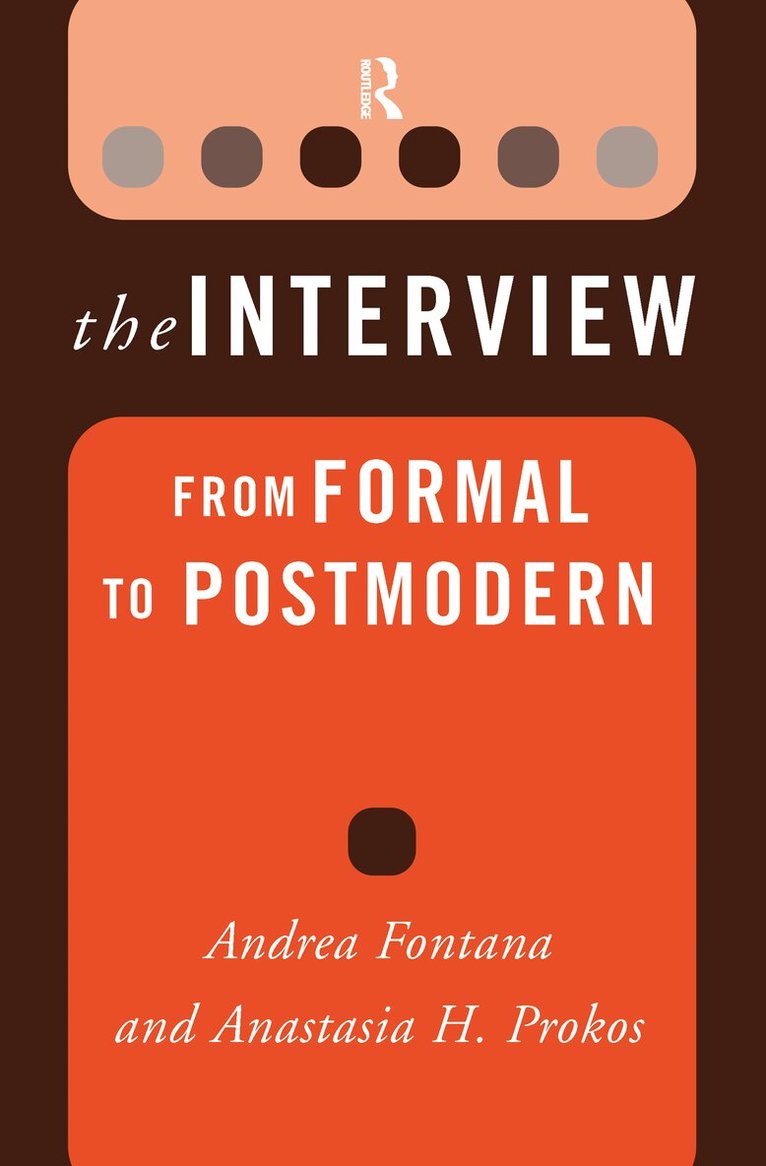
    Interview

    From Formal to Postmodern

    AvAndrea Fontana,Anastasia H Prokos

    Inbunden, Engelska, 2007

    2 421 kr

    Beställningsvara. Skickas inom 10-15 vardagar. Fri frakt över 249 kr.

    Fler format och utgåvor

    Häftad

    610 kr

    Beskrivning

    Used by everyone from survey researchers to oral historians, the interview may be the most basic and essential field method in the qualitative researcher’s toolkit. In this concise, student-friendly guide, Fontana and Prokos give a cogent introduction to the history, types, and methods of interviewing in the social sciences. They outline the range of ways in which interviews are conducted, both structured and unstructured, then provide instruction on conducting and interpreting interviews, and address ethical considerations in eliciting information from people. The authors also point to recent and future trends that will affect the use of this method. For researchers who need a primer and for students in methods courses or assigned fieldwork projects in other courses across the social sciences, this short, inexpensive volume is ideal.

    Produktinformation

    • Utgivningsdatum:2007-05-31
    • Mått:152 x 229 x 13 mm
    • Vikt:453 g
    • Format:Inbunden
    • Språk:Engelska
    • Antal sidor:148
    • Förlag:Left Coast Press Inc
    • ISBN:9781598741087

    Utforska kategorier

    • Sociologi inom Samhälle och politik

    Mer om författaren

    Andrea Fontana, Anastasia H. Prokos

    Recensioner i media

    "...The Interview is a major new book on the oldest of sociological methods. The grasp of the field is definitive. It moves from the modern to the postmodern, from oral history to grounded theory, active interviews, to the interview as a negotiated accomplishment. Accessible, well-written, this book will become the point of reference for all future treatments of the interview. "... --Norman K. Denzin, Univ. of Illinois, Urbana-Champaign " I sat down to read The Interview, expecting a textbook; soon I was caught up in an engaging, well-written and unfolding story about the interview society, the different approaches to interviews, their history, how they are used academically, and future directions. Full of poignant examples, this book is unique in its coverage of interviews along the continuum from art to science. Readers will appreciate the authors' focus on ethics and gender, as well as on electronic interviewing. This book makes a valuable contribution to qualitative classes that attempt to introduce students to the full range of research possibilities. I know it will fill a niche in my graduate qualitative methods class." -Carolyn Ellis, Univ. of South Florida "Fontana and Prokos simplify the essential features of interviewing and direct practitioners and theorists to a new appreciation of how to talk with people for maximum impact and minimum damage. The section New Trends in Interviewing illuminates how reflexive sociology can move forward without forgetting important lessons from the past. This is a good book." -David Altheide, Arizona State University "Qualitative and quantitative researchers have come to rely on the interview as a basic method of data gathering, whether with a single subject or thousands. Fontana and Prokos (both sociology, U. of Nevada, Las Vegas) concentrate on methods of interviewing a range of subjects in research relating to social science, but their ideas also translate to research in liberal and fine arts. They describe how interviewing has become ubiquitous in Western society and why, techniques of structured and group interviewing, unstructured interviewing, including understanding the language and culture of the respondents, locating informants, gaining trust, and collecting empirical material, and describe types of unstructured interviewing such as oral history and postmodern interviewing with attention to grounded theory and gender. They consider the ethics of interviewing, new trends such as empathetic interviewing and the interview as a negotiated accomplishment and give future directions in formal, group, unstructured and electronic interviewing." -Book News

    Innehållsförteckning

    • Chapter 1 Interviewing in Perspective; Chapter 2 Structured Interviewing; Chapter 3 Group Interviewing; Chapter 4 Unstructured Interviewing; Chapter 5 Types of Unstructured Interviewing; Chapter 6 Framing and Interpreting Interviews; Chapter 7 Ethical Considerations; Chapter 8 New Trends in Interviewing; Chapter 9 Future Directions; Chapter 10 Conclusion;