• Fri frakt över 249 kr
  • •
  • Snabba leveranser
  • •
  • Billiga böcker
Kundservice

Du är på sajten för privatpersoner.

Företag, bibliotek eller offentlig verksamhet?

Du handlar på classic.bokus.com, där alla dina funktioner finns intakta.
Till classic.bokus.com
Bokus logotyp. Gå till startsidan.
  • Erbjudanden
  • Nyheter
  • Student
  • Topplistor
  • Barn & ungdom
  • Bokus Play
  • E-böcker
  • Pocketböcker
  • Spel & pussel

10% rabatt på allt med kod NYSTART10 →

Sidfot

Mina sidor

    Hjälp

    • Kundservice
    • Vanliga frågor och svar
    • Frakt och leverans
    • Retur vid ångerrätt
    • Reklamera vara
    • Betalning
    • Köpvillkor
    • Allmänna villkor
    • Information om webbplatsens tillgänglighet

    Om Bokus

    • Om oss
    • Pressrum
    • För studenter
    • För företag
    • För bibliotek och offentlig verksamhet
    • För leverantörer
    • Hållbarhet

    Populärt

    • Aktuella erbjudanden
    • Presentkort
    • Studentlitteratur
    • Nya böcker
    • Topplistor
    • Signerade böcker
    • Engelska böcker

    Inspiration

    • Boktips
    • BookTok
    • Populära bokserier
    • Barnbokskaraktärer
    • Populära författare
    Logotyp för Bokus
    Följ oss på Facebook (extern länk)Följ oss på Instagram (extern länk)Följ oss på YouTube (extern länk)Följ oss på TikTok (extern länk)
    bokus @ CookiesAnpassa cookiesIntegritetspolicyKöpvillkor
    Till Citymail hemsida (extern länk)Till Budbee hemsida (extern länk)Till Postnord hemsida (extern länk)Till Schenker hemsida (extern länk)Till Early Bird hemsida (extern länk)Till Walleys hemsida (extern länk)
    1. Samhälle och politik
    2. Krig och försvar

    When Proliferation Causes Peace

    The Psychology of Nuclear Crises

    AvMichael D. Cohen

    Häftad, Engelska, 2017

    385 kr

    Beställningsvara. Skickas inom 7-10 vardagar. Fri frakt över 249 kr.

    Fler format och utgåvor

    Inbunden

    1 148 kr

    E-bok

    466 kr

    Beskrivning

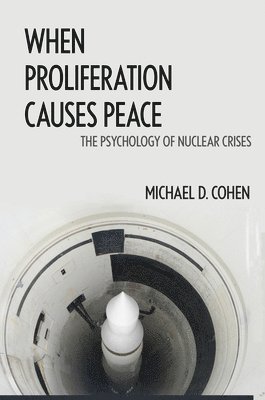
    Does state acquisition of nuclear weapons lead to stability and peace or instability and crises? This is one of the great debates in international relations scholarship. Michael D. Cohen argues that nuclear weapons acquisition often does dangerously embolden the acquiring state to undertake coercion and aggression, but that this behavior moderates over time as leaders learn the dangers and limitations of nuclear coercion. This book examines the historical cases of the Soviet Union and Pakistan in depth and also looks at mini-cases involving the United States, China, and India. This book broadens our understanding of how leaders and states behave when they acquire nuclear weapons and is important reading for scholars and students of international relations, security studies, and political psychology.

    Produktinformation

    • Utgivningsdatum:2017-12-01
    • Mått:152 x 229 x 32 mm
    • Vikt:408 g
    • Format:Häftad
    • Språk:Engelska
    • Antal sidor:280
    • Förlag:Georgetown University Press
    • ISBN:9781626164956
    • Utmärkelser:Robert L. Jervis and Paul W. Schroeder Best Book Award

    Utforska kategorier

    • Krig och försvar inom Samhälle och politik
    • Kärnvapen inom Samhälle och politik
    • Internationella relationer inom Samhälle och politik

    Mer om författaren

    Michael D. Cohen is a senior lecturer in security studies at Macquarie University in Australia. He is coeditor of North Korea and Nuclear Weapons. His articles have appeared in International Security, International Relations of the Asia-Pacific, The Non-Proliferation Review, and Strategic Studies Quarterly.

    Recensioner i media

    Cohen’s book has a number of admirable qualities. In addition to tackling a critically important question, the theory is refreshing in its focus on the experiences of individual leaders. . . . Cohen’s book is an important step toward understanding the role of psychology and leader experiences in nuclear decision-making.

    Innehållsförteckning

    • 1. Introduction2. Psychology, Nuclear Crisis, and Foreign Policy3. The Soviet Union, 1956-19624. Pakistan, 1998-20025. Further Tests: Kennedy, Vajpayee, Nixon, and Mao6. Conclusion: When Proliferation Causes PeaceBibliographyIndexAbout the Author