• Fri frakt över 249 kr
  • •
  • Snabba leveranser
  • •
  • Billiga böcker
Kundservice

Du är på sajten för privatpersoner.

Företag, bibliotek eller offentlig verksamhet?

Du handlar på classic.bokus.com, där alla dina funktioner finns intakta.
Till classic.bokus.com
Bokus logotyp. Gå till startsidan.
  • Erbjudanden
  • Nyheter
  • Student
  • Topplistor
  • Barn & ungdom
  • Bokus Play
  • E-böcker
  • Pocketböcker
  • Spel & pussel

10% rabatt på allt med kod: NYSTART10 →

Sidfot

Mina sidor

    Hjälp

    • Kundservice
    • Vanliga frågor och svar
    • Frakt och leverans
    • Retur vid ångerrätt
    • Reklamera vara
    • Betalning
    • Köpvillkor
    • Allmänna villkor
    • Information om webbplatsens tillgänglighet

    Om Bokus

    • Om oss
    • Pressrum
    • För studenter
    • För företag
    • För bibliotek och offentlig verksamhet
    • För leverantörer
    • Hållbarhet

    Populärt

    • Aktuella erbjudanden
    • Presentkort
    • Studentlitteratur
    • Nya böcker
    • Topplistor
    • Signerade böcker
    • Engelska böcker

    Inspiration

    • Boktips
    • BookTok
    • Populära bokserier
    • Barnbokskaraktärer
    • Populära författare
    Logotyp för Bokus
    Följ oss på Facebook (extern länk)Följ oss på Instagram (extern länk)Följ oss på YouTube (extern länk)Följ oss på TikTok (extern länk)
    bokus @ CookiesAnpassa cookiesIntegritetspolicyKöpvillkor
    Till Citymail hemsida (extern länk)Till Budbee hemsida (extern länk)Till Postnord hemsida (extern länk)Till Schenker hemsida (extern länk)Till Early Bird hemsida (extern länk)Till Walleys hemsida (extern länk)
    1. Skönlitteratur
    2. Litteraturvetenskap
    3. Litteraturvetenskap

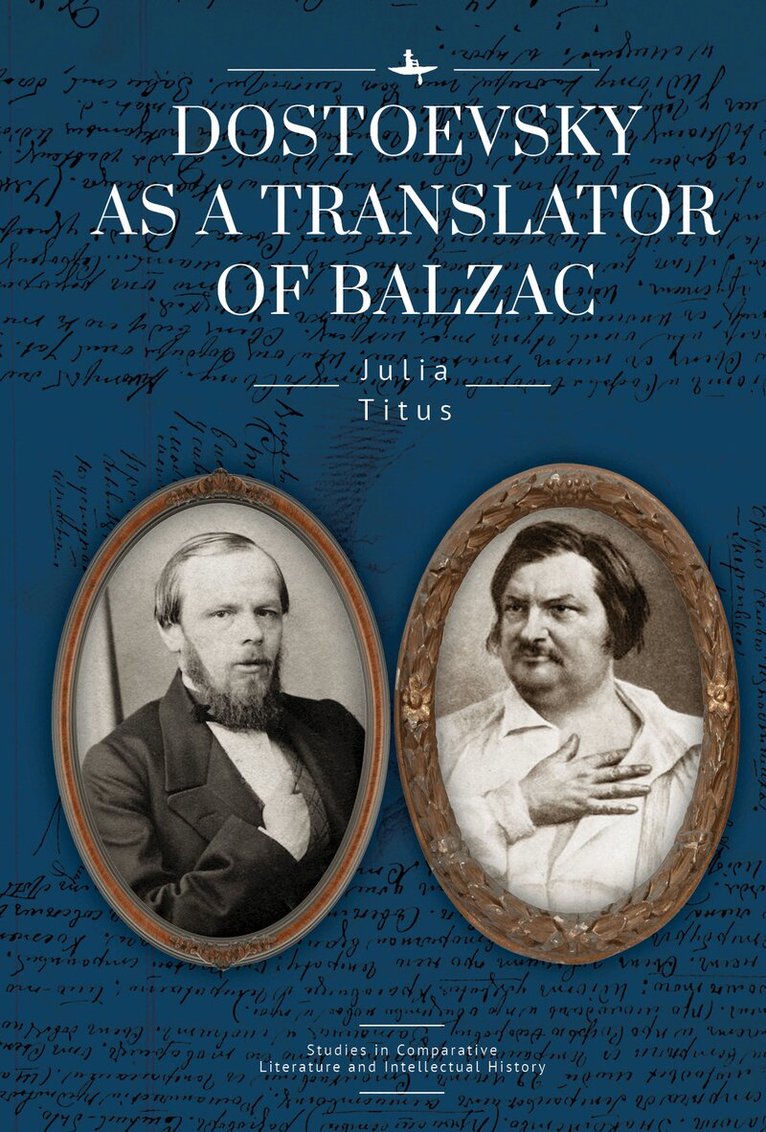
    Dostoevsky as a Translator of Balzac

    AvJulia Titus

    Inbunden, Engelska, 2022

    Del i serien Studies in Comparative Literature and Intellectual History

    1 261 kr

    Skickas . Fri frakt över 249 kr.

    Fler format och utgåvor

    E-bok

    2 892 kr

    E-bok

    1 832 kr

    Beskrivning

    The focus of this study in comparative criticism is close analysis of Dostoevsky’s first literary publication—his 1844 translation of the first edition of Balzac’s Eugе́nie Grandet (1834)—and the stylistic choices that he made as a young writer while working on Balzac’s novel. Through the prism of close reading, the author analyzes Dostoevsky’s literary debut in the context of his future mature aesthetic style and poetics. Comparing the original and the translation side by side, this book focuses on the omissions, additions and substitutions that Dostoevsky brought into the text. It demonstrates how young Dostoevsky’s free translation of Eugénie Grandet predicts the creation of his own literary characters, themes, and other aspects of his literary output that are now recognized as Dostoevsky’s signature style. It investigates the changes that Dostoevsky made while working on Balzac’s text and analyzes the complex transplantation of Balzac’s imagery, motifs, and character portraiture from Eugénie Grandet into Dostoevsky’s own writing later on.

    Produktinformation

    • Utgivningsdatum:2022-02-10
    • Mått:155 x 234 x 13 mm
    • Vikt:400 g
    • Format:Inbunden
    • Språk:Engelska
    • Serie:Studies in Comparative Literature and Intellectual History
    • Antal sidor:154
    • Förlag:Academic Studies Press
    • ISBN:9781644697795

    Utforska kategorier

    • Litteraturvetenskap inom Skönlitteratur

    Mer om författaren

    Educated in Russia and the United States, Julia Titus has been teaching courses in Russian language, literature, and theater at the department of Slavic languages and Literatures at Yale University for more than twenty years. Her research interests include Russian and French literature of the nineteenth century, translation theory, and heritage language studies. She is the editor of an annotated reader The Meek One (Yale University Press, 2012), and Poetry Reader for Russian Learners (Yale University Press, 2015).

    Recensioner i media

    “[This] monograph is based on close comparative reading of Dostoevsky’s Russian translation (long since superseded by two twentieth-century versions) against Balzac’s original, using extracts from each as a basis for assessing Balzac’s lasting influence on Dostoevskian thematics… Titus shows how translation reappears as a theme in several of Dostoevsky’s later novels, most famously in Crime and Punishment as the resourceful Razumikhin’s side hustle. She demonstrates how Balzac’s aesthetics and characterization penetrated numerous early novels by Dostoevsky; her argument that Crime and Punishment was enhanced by elements from Eugénie Grandet (from the bleakness of Raskolnikov’s garret room to Sonia’s spiritual beauty) is both insightful and original. Her discussion of numerous short extracts from Dostoevsky’s (idiosyncratically flawed) translation reveals its omissions and arbitrary reformulations, while explaining perceptively how the younger writer’s divergences from Balzac indicate aesthetic and philosophical independence rather than carelessness… As Titus reminds us in this enjoyable monograph, paraphrasing Jorge Luis Borges, ‘literary translations are always embedded in the context of a target literary system’ (p. 85).”— Muireann Maguire, Modern Language Review“Titus’s scrupulous examination of Dostoevskii’s ‘free’ translation reveals a pattern of departures from Balzac’s original that allow her to argue that these were intentional choices reflective of the translator’s fledgling poetics. … Titus’s study offers an illuminating account of an important moment in Dostoevskii’s creative career and sheds further light on the larger question of, to quote Priscilla Meyer, ‘how the Russians read the French.’”— Anna Schur, Keene State College, Slavic Review“Julia Titus argues that Dostoevsky’s first published work, his ‘free translation’ of Balzac’s Eugénie Grandet… ought to be considered among his literary texts. Repeatedly straying from Balzac’s original, Dostoevsky offered Russian readers a narrative that contains many of the themes that later became central in his own literary work. Titus selects three topical and engaging examples in the chapters that constitute the body of her book: female characters, the material world, and money. … [T]his accessible book will appeal to students interested in translation studies, in Dostoevsky’s rapport with Balzac, and in the recurrence in Dostoevsky’s oeuvre of the specific themes outlined here. … Her book will lead readers of Dostoevsky to Balzac (not only to Eugénie Grandet, but also to Le Père Goriot and other texts) and back to read Dostoevsky with a new awareness of some of the first choices that he made in articulating his favorite themes.”— Sara Dickinson, Dostoevsky Studies (2022: Vol. 25)“In Dostoevsky as a Translator of Balzac, Julia Titus revisits Dostoevskii’s free translation of Eugénie Grandet from a more positive angle. In Dostoevskii’s rewriting of Balzac’s novel she reads the emergence of the Russian author’s own voice. In the first place, she considers the stylistic decisions Dostoevskii made in the interests of rendering the book accessible to a Russian reading public: substituting Russian equivalents for unfamiliar French objects and terms or simply eliminating such details. In the discrepancies between the French original and the Russian translation – as well as in the similarities – Titus further reads indices of Dostoevskian themes and preoccupations that would reappear in the author’s subsequent novels. … Throughout this short book Titus provides insightful commentaries on Dostoevskii’s translations of and indebtedness to Balzac’s original text.”— Sima Godfrey, University of British Columbia, Canadian Slavonic Papers"A free translation or a complete rewrite? Readers of Dostoevsky’s literary debut – his rendering, in 1844, of the first edition of Balzac’s Eugénie Grandet – have often wondered. As Julia Titus suggests, Dostoevsky may have felt emboldened by a tradition in which Russian versions of European poetry sometimes eclipsed their originals… Titus has serious points to make... Titus’s judgements on why Dostoevsky made various alterations are insightful, if at times overly categorical; the extensive quotations she provides, however, allow the reader to draw their own conclusions… As Titus also reveals, the twenty-two-year-old Dostoevsky made a good fist of some difficult passages, despite a lack of dictionaries and reference works. He coped well with ‘various historical coins, their design elements, and other specifics’, adding affectionate and, as time would prove, entirely characteristic suffixes in order to bring M. Grandet’s sensuous love for lucre alive. Young Dostoevsky considered his translation ‘incomparable’ (bespodobnyi). Strictly speaking, he was right.”— Oliver Ready, The Times Literary Supplement“At last, a comprehensive exploration of Dostoevsky's first published work, a translation of Balzac's novel Eugénie Grandet, and of its relationship to the Russian author's original writing! Julia Titus's detailed and insightful study makes a compelling argument for translation's constitutive role in the author's creative process and represents an important step toward the full integration of translation into literary studies.”— Brian James Baer, author of Translation and the Making of Russian Literature“It is little known that Dostoevsky began his literary career as a translator. His first published book, a Russian translation of Balzac’s novel Eugénie Grandet, was later superseded by more literal versions. Julia Titus’s meticulous juxtaposition of Balzac’s French original and Dostoevsky’s “free” translation demonstrates how the Russian novelist used strategic deviations from the source text to incorporate Balzac into his own fictional universe. As Titus’s fascinating study shows, Dostoevsky’s appropriations of Balzac’s characters, depictions of the material world, and obsession with the allure of money reverberate through his entire novelistic oeuvre. At the same time, Titus highlights how Dostoevsky distanced himself from Balzac by translating him. This book will be of interest to scholars of Russian and French literature as well as anyone concerned with translation as creative appropriation.”— Adrian Wanner, Liberal Arts Professor of Russian and Comparative Literature, The Pennsylvania State University

    Innehållsförteckning

    • IntroductionReflections of Eugénie in Dostoevsky’s Female CharactersThe Material World in Balzac’s Eugénie Grandet and in Dostoevsky’s TextsThe Theme of Money in Eugénie Grandet and Dostoevsky’s TextsConclusionBibliography