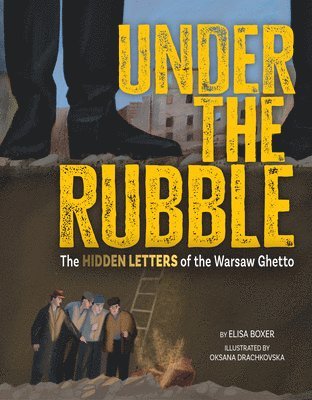
Inbunden, Engelska, 2026
Under the Rubble
The Hidden Letters of the Warsaw Ghetto
Av Elisa Boxer
203 kr
Beställningsvara. Skickas inom 5-8 vardagar. Fri frakt över 249 kr.
Beskrivning
Produktinformation
- Utgivningsdatum: 2026-04-30
- Mått: 212 x 276 x 11 mm
- Vikt: 426 g
- Format: Inbunden
- Språk: Engelska
- Antal sidor: 32
- Förlag: Behrman House Inc.,U.S.
- Illustratör: Oksana Drachkovska
- ISBN: 9781681157092
Utforska kategorier
Mer om författaren
Elisa Boxer is an Emmy-winning journalist and Sydney Taylor Honor author whose work has been featured in publications including The New York Times, Fast Company, and Inc. magazine. Elisa is the author of numerous children’s books, including One Turtle's Last Straw (which won the 2024 Maine Chickadee Award) and Hidden Hope: How a Toy and a Hero Saved Lives During the Holocaust, which won the Sydney Taylor Silver Medal, the Maine Literary Award for Best Children's Book, and was a Booklist Editor's Choice pick for 2024. Elisa lives in Scarborough, Maine.Oksana Drachkovska graduated from the National Academy of Arts in Lviv, Ukraine, majoring in fine arts, she decided to focus on illustration. In 2016, she was granted scholarships from Gaude Polonia (Poland) and SAIA (Slovakia). In 2020, the book she illustrated, A Bunny Who Didn’t Jump and His Brave Mother, won Lviv Book Forum’s award as the best book for children aged 6 to 8. In 2021 and 2022, she was shortlisted for Bologna Book Fair’s International Award for Illustration. Oksana lives in Barcelona, Spain.
Recensioner i media
"These firsthand accounts offer a chilling yet poignant portrayal of life during the Nazi occupation. The narrative follows a group of individuals determined to preserve their stories, ensuring their history would never be forgotten beneath the rubble. Their courage and foresight frame the book as a historical account and a testament to resilience. Boxer weaves powerful quotes throughout the work, drawn from the voices of those who lived through it. Drachkovska's illustrations deepen the emotional impact, adding a visual layer that conveys hope and heartbreak in ways words alone cannot.VERDICT A powerful and accessible introduction to the horrors of the Holocaust for younger readers. The inclusion of supplemental videos and links encourages further inquiry, making this a valuable addition to any library collection."—School Library Journal"A compelling narrative...This first person account, as relived by Wasser himself, moves into a flashback. It’s six years earlier in 1940 when the work of the documentarians begins. Everyone they could recruit is given paper and pencil. But the work and the writing become increasingly difficult as the Nazi grip on the Ghetto tightens. And then the deportations begin. When it becomes clear that they may not survive, they bury their work, in the hope that the truth may one day come to light.There was always hope, if not for their lives, then for their words. The light in the illustrations captures this spirit. Small vignettes of Jewish life are captured in muted tones. There are oversized Nazi boots above a tunnel and large Nazi shadows against the Ghetto wall. But mostly, there are the faces of fear and the postures of a people oppressed. A floating piece of parchment in each spread quotes a writer from the Ghetto and creates its own narrative. There is an Author's Note, a Glossary, Selected Sources, a few photos, and a hand drawn map in the back matter. This supporting material gives context to a story told in simple, flowing language.Under the Rubble: The Hidden Letters of the Warsaw Ghetto is a fitting tribute to the bravery and foresight of the members of the Oneg Shabbat. It can be read as a stand alone or as part of a broader discussion of the Holocaust and is suitable for home or curricular use. A young child can read the picture book at face value. An older child can find more meaning behind the carefully considered and discerningly chosen words. This is a book for All Ages."—The Jewish Book Garden"This picture book written in free verse tells a true story of the Warsaw Ghetto from the first-person viewpoint of Hersh Wasser, one of that story’s participants. After a brief, context-setting introduction, the book opens in 1946; World War II has ended, and Wasser—'the only person in the world who knows / where the treasure is buried, and what it contains'—is guiding searchers as they dig up several tin boxes. An extended flashback to 1940, during the war, reveals what is in those boxes: Wasser was part of a group of prisoners in the ghetto who documented what they witnessed—'each new horror'—and buried the archive, realizing that few if any of them would survive to unearth it. The verse is both informative and clear about the affecting stakes of the situation: 'We decided to hide history while / it was still happening, to bury / the proof, to protect it for future / generations to find.' Quotes from the archive appear as occasional callouts. The illustrations’ intentionally dreary palette gives way to lighter colors and more uplifting images at the hopeful ending ('Our evidence, once concealed, / now coming to light. / Our voices, / once silenced, / now rising from the rubble'). An author’s note adds historical background; a glossary, sources, and a (roughly sketched) map of the Warsaw Ghetto are also appended."—The Horn Book"The Warsaw Ghetto Uprising has become enshrined in history as an example of Jewish resistance during the Holocaust. The focus of Elisa Boxer and Oksana Drachkovska’s picture book is the secret archive created and hidden by the ghetto’s residents. Aware that their survival was imperiled, they were determined to document the truth about Nazi terror as well as evidence of their own humanity when confronting destruction. A quietly dramatic text, stunning pictures, and inventive design present young readers with a truthful and inspiring vision of heroism. . . .Drachkovska’s illustrations, rendered in muted colors, capture the pervasive darkness of the ghetto as a kind of nightmare, relieved only by moments of courage. In one illustration, two girls draw with white chalk on a wall, and a boy plays his violin in the street. Another scene was inspired by the iconic photograph of a young boy, Nazi guns aimed towards him, raising his arms in fear. The illustration is not a literal reproduction, but rather an imaginative response to that image.When the war ends, there is at last a scene of joy. This is followed by the successful, if partial, retrieval of the archive one year later. A flock of white paper birds emerge from its pages, and are transformed into real doves — symbols of life."—Jewish Book Council
Betyg & recensioner
0 recensioner
Inga recensioner tillgängliga.