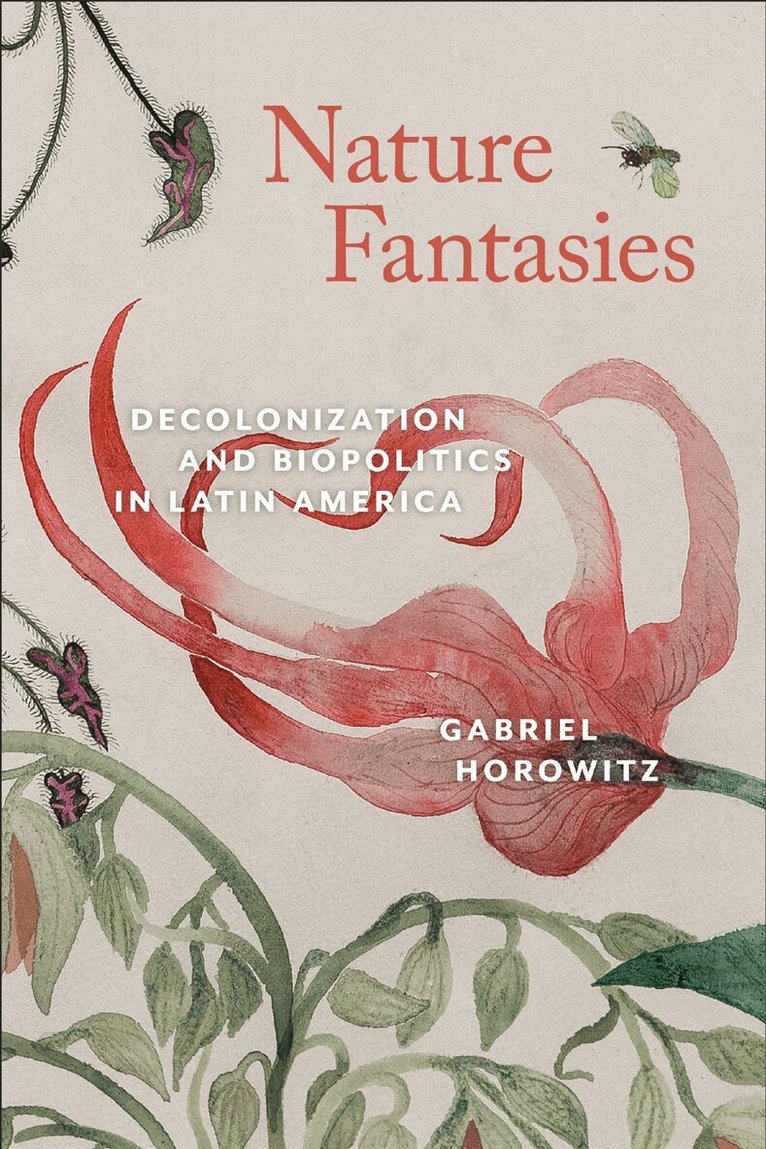
"In its candid engagement with the modern Latin American literary canon, Nature Fantasies: Decolonization and Biopolitics in Latin America provides a succinctly written assessment of some of the limitations inherent to current paradigms of thought such as decolonial thinking and the environmental humanities. It makes a valuable contribution to contemporary debates on Latin America's past and present."— Gareth Williams, author of Infrapolitical Passages: Global Turmoil, Narco-Accumulation, and the Post-Sovereign State"A formidable and provocative examination of the role of nature thinking (and nature writing) in the historical transition from cultural decolonization to the modern biopolitical state in Latin America. A must-read for anyone interested in the ways nature and politics intersect."— Alejandro Quin, coeditor of Authoritarianism, Cultural History, and Political Resistance in Latin America: Exposing"Horowitz challenges conventional approaches, particularly in recent environmental criticism, that see a return to nature as an emancipatory act (from the colonial period to today), when quite to the contrary, it might be a reifying act that further leads to a biopolitical state. Those committed to a rigorous Latin American ecocriticism will need and want to engage with this cross examination."— Christopher Travis, author of Resisting Alienation: The Literary Work of Enrique Lihn"Gabriel Horowitz's Nature Fantasies is a ground-breaking book that explores the complex and contradictory construction of 'nature' in nineteenth and twentieth century Spanish American cultural production. Horowitz demonstrates how 'nature' as it is determined within this history is a figure both of what must be walled off—disciplined or controlled—and of what must be incorporated into the hegemonic sensibility. One of the important implications of Horowitz's discussion of nature as both the outside and the inside of criollista cultural ideology is that the biopolitical developments of the twentieth century and beyond turn out to have their roots in colonial and post-colonial histories."— Patrick Dove, author of Literature and "Interregnum": Globalization, War, and the Crisis of Sovereignty in Latin A"A study on the discursive history of nature in Latin America, Nature Fantasies is a far-reaching and well-documented intervention that offers fresh new readings of such classics as Gómez de Avellaneda, Martí, and Heredia. The author argues for the nineteenth-century signifier 'nature' in Spanish America as one housing criollo fantasies that aimed at superseding and erasing both indigenous histories of the region and the continent's own non-human history. A readable theoretical intervention on our own historical uses of the word-concept 'nature,' this book is also a study that challenges, in productive ways, the very tenets of ecocriticism and what we do as ecocritics."— Felipe Martínez Pinzón, coeditor of Intimate Frontiers: A Literary Geography of the Amazon"Horowitz challenges conventional approaches, particularly in recent environmental criticism, that see a return to nature as an emancipatory act (from the colonial period to today), when quite to the contrary, it might be a reifying act that further leads to a biopolitical state. Those committed to a rigorous Latin American ecocriticism will need and want to engage with this cross examination."— Christopher Travis, author of Resisting Alienation: The Literary Work of Enrique Lihn"A formidable and provocative examination of the role of nature thinking (and nature writing) in the historical transition from cultural decolonization to the modern biopolitical state in Latin America. A must-read for anyone interested in the ways nature and politics intersect."— Alejandro Quin, coeditor of Authoritarianism, Cultural History, and Political Resistance in Latin America: Exposing" . . . very sharp, provocative and sophisticated [approach] to nature and literature that open[s] the way to future ecocritical and environmental humanities studies . . . "— Ímpetu"In its candid engagement with the modern Latin American literary canon, Nature Fantasies: Decolonization and Biopolitics in Latin America provides a succinctly written assessment of some of the limitations inherent to current paradigms of thought such as decolonial thinking and the environmental humanities. It makes a valuable contribution to contemporary debates on Latin America's past and present."— Gareth Williams, author of Infrapolitical Passages: Global Turmoil, Narco-Accumulation, and the Post-Sovereign State"Gabriel Horowitz's Nature Fantasies is a ground-breaking book that explores the complex and contradictory construction of 'nature' in nineteenth and twentieth century Spanish American cultural production. Horowitz demonstrates how 'nature' as it is determined within this history is a figure both of what must be walled off—disciplined or controlled—and of what must be incorporated into the hegemonic sensibility. One of the important implications of Horowitz's discussion of nature as both the outside and the inside of criollista cultural ideology is that the biopolitical developments of the twentieth century and beyond turn out to have their roots in colonial and post-colonial histories."— Patrick Dove, author of Literature and "Interregnum": Globalization, War, and the Crisis of Sovereignty in Latin A"A study on the discursive history of nature in Latin America, Nature Fantasies is a far-reaching and well-documented intervention that offers fresh new readings of such classics as Gómez de Avellaneda, Martí, and Heredia. The author argues for the nineteenth-century signifier 'nature' in Spanish America as one housing criollo fantasies that aimed at superseding and erasing both indigenous histories of the region and the continent's own non-human history. A readable theoretical intervention on our own historical uses of the word-concept 'nature,' this book is also a study that challenges, in productive ways, the very tenets of ecocriticism and what we do as ecocritics."— Felipe Martínez Pinzón, coeditor of Intimate Frontiers: A Literary Geography of the Amazon