• Fri frakt över 249 kr
  • •
  • Snabba leveranser
  • •
  • Billiga böcker
Kundservice

Du är på sajten för privatpersoner.

Företag, bibliotek eller offentlig verksamhet?

Du handlar på classic.bokus.com, där alla dina funktioner finns intakta.
Till classic.bokus.com
Bokus logotyp. Gå till startsidan.
  • Erbjudanden
  • Nyheter
  • Student
  • Topplistor
  • Barn & ungdom
  • Bokus Play
  • E-böcker
  • Pocketböcker
  • Spel & pussel

10% studentrabatt med kod TERM26

Sidfot

Mina sidor

    Hjälp

    • Kundservice
    • Vanliga frågor och svar
    • Frakt och leverans
    • Retur vid ångerrätt
    • Reklamera vara
    • Betalning
    • Köpvillkor
    • Allmänna villkor
    • Information om webbplatsens tillgänglighet

    Om Bokus

    • Om oss
    • Pressrum
    • För studenter
    • För företag
    • För bibliotek och offentlig verksamhet
    • För leverantörer
    • Hållbarhet

    Populärt

    • Aktuella erbjudanden
    • Presentkort
    • Studentlitteratur
    • Nya böcker
    • Topplistor
    • Signerade böcker
    • Engelska böcker

    Inspiration

    • Boktips
    • BookTok
    • Populära bokserier
    • Barnbokskaraktärer
    • Populära författare
    Logotyp för Bokus
    Följ oss på Facebook (extern länk)Följ oss på Instagram (extern länk)Följ oss på YouTube (extern länk)Följ oss på TikTok (extern länk)
    bokus @ CookiesAnpassa cookiesIntegritetspolicyKöpvillkor
    Till Citymail hemsida (extern länk)Till Budbee hemsida (extern länk)Till Postnord hemsida (extern länk)Till Schenker hemsida (extern länk)Till Early Bird hemsida (extern länk)Till Walleys hemsida (extern länk)
    1. Skönlitteratur
    2. Litteraturvetenskap
    3. Litteraturvetenskap

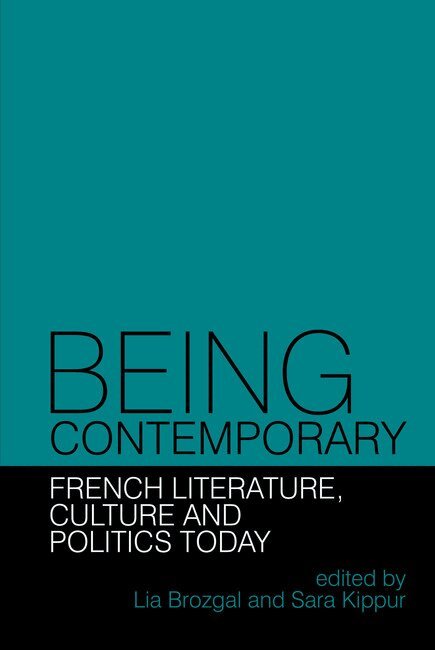
    Being Contemporary: French Literature, Culture and Politics Today

    AvLia Brozgal,Sara Kippur

    Inbunden, Engelska, 2016

    Del 39 i serien Contemporary French and Francophone Cultures

    2 323 kr

    Beställningsvara. Skickas inom 5-8 vardagar. Fri frakt över 249 kr.

    Beskrivning

    Being Contemporary is a volume of original essays by 23 preeminent scholars of French and Comparative literature, hailing from both sides of the Atlantic, in response to the editors’ invitation to “think through the contemporary.” The volume offers a sustained critical reflection on the contemporary as a concept, a category, a condition, and a set of relationships to others and to one’s own time. Being Contemporary emerges from a sense of a critical urgency to probe the notion of “the contemporary,” and the place of the contemporary critic, in French literary and cultural studies today. Its point of departure is Susan Suleiman’s book Risking Who One Is (Harvard, 1994), which proposed two decades ago that “being contemporary” offers a heuristic category for assessing the role of the scholar and critic, for studying the current moment in literature, art, and culture, and for engaging with historical and philosophical questions in a way that resonates with readers in the present day. Returning to these ideas with renewed vigor, the thought-provoking essays that comprise this volume center on 20th- and 21st-century French literature, politics, memory, and history, and problematize the contemporary as a critical position with respect to the current moment.


    Produktinformation

    • Utgivningsdatum:2016-01-26
    • Mått:163 x 239 x undefined mm
    • Format:Inbunden
    • Språk:Engelska
    • Serie:Contemporary French and Francophone Cultures
    • Antal sidor:288
    • Förlag:Liverpool University Press
    • ISBN:9781781382639

    Utforska kategorier

    • Litteraturvetenskap inom Skönlitteratur

    Mer om författaren

    Lia Brozgal is Associate Professor of French and Francophone Studies in the Department of European Languages and Transcultural Studies (ELTS) at the University of California, Los Angeles (UCLA). Sara Kippur is Assistant Professor of French at Trinity College, Connecticut.

    Recensioner i media

    'As a book exploring how Susan Rubin Suleiman’s thought continues to orient and inspire research in a number of disciplines, Being Contemporary is nothing short of excellent.'Lucas Hollister, French Review

    Innehållsförteckning

    • Introduction: Being Contemporary, Then and NowLia Brozgal and Sara Kippur I. Conceptualizing the Contemporary1. Henry Rousso, “Coping with Contemporariness” 2. Emily Apter, “Rethinking Periodization for the Now Time” 3. Carrie Noland, “(After) Conceptualism: Contemporaneity and Choreography” II. Contemporary Politics and French Thought4. Régine Robin, “Identities in Flux” 5. Lawrence D. Kritzman, “The Paradoxes of Being Contemporary: Derrida and the Political” 6. Jeffrey Mehlman, “Of Sade, Blanchot, and the French Twentieth Century: Thoughts at Columbia” 7. Maurice Samuels, “Alain Badiou and Antisemitism” III. World War II and Vichy: Present Perspectives8. Richard J. Golsan, “What Does ‘Vichy’ Mean Now?”9. Gisèle Sapiro, “Forces of Solidarity and Logics of Exclusion: The Role of Literary Institutions in Times of Crisis”10. Jakob Lothe, “Narrative, Testimony, Fiction: The Challenge of Not Forgetting the Holocaust”11. Sidra DeKoven Ezrahi, “‘Moral Witnessing?’” An Israeli Perspective on Jonathan Littell’s Les Bienveillantes”12. Irene Kacandes, “From ‘Never Forgetting’ to ‘Post-Remembering’ and ‘Co-Witnessing’: Memory Work for the Twenty-First Century”IV. Writing the Contemporary Self 13. Annette Wieviorka, “‘I’ in the Plural: A New Writing of History” 14. Tom Conley, “Selves at Risk: Reading Susan Suleiman with Marc Augé, La Vie en double”15. Alice Jardine, “Risking Who One Is, At The Risk of Thinking: On Writing an Intellectual Biography of Julia Kristeva”16. Michael Sheringham, “‘La Connaissance par corps’: Writing and Self-Exposure in Annie Ernaux”V. Novel Rereadings17. Mieke Bal, “Long Live Anachronism” 18. Janet Beizer, “Colette’s Côtelettes, or the Word Made Flesh”19. Christie McDonald, “Choices: Beckett’s Way”20. Alice Kaplan, “Making L'Etranger Contemporary: Kamel Daoud’s Meursault, contre-enquête”VI. Memory: Past and Future21. Emmanuel Bouju, “A Nest in the Air: Phantom Pain and Contemporary Narrative” 22. Deborah Jenson, “Adrien and Marcel Proust: The Memory Patient” 23. Marianne Hirsch, “Vulnerable Times”