• Fri frakt över 249 kr
  • •
  • Snabba leveranser
  • •
  • Billiga böcker
Kundservice

Du är på sajten för privatpersoner.

Företag, bibliotek eller offentlig verksamhet?

Du handlar på classic.bokus.com, där alla dina funktioner finns intakta.
Till classic.bokus.com
Bokus logotyp. Gå till startsidan.
  • Erbjudanden
  • Nyheter
  • Student
  • Topplistor
  • Barn & ungdom
  • Bokus Play
  • E-böcker
  • Pocketböcker
  • Spel & pussel

10% rabatt på allt med kod NYSTART10 →

Sidfot

Mina sidor

    Hjälp

    • Kundservice
    • Vanliga frågor och svar
    • Frakt och leverans
    • Retur vid ångerrätt
    • Reklamera vara
    • Betalning
    • Köpvillkor
    • Allmänna villkor
    • Information om webbplatsens tillgänglighet

    Om Bokus

    • Om oss
    • Pressrum
    • För studenter
    • För företag
    • För bibliotek och offentlig verksamhet
    • För leverantörer
    • Hållbarhet

    Populärt

    • Aktuella erbjudanden
    • Presentkort
    • Studentlitteratur
    • Nya böcker
    • Topplistor
    • Signerade böcker
    • Engelska böcker

    Inspiration

    • Boktips
    • BookTok
    • Populära bokserier
    • Barnbokskaraktärer
    • Populära författare
    Logotyp för Bokus
    Följ oss på Facebook (extern länk)Följ oss på Instagram (extern länk)Följ oss på YouTube (extern länk)Följ oss på TikTok (extern länk)
    bokus @ CookiesAnpassa cookiesIntegritetspolicyKöpvillkor
    Till Citymail hemsida (extern länk)Till Budbee hemsida (extern länk)Till Postnord hemsida (extern länk)Till Schenker hemsida (extern länk)Till Early Bird hemsida (extern länk)Till Walleys hemsida (extern länk)
    1. Data och IT
    2. Systemvetenskap och AI

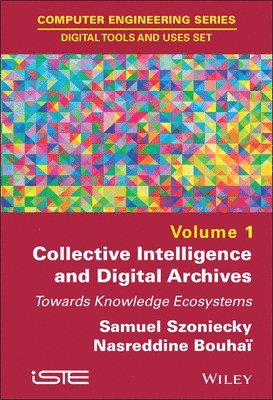
    Collective Intelligence and Digital Archives

    Towards Knowledge Ecosystems

    AvSamuel Szoniecky,Samuel Szoniecky

    Inbunden, Engelska, 2017

    1 801 kr

    Beställningsvara. Skickas inom 5-8 vardagar. Fri frakt över 249 kr.

    Beskrivning

    Collective Intelligence and Digital Archives DIGITAL TOOLS AND USES SET Coordinated by Imad Saleh This book presents the most up-to-date research from different areas of digital archives to show how and why collective intelligence is being developed to organize and better communicate new masses of information. Current archive digitization projects produce an enormous amount of digital data (Big Data). Thanks to the proactive approach of large public institutions, this data is increasingly accessible. Despite the recent stabilization of technical and legal frameworks, the use of data has yet to be enriched by processes such as collective intelligence. By exploring the field of digital humanities, audiovisual archives, preservation of cultural heritage, crowdsourcing and the recovery of scientific archives, this book presents and analyzes concrete examples of collective intelligence for use in digital archives.

    Produktinformation

    • Utgivningsdatum:2017-01-17
    • Mått:155 x 234 x 20 mm
    • Vikt:522 g
    • Format:Inbunden
    • Språk:Engelska
    • Antal sidor:260
    • Förlag:ISTE Ltd and John Wiley & Sons Inc
    • ISBN:9781786300607

    Utforska kategorier

    • Systemvetenskap och AI inom Data och IT
    • Sociologi och antropologi inom Samhälle och politik

    Mer om författaren

    Samuel Szoniecky is Associate Professor at the University of Paris 8, France in the Department of Digital Humanities. Nasreddine Bouhaï is Associate Professor at the University of Paris 8, France in the Department of Digital Humanities.

    Innehållsförteckning

    • Chapter 1 Ecosystems of Collective Intelligence in the Service of Digital Archives 1Samuel SZONIECKY1.1 Digital archives 11.2 Collective intelligence 31.3 Knowledge ecosystems 51.4 Examples of ecosystems of knowledge 71.4.1 Modeling digital archive interpretation 71.4.2 Editing archives via the semantic web 101.4.3 A semantic platform for analyzing audiovisual corpuses 121.4.4 Digital libraries and crowdsourcing: a state-of-the-art 141.4.5 Conservation and promotion of cultural heritage 161.4.6 Modeling knowledge for innovation 181.5 Solutions 201.6 Bibliography 21Chapter 2 Tools for Modeling Digital Archive Interpretation 23Muriel LOUÂPRE and Samuel SZONIECKY2.1 What archives are we speaking of? Definition, issues and collective intelligence methods 252.1.1 Database archives, evolution of a concept and its functions 252.1.2 The exploitation of digital archives in the humanities 272.1.3 The specific case of visualization tools 322.2 Digital archive visualization tools: lessons from the Biolographes experiment 342.2.1 Tools for testing 372.2.2 Tools for visualizing networks: DBpedia, Palladio 382.2.3 Multi-purpose tools (Keshif, Table) 402.3 Prototype for influence network modeling 442.3.1 Categorization of relationships 452.3.2 Assisted influence network entry 472.4 Limits and perspectives 502.4.1 Epistemological conflicts 512.4.2 The digital “black box”? 552.4.3 From individual expertise to group intelligence 562.5 Conclusion 572.6 Bibliography 58Chapter 3 From the Digital Archive to the Resource Enriched Via Semantic Web: Process of Editing a Cultural Heritage 61Lénaïk LEYOUDEC3.1 Influencing the intelligibility of a heritage document 613.2 Mobilizing differential semantics 623.3 Applying an interpretive process to the archive 633.4 Assessment of the semiotic study 673.5 Popularizing the data web in the editorialization approach 703.6 Archive editorialization in the Famille™ architext 733.7 Assessment of the archive’s recontextualization 793.8 Bibliography 81Chapter 4 Studio Campus AAR: A Semantic Platform for Analyzing and Publishing Audiovisual Corpuses 85Abdelkrim BELOUED, Peter STOCKINGER and Steffen LALANDE4.1 Introduction 854.2 Context and issues 864.2.1 Archiving and appropriation of audiovisual data 894.2.2 General presentation of the Campus AAR environment 944.3 Editing knowledge graphs – the Studio Campus AAR example 964.3.1 Context 974.3.2 Representations of OWL2 restrictions 994.3.3 Resolution of OWL2 restrictions 1014.3.4 Relaxing constraints 1024.3.5 Classification of individuals 1044.3.6 Opening and interoperability with the web of data 1064.3.7 Graphical interfaces 1074.4 Application to media analysis 1084.4.1 Model of audiovisual description 1094.4.2 Reference works and description models 1104.4.3 Description pattern 1114.4.4 The management of contexts 1124.4.5 Suggestion of properties 1134.4.6 Suggestion of property values 1144.4.7 Opening on the web of data 1154.5 Application to the management of individuals 1164.5.1 Multi-ontology description 1164.5.2 Faceted browsing 1174.5.3 An individual’s range 1174.6 Application to information searches 1184.6.1 Semantic searches 1184.6.2 Transformation of SPARQL query graphs 1204.6.3 Transformation of OWL2 axioms into SPARQL 1204.6.4 Interface 1214.7 Application to corpus management 1224.8 Application to author publication 1234.8.1 Publication ontologies 1254.8.2 Transformation engine 1284.8.3 Final product 1294.8.4 Opening on the web of data 1294.8.5 Graphical Interface 1304.9 Conclusion 1314.10 Bibliography 132Chapter 5 Digital Libraries and Crowdsourcing: A Review 135Mathieu ANDRO and Imad SALEH5.1 The concept of crowdsourcing in libraries 1365.1.1 Definition of crowdsourcing 1365.1.2 Historic origins of crowdsourcing 1375.1.3 Conceptual origins of crowdsourcing 1405.1.4 Critiques of crowdsourcing. Towards the uberization of libraries? 1405.2 Taxonomy and panorama of crowdsourcing in libraries 1415.2.1 Explicit crowdsourcing 1435.2.2 Gamification and implicit crowdsourcing 1455.2.3 Crowdfunding 1485.3 Analyses of crowdsourcing in libraries from an information and communication perspective 1505.3.1 Why do libraries have recourse to crowdsourcing and what are the necessary conditions? 1505.3.2 Why do Internet users contribute? Taxonomy of Internet users’ motivations 1535.3.3 From symbolic recompense to concrete remuneration 1545.3.4 Communication for recruiting contributors 1555.3.5 Community management for keeping contributors 1555.3.6 The quality and reintegration of produced data 1565.3.7 The evaluation of crowdsourcing projects 1575.4 Conclusions on collective intelligence and the wisdom of crowds 1585.5 Bibliography 159Chapter 6 Conservation and Promotion of Cultural Heritage in the Context of the Semantic Web 163Ashraf AMAD and Nasreddine BOUHAÏ6.1 Introduction 1636.2 The knowledge resources and models relative to cultural heritage 1646.2.1 Metadata norms 1646.2.2 Controlled vocabularies 1716.2.3 Lexical databases 1726.2.4 Ontologies 1726.3 Difficulties and possible solutions 1746.3.1 Data acquisition 1756.3.2 Information modeling 1856.3.3 Use 1956.3.4 Interoperability 1976.4 Conclusion 2016.5 Bibliography 202Chapter 7 On Knowledge Organization and Management for Innovation: Modeling with the Strategic Observation Approach in Material Science 207Sahbi SIDHOM and Philippe LAMBERT7.1 General introduction 2077.2 Research context: KM and innovation process 2107.2.1 Jean Lamour Institute 2107.2.2 Technology and Knowledge Transfer Office (or CC-VIT) 2117.3 Methodological approach 2127.3.1 Observation and accumulation of knowledge for innovation 2127.3.2 Strategic observation and extraction of knowledge: towards an ontological approach 2157.3.3 Creation of a class hierarchy (of knowledge) 2247.4 Conceptual modeling for innovation: technological transfer 2257.4.1 Implementations 2267.4.2 Corpus specificities 2277.4.3 NLP engineering applied to the corpus 2287.4.4 “Polyfunctionalities” favoring strategic observation 2327.5 Conclusion: principal results and recommendations 2337.6 Bibliography 235List of Authors 239Index 241