• Fri frakt över 249 kr
  • •
  • Snabba leveranser
  • •
  • Billiga böcker
Kundservice

Du är på sajten för privatpersoner.

Företag, bibliotek eller offentlig verksamhet?

Du handlar på classic.bokus.com, där alla dina funktioner finns intakta.
Till classic.bokus.com
Bokus logotyp. Gå till startsidan.
  • Erbjudanden
  • Nyheter
  • Student
  • Topplistor
  • Barn & ungdom
  • Bokus Play
  • E-böcker
  • Pocketböcker
  • Spel & pussel

10% rabatt på allt med kod: NYSTART10 →

Sidfot

Mina sidor

    Hjälp

    • Kundservice
    • Vanliga frågor och svar
    • Frakt och leverans
    • Retur vid ångerrätt
    • Reklamera vara
    • Betalning
    • Köpvillkor
    • Allmänna villkor
    • Information om webbplatsens tillgänglighet

    Om Bokus

    • Om oss
    • Pressrum
    • För studenter
    • För företag
    • För bibliotek och offentlig verksamhet
    • För leverantörer
    • Hållbarhet

    Populärt

    • Aktuella erbjudanden
    • Presentkort
    • Studentlitteratur
    • Nya böcker
    • Topplistor
    • Signerade böcker
    • Engelska böcker

    Inspiration

    • Boktips
    • BookTok
    • Populära bokserier
    • Barnbokskaraktärer
    • Populära författare
    Logotyp för Bokus
    Följ oss på Facebook (extern länk)Följ oss på Instagram (extern länk)Följ oss på YouTube (extern länk)Följ oss på TikTok (extern länk)
    bokus @ CookiesAnpassa cookiesIntegritetspolicyKöpvillkor
    Till Citymail hemsida (extern länk)Till Budbee hemsida (extern länk)Till Postnord hemsida (extern länk)Till Schenker hemsida (extern länk)Till Early Bird hemsida (extern länk)Till Walleys hemsida (extern länk)
    1. Ekonomi och Ledarskap
    2. Företagsekonomi

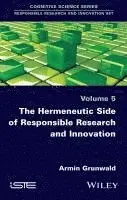
    Hermeneutic Side of Responsible Research and Innovation

    AvArmin Grunwald

    Inbunden, Engelska, 2016

    1 859 kr

    Beställningsvara. Skickas inom 5-8 vardagar. Fri frakt över 249 kr.

    Fler format och utgåvor

    E-bok

    2 258 kr

    E-bok

    2 258 kr

    Beskrivning

    The book investigates the meaning of RRI if little or no valid knowledge about consequences of innovation and technology is available. It proposes a hermeneutical turn to investigate narratives about possible futures with respect to their contemporary meaning instead of regarding them as anticipations of the future.

    Produktinformation

    • Utgivningsdatum:2016-12-05
    • Mått:155 x 236 x 23 mm
    • Vikt:499 g
    • Format:Inbunden
    • Språk:Engelska
    • Antal sidor:240
    • Förlag:ISTE Ltd and John Wiley & Sons Inc
    • ISBN:9781786300850

    Utforska kategorier

    • Företagsekonomi inom Ekonomi och Ledarskap

    Mer om författaren

    Armin Grunwald, Professor of philosophy and ethics of technology at Karlsruhe Institute of Technology (KIT); Head of the Institute of Technology Assessment and Systems Analysis (ITAS) at KIT; Head of the Office of Technology Assessment at the German Parliament (TAB).

    Innehållsförteckning

    • Foreword  ixPreface xiiiChapter 1. What Makes New Science and Technology Meaningful to Society? 11.1. Motivation and objectives  11.2. The need for orientation in NEST fields  81.3. Short propaedeutic 121.3.1. The meaning of “sociotechnical meaning”  121.3.2. NEST: new and emerging science and technologies  131.3.3. Techno-visionary futures  151.4. A brief guide to this book  171.4.1. The flow of argumentation 171.4.2. The chapters  181.4.3. The achievements 22Chapter 2. Extending the Object of Responsibility Assessments in RRI 252.1. Motivation and overview 252.2. Some impressions of RRI debates so far  272.3. A pragmatic view on the notion of responsibility  312.3.1. The concept of responsibility  322.3.2. The EEE approach to responsibility  342.3.3. Responsibility assessment  352.4. The object of responsibility debates in RRI so far  382.5. The object of responsibility debates in RRI: an extension 392.6. Concluding remarks  43Chapter 3. Assessing Responsibility by Considering Techno-Futures  453.1. Responsibility assessments: introduction and overview 453.2. Brief remarks on the epistemology of prospective knowledge 463.2.1. The epistemologically precarious character of prospective knowledge  473.2.2. Futures as social constructs 483.3. Responsibility for NEST: the orientation dilemma  503.3.1. Challenges to providing orientation in NEST fields  523.3.2. The orientation dilemma 553.4. Three modes of orientation  563.4.1. Prediction and prognostication: mode 1 orientation  573.4.2. Scenarios and the value of diversity: mode 2 orientation  583.4.3. The value of divergence: mode 3 orientation 603.5. The hermeneutic approach to techno-visionary futures 61Chapter 4. Definitions and Characterizations of NEST as Construction of Meaning  654.1. Motivation and point of departure 654.2. Some observations from NEST debates  664.2.1. Nanotechnology  664.2.2. Synthetic biology 684.2.3. Enhancement 714.3. The pragmatic character of definitions 724.4. Defining and characterizing as meaning-giving activity  75Chapter 5. Understanding Nanotechnology: A Process Involving Contested Assignments of Meaning  795.1. Nanotechnology: a paradigmatic RRI story  795.2. The early time of nanotechnology: troubled beginnings  825.2.1. Apocalyptic techno-visionary futures related to nano 825.2.2. Threats to human health and the environment  845.2.3. Philosophical characterizations 865.3. Defining nanotechnology: a mission impossible?  895.4. The meaning of nanotechnology: the shift from a revolutionary to a quite normal technology  945.4.1. Looking back: the development of nanotechnology’s meaning 945.4.2. Hermeneutic work on nanotechnology  965.4.3. Lessons learned for RRI debates  99Chapter 6. Robots: Challenge to the Self-Understanding of Humans 1016.1. Autonomous technology: challenges to our comprehension 1016.2. Robots that can make plans and Man’s self-image  1036.2.1. Planning robots  1036.2.2. Planning as special type of acting 1056.2.3. Step 1: Can robots act?  1076.2.4. Step 2: What do robots do when they plan? 1096.2.5. The difference between planning humans and planning robots 1136.3. Technology futures in robotics 1156.4. The hermeneutic view of robots 119Chapter 7. Enhancement as a Cipher of the Future 1237.1. Introduction and overview  1237.2. On the semantics of (technical) enhancement 1257.2.1. Enhancement as action  1257.2.2. Technical enhancement 1277.3. Human enhancement 1287.3.1. Enhancement in history: some ambivalences  1287.3.2. Human enhancement: some illustrations 1307.3.3. Healing, doping and enhancement 1327.3.4. Human enhancement: from visions to the marketplace  1367.4. Animal enhancement 1387.5. Conclusions 1427.5.1. Conclusions I: dissolving borders between humans, animals and technology 1427.5.2. Conclusions II: better understanding contemporary time  1447.5.3. Conclusions III: technicalizing the self-image of humans  1487.5.4. Conclusions IV: RRI debates on enhancement 1497.6. Enhancement as a cipher of the future 151Chapter 8. Technology to Combat Climate Change: the Hermeneutic Dimension of Climate Engineering  1538.1. Climate change and the ambivalence of technology 1538.2. Limitations of the previous approaches to finding a solution  1568.3. Climate engineering as a technical option 1578.4. Chances and risks of climate engineering 1598.5. The hermeneutics of climate engineering 1628.5.1. Climate engineering: revival of Baconism? 1638.5.2. Expanding the object of responsibility  1668.6. Epilogue: hermeneutic extension of the imperative of responsibility? 168Chapter 9. Hermeneutic Assessment: Toward an Interdisciplinary Research Program 1699.1. Assigning meaning to NEST as object of responsibility  1699.2. Hermeneutic approaches 1729.3. The emergence of NEST meaning: hermeneutic assessment  1759.3.1. The dynamics of assigning meaning  1759.3.2. NEST meaning: understanding origin and process 1789.3.3. NEST meaning: understanding content  1809.3.4. NEST meaning: understanding diffusion and impact  1839.4. Reflection and epilogue  185Inspiration Behind the Chapters  189Bibliography  191Index 215