• Fri frakt över 249 kr
  • •
  • Snabba leveranser
  • •
  • Billiga böcker
Kundservice

Du är på sajten för privatpersoner.

Företag, bibliotek eller offentlig verksamhet?

Du handlar på classic.bokus.com, där alla dina funktioner finns intakta.
Till classic.bokus.com
Bokus logotyp. Gå till startsidan.
  • Erbjudanden
  • Nyheter
  • Student
  • Topplistor
  • Barn & ungdom
  • Bokus Play
  • E-böcker
  • Pocketböcker
  • Spel & pussel

10% rabatt på allt med kod NYSTART10 →

Sidfot

Mina sidor

    Hjälp

    • Kundservice
    • Vanliga frågor och svar
    • Frakt och leverans
    • Retur vid ångerrätt
    • Reklamera vara
    • Betalning
    • Köpvillkor
    • Allmänna villkor
    • Information om webbplatsens tillgänglighet

    Om Bokus

    • Om oss
    • Pressrum
    • För studenter
    • För företag
    • För bibliotek och offentlig verksamhet
    • För leverantörer
    • Hållbarhet

    Populärt

    • Aktuella erbjudanden
    • Presentkort
    • Studentlitteratur
    • Nya böcker
    • Topplistor
    • Signerade böcker
    • Engelska böcker

    Inspiration

    • Boktips
    • BookTok
    • Populära bokserier
    • Barnbokskaraktärer
    • Populära författare
    Logotyp för Bokus
    Följ oss på Facebook (extern länk)Följ oss på Instagram (extern länk)Följ oss på YouTube (extern länk)Följ oss på TikTok (extern länk)
    bokus @ CookiesAnpassa cookiesIntegritetspolicyKöpvillkor
    Till Citymail hemsida (extern länk)Till Budbee hemsida (extern länk)Till Postnord hemsida (extern länk)Till Schenker hemsida (extern länk)Till Early Bird hemsida (extern länk)Till Walleys hemsida (extern länk)
    1. Ekonomi och Ledarskap
    2. Företagsekonomi

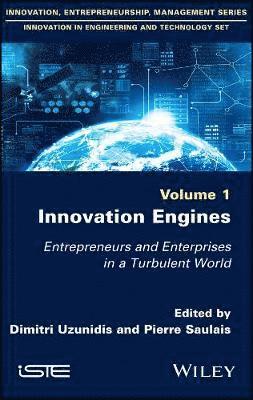
    Innovation Engines

    Entrepreneurs and Enterprises in a Turbulent World

    AvDimitri Uzunidis,Pierre Saulais

    Inbunden, Engelska, 2017

    1 855 kr

    Beställningsvara. Skickas inom 5-8 vardagar. Fri frakt över 249 kr.

    Beskrivning

    In an uncertain economy where business risk is significant, the company tends to rely more on its environment than to invest, for example, in all steps of technological creation; This can be explained by the fact that investments in the acquisition (ownership) of production resources are less expensive than those implied in the formation of these resources; which also explains the attractiveness (in an open economy) of regions with abundant scientific and technical resources. To understand and analyze the innovation process in order to better design and launch new goods, services and technologies, one has to consider the creative dimension of the individual, the business and the organization in general. In new approaches to innovation, the entrepreneur and the company are analyzed through their skills, and their function of resource generation; Innovation thus becomes endogenous, gradual or radical, integrated in a complex process with many feedbacks and interactions. The innovative organization (small or large) is presented in this book as a dynamic system composed of specific and diverse skills (including those of the contractor, engineers or managers). By acquiring, combining and mobilizing these skills, the innovative agent (entrepreneur or company) can create technological resources and develop relations with its environment. Hence the importance of management in design, implementation, protection of intellectual property as well as of the development of new goods, services and technology, commercial and organizational models.

    Produktinformation

    • Utgivningsdatum:2017-05-23
    • Mått:163 x 239 x 18 mm
    • Vikt:476 g
    • Format:Inbunden
    • Språk:Engelska
    • Antal sidor:224
    • Förlag:ISTE Ltd and John Wiley & Sons Inc
    • ISBN:9781786301642

    Utforska kategorier

    • Företagsekonomi inom Ekonomi och Ledarskap

    Mer om författaren

    Dimitri Uzunidis, University of Lille, France, is Professor in Political Economy. He is currently President of the Research Network on Innovation in Paris, France.Pierre Saulais, Consultant, France, is a civil engineer in Aeronautics and Space and is the holder of a doctorate in Knowledge Management. His research interests focus on knowledge-based innovation (KBI), as well as on the generation and extraction of inventive knowledge.

    Innehållsförteckning

    • Introduction xiDimitri UZUNIDIS and Pierre SAULAISChapter 1 Innovation Strategies and Entrepreneurial Dynamics 1Michel MARCHESNAY1.1 The entrepreneur: the key player in innovation 21.1.1 By their very nature, every entrepreneur takes a risk dependent on innovation 21.1.2 Innovation restores a range of logical structures and practices in entrepreneurial action 31.2 Industrial analysis of innovation 31.2.1 The analytical approach: the SCP model 41.2.2 The institutional approach: mesosystems 41.3 The three eras of industrial capitalism 51.3.1 The origins of industrial capitalism 51.3.2 The development of industrial capitalism: the concept of generations 61.4 Extensive and intensive stages 71.4.1 The extensive stage 71.4.2 The intensive stage 81.5 Innovation: between order and progress 81.5.1 The role of ideologies 91.5.2 The role of the “zeitgeist”, the spirit of the age 101.6 Innovation and the “technical age”: a Pandora’s box? 111.6.1 The innovative entrepreneur: is there an ideal type? 121.6.2 Types of innovative entrepreneur 131.6.3 The capabilities of the innovative entrepreneur 151.7 The major strategic choices 151.7.1 Breakthrough innovation or adaptive development? 151.7.2 Dependence or individuality? (“One of a kind”) 161.8 The spread of innovation 181.8.1 The transfer: the basis of national technological policy 181.8.2 The subsidiary: an instrument of the industrial strategy of groups 191.8.3 The region: a hub of technological development 201.9 Conclusion 211.10 Bibliography 22Chapter 2 Innovative Milieus and Innovative Entrepreneurship 25Corinne TANGUY and Dimitri UZUNIDIS2.1 The innovative milieu and proximities 272.1.1 The concept of the innovative milieu 272.1.2 Proximity: from space to organization 292.2 The innovative milieu and entrepreneurs 322.2.1 The innovative entrepreneur: networks and resources 332.2.2 Policies for creating innovative milieus and the emergence of an innovative entrepreneurship 352.3 Conclusion 372.4 Bibliography 38Chapter 3 Start-up Founders and Support for Technology Entrepreneurs 43Gérard A. KOKOU DOKOU3.1 Putting entrepreneurial identity into theoretical perspective 453.1.1 The needs for existence, knowledge and ability at the heart of entrepreneurial identity 453.1.2 Expanding towards a resource-based approach 473.2 Demonstration of the components of the identity of a start-up entrepreneur 513.2.1 Creating the body of research and operational tool used 513.2.2 Revealing the main identity components 533.2.3 Three main identity components to be considered when supporting the technology entrepreneur 573.3 Conclusion 623.4 Bibliography 63Chapter 4 The Importance of Entrepreneurial Creativity 73Marc JAILLOT4.1 Creativity, innovation and entrepreneurial context 744.1.1 Entrepreneurial creativity 744.1.2 The entrepreneurial context of small businesses 754.1.3 The reality of innovation in small businesses 784.2 What does the economic reality teach us? 804.3 Discussion 834.4 Conclusion 864.5 Bibliography 87Chapter 5 From Ideation to Product Launch 91Maggy PERRIER and Audrey DEPEIGE5.1 The quest for continuous renewal: collaborative innovation within business strategy 925.2 An internal environment supporting innovation 985.3 Managing invention through innovation: building a strong intellectual property management process to maintain a competitive advantage 1015.4 Conclusion 1045.5 Bibliography 105Chapter 6 The Patent: A “Swiss Army Knife” for Invention and Innovation 111Yann de KERMADEC6.1 Invention, innovation and intellectual property: some references 1126.1.1 Definitions 1126.1.2 Links between innovation, inventions and patents 1136.2 The means tree: a language for innovation and good use of patents 1166.2.1 Is the “language of patents” accessible to all? 1166.2.2 The means tree: the “language of patents” translated into graphic patterns 1176.2.3 The means tree and its varied uses 1206.2.4 The means tree: a “turbocharger” for the “innovate thanks to patents” approach 1226.3 The patent system: a model for the management of knowledge for innovation 1246.4 Conclusion 1296.5 Bibliography 131Chapter 7 Invention, Innovation and Intellectual Property Rights 133Pierre SAULAIS7.1 Innovation 1347.1.1 The multidimensional aspect of innovation 1347.1.2 Innovation procedures and processes 1357.1.3 The intense knowledge stages of the innovation process 1397.2 Invention and the ability to invent 1417.2.1 The concept of inventiveness 1417.2.2 Combining creativity and inventiveness 1417.2.3 Overview of some standard methods 1427.3 The inventive intellectual corpus 1437.3.1 Intellectual works and intellectual corpus 1447.3.2 Intellectual works and intangible capital 1477.3.3 Traces in the inventive intellectual corpus 1497.3.4 Synthesis of the inventive intellectual corpus 1517.4 Analysis of the links between invention, innovation and the inventive intellectual heritage 1517.4.1 Links between industrial property rights and innovation 1517.4.2 Links between industrial property rights and invention 1527.4.3 Links between invention and industrial property rights 1547.4.4 Links between innovation and industrial property rights 1557.4.5 Links between invention and innovation 1557.4.6 Links between innovation and invention 1557.4.7 Reciprocal links between inventive activity and the inventive intellectual corpus 1557.5 The nature of bridges between knowledge areas 1577.5.1 The perspective of economists 1577.5.2 The knowledge management perspective on innovation 1587.5.3 The perspective of KBI (Knowledge-Based Innovation) 1587.5.4 The perspective of knowledge-based ideation 1597.6 Conclusion 1597.7 Bibliography 160Chapter 8 Commitment to an Industrial Evolution 165Theodor FELEZEU8.1 Findings, shared feelings and risks incurred 1668.2 Focus on the new industrial order 1728.2.1 Beyond industry 4.0 1738.2.2 Towards a rebirth, but without actually having to die first (or at least without suffering too much) 1798.2.3 Economic alternatives: look left and right before crossing 1848.3 Corollaries: impacts on innovation 1868.3.1 Cultures 1868.3.2 Visions and strategies 1878.3.3 Processes 1878.3.4 Tools 1878.4 Conclusion 1888.5 Bibliography 188List of Authors 193Index 195