• Fri frakt över 249 kr
  • •
  • Snabba leveranser
  • •
  • Billiga böcker
Kundservice

Du är på sajten för privatpersoner.

Företag, bibliotek eller offentlig verksamhet?

Du handlar på classic.bokus.com, där alla dina funktioner finns intakta.
Till classic.bokus.com
Bokus logotyp. Gå till startsidan.
  • Erbjudanden
  • Nyheter
  • Student
  • Topplistor
  • Barn & ungdom
  • Bokus Play
  • E-böcker
  • Pocketböcker
  • Spel & pussel

10% rabatt på allt med kod: NYSTART10 →

Sidfot

Mina sidor

    Hjälp

    • Kundservice
    • Vanliga frågor och svar
    • Frakt och leverans
    • Retur vid ångerrätt
    • Reklamera vara
    • Betalning
    • Köpvillkor
    • Allmänna villkor
    • Information om webbplatsens tillgänglighet

    Om Bokus

    • Om oss
    • Pressrum
    • För studenter
    • För företag
    • För bibliotek och offentlig verksamhet
    • För leverantörer
    • Hållbarhet

    Populärt

    • Aktuella erbjudanden
    • Presentkort
    • Studentlitteratur
    • Nya böcker
    • Topplistor
    • Signerade böcker
    • Engelska böcker

    Inspiration

    • Boktips
    • BookTok
    • Populära bokserier
    • Barnbokskaraktärer
    • Populära författare
    Logotyp för Bokus
    Följ oss på Facebook (extern länk)Följ oss på Instagram (extern länk)Följ oss på YouTube (extern länk)Följ oss på TikTok (extern länk)
    bokus @ CookiesAnpassa cookiesIntegritetspolicyKöpvillkor
    Till Citymail hemsida (extern länk)Till Budbee hemsida (extern länk)Till Postnord hemsida (extern länk)Till Schenker hemsida (extern länk)Till Early Bird hemsida (extern länk)Till Walleys hemsida (extern länk)
    1. Psykologi och pedagogik
    2. Pedagogik

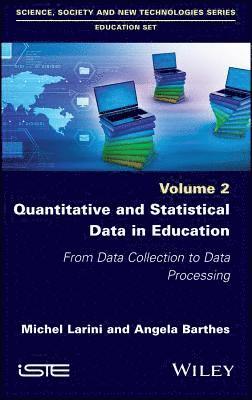
    Quantitative and Statistical Data in Education

    From Data Collection to Data Processing

    AvMichel Larini,Angela Barthes

    Inbunden, Engelska, 2018

    1 754 kr

    Beställningsvara. Skickas inom 5-8 vardagar. Fri frakt över 249 kr.

    Beskrivning

    This book presents different data collection and representation techniques: elementary descriptive statistics, confirmatory statistics, multivariate approaches and statistical modeling. It exposes the possibility of giving more robustness to the classical methodologies of education sciences by adding a quantitative approach. The fundamentals of each approach and the reasons behind them are methodically analyzed, and both simple and advanced examples are given to demonstrate how to use them. Subsequently, this book can be used both as a course for the uninitiated and as an accompaniment for researchers who are already familiar with these concepts.

    Produktinformation

    • Utgivningsdatum:2018-09-28
    • Mått:165 x 239 x 20 mm
    • Vikt:567 g
    • Format:Inbunden
    • Språk:Engelska
    • Antal sidor:304
    • Förlag:ISTE Ltd and John Wiley & Sons Inc
    • ISBN:9781786302281

    Utforska kategorier

    • Pedagogik inom Psykologi och pedagogik

    Mer om författaren

    Michel Larini is Professor Emeritus at Aix-Marseille University, France, and has a doctorate in Mathematical Sciences. Angela Barthes is Professor in Education Sciences at Aix-Marseille University, France. She has two doctorates, in Physical Sciences and Geography.

    Innehållsförteckning

    • Introduction ixChapter 1 Data Collection in Education 11.1 Use of existing databases in education 11.1.1 International databases 21.1.2 Compound databases 31.2 Survey questionnaire 41.2.1 Objective of a questionnaire 41.2.2 Constitution of the sample 41.2.3 Questions 71.2.4 Structure of a questionnaire 81.2.5 Writing 91.3 Experimental approaches 101.3.1 Inductive and deductive approaches 101.3.2 Experimentation by psychologists 111.3.3 Experimentation in education 11Chapter 2 Elementary Descriptive Statistics and Data Representation 152.1 Tables and graphic representations 152.1.1 Population, sample and individuals 152.1.2 Variables 162.1.3 Tables 182.1.4 Graphic representations 232.2 Mathematical indicators 292.2.1 General points 292.2.2 Some fundamentals of mathematical language 292.2.3 Monovariate mathematical indicators 322.2.4 Bivariate mathematical indicators 372.3 Spatial data representation methods 412.3.1 Maps to understand the geography of educational phenomena 412.3.2 Statistical data represented on a map 422.3.3 Range-based and point-based maps 432.3.4 Other maps 452.3.5 Geographic information systems 462.3.6 Specific map-analysis methods 46Chapter 3 Confirmatory Statistics 493.1 Law of random chance and law of large numbers: hypothesis tests 503.1.1 General points 503.1.2 Probability laws 513.1.3 Hypothesis tests 763.2 Tests on means: Student’s tests 813.2.1 General 813.2.2 Comparison of a mean and a norm 813.2.3 Comparison of two observed means 923.2.4 What we have learned 973.2.5 Implementation of tests: use of software 983.3 Analysis of variance 993.3.1 General points 993.3.2 ANOVA for K > 2 independent samples 1003.3.3 ANOVA for K > 2 matched samples: repeated measurement ANOVA 1103.4 Bivariate analysis: Bravais–Pearson correlation test 1113.4.1 General points 1113.4.2 Bravais–Pearson test 1123.4.3 Pitfalls in using linear tests 1143.4.4 Example of calculation 1153.5. Confirmatory tests for qualitative variables: χ2 and frequency comparison 1183.5.1 General points 1183.5.2 Presentation of a χ2 test: the “loaded die” 1193.5.3 Fitting χ2 test: general formulation 1243.5.4 χ2 tests of the independence of two variables 1263.5.5 Sample equality tests 1333.5.6 Intensity of the link between variables: Cramer’s V 139Chapter 4 Multivariate Analyses 1414.1 Principal component analysis 1424.1.1 Overview 1424.1.2 Bivariate approach 1424.1.3 PCA 3D 1544.1.4 4D examples 1624.1.5 Another example: study of “graduation from school” in nine European countries 1674.2 Factorial correspondence analyses 1734.2.1 Overview 1734.2.2 Factorial correspondence analysis 1734.2.3 Factorial multiple correspondence analysis 186Chapter 5 Statistical Modeling 1935.1 Simple bivariate linear modeling 1945.1.1 Problem statement 1945.1.2 Determining the regression line in the population 1955.1.3 Quality of representation: confidence and prediction interval 2015.1.4 Explanatory power of the model 2075.2 Multiple linear regressions for quantitative explanatory variables 2095.2.1 Overview 2095.2.2 Example: graduation from school 2115.2.3 Progressive development of a multivariate model 2155.3 Modeling with qualitative explanatory variables 2165.3.1 Quantitative explanatory variable and dichotomous qualitative variable 2165.3.2 Quantitative explanatory variable and polytomous qualitative variable 2195.4 Considering interactions between variables 2205.4.1 Overview 2205.4.2 Quantitative variable and dichotomous qualitative variable 2205.4.3 Other types of interactions 2215.5 Complex modeling 2235.5.1 Nonlinear modeling 2235.5.2 Multilevel approach 2265.5.3 Logistic regression 227Chapter 6 Toward the Robustness in Studies in Education by the Quantitative Approach 2296.1 Quantitative approach to social representations in education 2296.1.1 Methodological milestones of a quantitative approach to social representations 2306.1.2 Choice of study corpora, questionnaires and interviews 2326.1.3 Graphical representation methods 2336.1.4 Analytical model for explicitation of ideological loads 2376.1.5 Comparative analytical model 2416.1.6 Case study 2426.2 Example of a quantitative approach to relationships to knowledge 2486.2.1 From the theory of relationships to knowledge to the definition of variables 2486.2.2 From the definition of variables to quantitative tools 2526.2.3 Case study of heritage education 2546.2.4 Conduct a quantitative study of relationships to knowledge 256References 267Index 273