• Fri frakt över 249 kr
  • •
  • Snabba leveranser
  • •
  • Billiga böcker
Kundservice

Du är på sajten för privatpersoner.

Företag, bibliotek eller offentlig verksamhet?

Du handlar på classic.bokus.com, där alla dina funktioner finns intakta.
Till classic.bokus.com
Bokus logotyp. Gå till startsidan.
  • Erbjudanden
  • Nyheter
  • Student
  • Topplistor
  • Barn & ungdom
  • Bokus Play
  • E-böcker
  • Pocketböcker
  • Spel & pussel

10% rabatt på allt med kod NYSTART10 →

Sidfot

Mina sidor

    Hjälp

    • Kundservice
    • Vanliga frågor och svar
    • Frakt och leverans
    • Retur vid ångerrätt
    • Reklamera vara
    • Betalning
    • Köpvillkor
    • Allmänna villkor
    • Information om webbplatsens tillgänglighet

    Om Bokus

    • Om oss
    • Pressrum
    • För studenter
    • För företag
    • För bibliotek och offentlig verksamhet
    • För leverantörer
    • Hållbarhet

    Populärt

    • Aktuella erbjudanden
    • Presentkort
    • Studentlitteratur
    • Nya böcker
    • Topplistor
    • Signerade böcker
    • Engelska böcker

    Inspiration

    • Boktips
    • BookTok
    • Populära bokserier
    • Barnbokskaraktärer
    • Populära författare
    Logotyp för Bokus
    Följ oss på Facebook (extern länk)Följ oss på Instagram (extern länk)Följ oss på YouTube (extern länk)Följ oss på TikTok (extern länk)
    bokus @ CookiesAnpassa cookiesIntegritetspolicyKöpvillkor
    Till Citymail hemsida (extern länk)Till Budbee hemsida (extern länk)Till Postnord hemsida (extern länk)Till Schenker hemsida (extern länk)Till Early Bird hemsida (extern länk)Till Walleys hemsida (extern länk)
    1. Naturvetenskap och teknik
    2. Teknik och industri
    3. Elektronik och kommunikationer

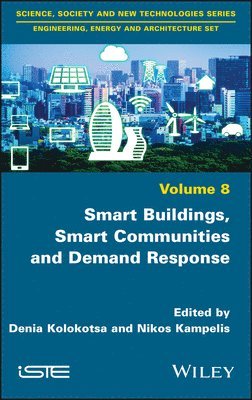
    Smart Buildings, Smart Communities and Demand Response

    AvDenia Kolokotsa,Nikos Kampelis

    Inbunden, Engelska, 2021

    1 919 kr

    Beställningsvara. Skickas inom 5-8 vardagar. Fri frakt över 249 kr.

    Beskrivning

    This book focuses on near-zero energy buildings (NZEBs), smart communities and microgrids. In this context, demand response (DR) is associated with significant environmental and economic benefits when looking at how electricity grids, communities and buildings can operate optimally. In DR, the consumer becomes a prosumer with an important active role in the exchange of energy on an hourly basis. DR is gradually gaining ground with respect to the reduction of peak loads, grid balancing and dealing with the volatility of renewable energy sources (RES). This transition calls for high environmental awareness and new tools or services that will improve the dynamic as well as secure multidirectional exchange of energy and data. Overall, DR is identified as an important field for technological and market innovations aligned with climate change mitigation policies and the transition to sustainable smart grids in the foreseeable future. Smart Buildings, Smart Communities and Demand Response provides an insight into various intrinsic aspects of DR potential, at the building and the community level.

    Produktinformation

    • Utgivningsdatum:2021-02-12
    • Mått:10 x 10 x 10 mm
    • Vikt:454 g
    • Format:Inbunden
    • Språk:Engelska
    • Antal sidor:208
    • Förlag:ISTE Ltd and John Wiley & Sons Inc
    • ISBN:9781786304261

    Utforska kategorier

    • Elektronik och kommunikationer inom Naturvetenskap och teknik

    Mer om författaren

    Denia Kolokotsa is Associate Professor at the School of Environmental Engineering of the Technical University of Crete in Greece, President of the European Cool Roofs Council, Editor of the Elsevier Energy and Buildings Journal and former Editor-in-Chief of the Advances in Building Energy Research Journal.Nikos Kampelis works as a Research Associate at the Energy Management in the Built Environment Research (EMBER) laboratory of the Technical University of Crete. He completed his PhD on demand response for the optimal integration of loads and renewable energy in microgrids.

    Innehållsförteckning

    • Preface ixNikos KAMPELISNomenclature xvNikos KAMPELISChapter 1. Demand Response in Smart Zero Energy Buildings and Grids 1Nikos KAMPELIS1.1. Introduction 11.2. Smart and zero energy buildings 21.3. DR and smart grids 91.3.1. DR and congestion management 181.3.2. DR and AS 191.3.3. DR programs 211.3.4. Building level DR 221.3.5. District level DR and microgrids 261.3.6. ANN-based short-term power forecasting 311.4. Scientific focus of the book 321.5. Book outline and objectives 34Chapter 2. DR in Smart and Near-zero Energy Buildings: The Leaf Community 37Nikos KAMPELIS, Konstantinos GOBAKIS, Vagias VAGIAS, Denia KOLOKOTSA, Laura STANDARDI, Daniela ISIDORI, Cristina CRISTALLI, Fabio Maria MONTAGNINO, Filippo PAREDES, Pietro MURATORE, Luca VENEZIA, Marina Kyprianou DRACOU, Alaric MONTENON, Andri PYRGOU, Theoni KARLESSI, Mattheos SANTAMOURIS2.1. The Leaf Lab industrial building, AEA Italy 392.2. The Leaf House residential building, AEA Italy 41Chapter 3. Performance of Industrial and Residential Near-zero Energy Buildings 43Nikos KAMPELIS, Konstantinos GOBAKIS, Vagias VAGIAS, Denia KOLOKOTSA, Laura STANDARDI, Daniela ISIDORI, Cristina CRISTALLI, Fabio Maria MONTAGNINO, Filippo PAREDES, Pietro MURATORE, Luca VENEZIA, Marina Kyprianou DRACOU, Alaric MONTENON, Andri PYRGOU, Theoni KARLESSI, Mattheos SANTAMOURIS3.1. Materials and methods 443.1.1. Energy simulation model 453.2. Energy performance analysis 513.2.1. The Leaf Lab 513.2.2. The Leaf House 573.3. Discussion 613.4. Conclusion 63Chapter 4. HVAC Optimization Genetic Algorithm for Industrial Near-Zero Energy Building Demand Response 65Nikos KAMPELIS, Nikolaos SIFAKIS, Denia KOLOKOTSA, Konstantinos GOBAKIS, Konstantinos KALAITZAKIS, Daniela ISIDORI, Cristina CRISTALLI4.1. Methodology 664.2. GA optimization model 704.3. Model of energy cost 724.4. Results and discussion 734.4.1. Scenario 1: January 25, 2018 (winter) 744.4.2. Scenario 2: March 27, 2018 (spring) 764.4.3. Scenario 3: August 15, 2018 (summer) 774.4.4. Scenario 4: September 10, 2018 (autumn) 814.4.5. Scenario 5: September 21, 2018 (autumn) 844.4.6. Scenario 6: November 20, 2018 (winter) 844.4.7. Scenario 7: November 22, 2018 (winter) 884.4.8. Scenario 8: November 25, 2018 (winter) 884.5. Conclusion and future steps 92Chapter 5. Smart Grid/Community Load Shifting GA Optimization Based on Day-ahead ANN Power Predictions 95Nikos KAMPELIS, Elisavet TSEKERI, Denia KOLOKOTSA, Konstantinos KALAITZAKIS, Daniela ISIDORI, Cristina CRISTALLI5.1. Infrastructure and methods 1005.2. Day-ahead GA cost of energy/load shifting optimization based on ANN hourly power predictions 1045.3. ToU case study 1065.3.1. ANN-based predictions 1065.3.2. GA optimization results 1125.4. DA real-time case study 1215.4.1. ANN-based predictions 1215.4.2. Combined ANN prediction/GA optimization results 1265.5. Limitations of the proposed approach 1395.6. Conclusion 139Conclusions and Recommendations 143Nikos KAMPELISReferences 147List of Authors 163Index 167