• Fri frakt över 249 kr
  • •
  • Snabba leveranser
  • •
  • Billiga böcker
Kundservice

Du är på sajten för privatpersoner.

Företag, bibliotek eller offentlig verksamhet?

Du handlar på classic.bokus.com, där alla dina funktioner finns intakta.
Till classic.bokus.com
Bokus logotyp. Gå till startsidan.
  • Erbjudanden
  • Nyheter
  • Student
  • Topplistor
  • Barn & ungdom
  • Bokus Play
  • E-böcker
  • Pocketböcker
  • Spel & pussel

10% studentrabatt med kod TERM26

Sidfot

Mina sidor

    Hjälp

    • Kundservice
    • Vanliga frågor och svar
    • Frakt och leverans
    • Retur vid ångerrätt
    • Reklamera vara
    • Betalning
    • Köpvillkor
    • Allmänna villkor
    • Information om webbplatsens tillgänglighet

    Om Bokus

    • Om oss
    • Pressrum
    • För studenter
    • För företag
    • För bibliotek och offentlig verksamhet
    • För leverantörer
    • Hållbarhet

    Populärt

    • Aktuella erbjudanden
    • Presentkort
    • Studentlitteratur
    • Nya böcker
    • Topplistor
    • Signerade böcker
    • Engelska böcker

    Inspiration

    • Boktips
    • BookTok
    • Populära bokserier
    • Barnbokskaraktärer
    • Populära författare
    Logotyp för Bokus
    Följ oss på Facebook (extern länk)Följ oss på Instagram (extern länk)Följ oss på YouTube (extern länk)Följ oss på TikTok (extern länk)
    bokus @ CookiesAnpassa cookiesIntegritetspolicyKöpvillkor
    Till Citymail hemsida (extern länk)Till Budbee hemsida (extern länk)Till Postnord hemsida (extern länk)Till Schenker hemsida (extern länk)Till Early Bird hemsida (extern länk)Till Walleys hemsida (extern länk)
    1. Ekonomi och Ledarskap
    2. Nationalekonomi

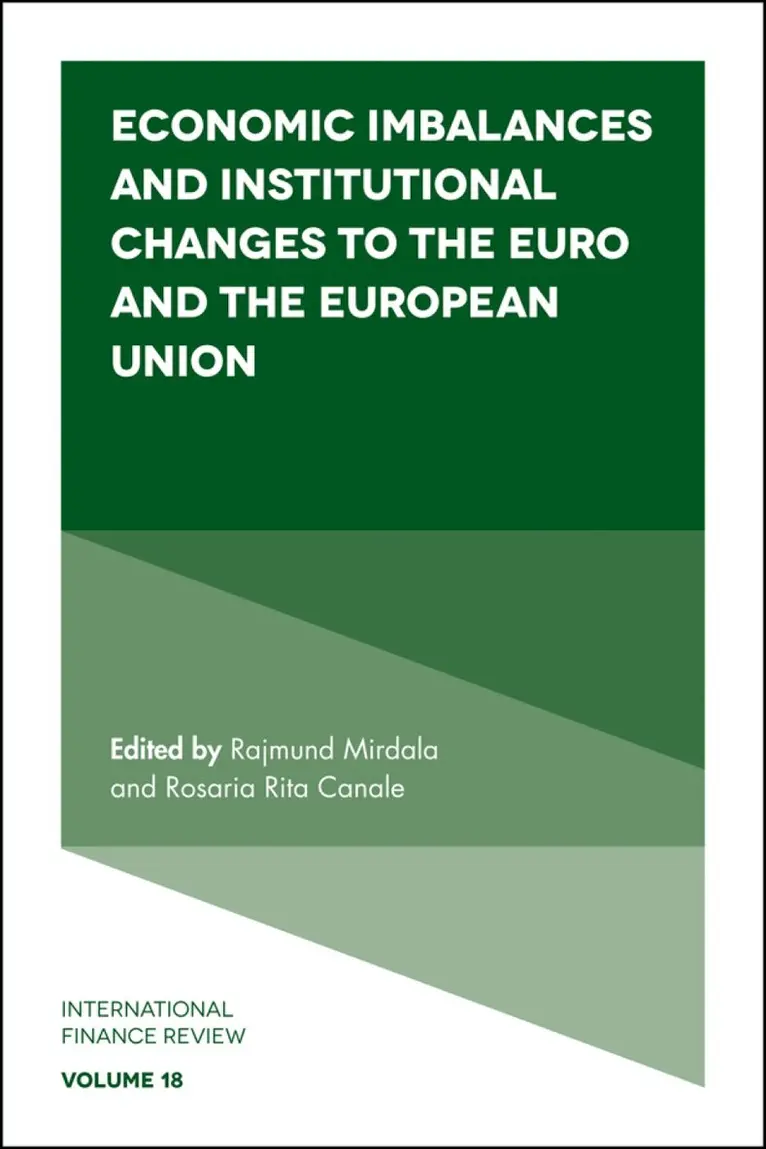
    Economic Imbalances and Institutional Changes to the Euro and the European Union

    AvRajmund Mirdala,Rosaria Rita Canale

    Inbunden, Engelska, 2017

    Del 18 i serien International Finance Review

    1 459 kr

    Beställningsvara. Skickas inom 5-8 vardagar. Fri frakt över 249 kr.

    Beskrivning

    This book offers a criticalperspective from which to observe evolution of the Euro Area and the EuropeanUnion in these times of growing economic and political conflict. Keyimplications of design failures in the Euro Area (i.e. incorrect diagnostics ofthe public finance crisis, single monetary policy failure, heterogeneousmacroeconomic environment, asymmetry in macroeconomic policies, obstacles forpolicy coordination) and their contribution to the excessive external andinternal economic imbalances will be critically discussed from the economic,policy and institutional perspectives. This critical insight is used to examineboth institutional asset and economic performance of Europe after the crisis,moving from the authors’ shared perspective that the crisis revealed the weakaspects of the whole architecture of the European Union.The economic crisis revealed theexistence of different forms of imbalances inside the Eurozone and highlightedthe flaws of the institutional architecture of economic policy in Europe. Thegreater fragility of some countries in respect to others has triggered abackward process in which national interests have started to prevail over thoseof both the currency area and the entire European Union. In turn, this hasfuelled a progressive decline in confidence in the European institutions and iscreating growing questions of interpretation both in terms of economic theoryand institutional asset. This book focuses on these issues and on the degree oflegitimacy of the European institutions resulting therefrom. It aims toinvestigate the nature and validity of the European integration processemphasizing limits and challenges arising from it.

    Produktinformation

    • Utgivningsdatum:2017-08-22
    • Mått:152 x 229 x 15 mm
    • Vikt:666 g
    • Format:Inbunden
    • Språk:Engelska
    • Serie:International Finance Review
    • Antal sidor:480
    • Förlag:Emerald Publishing Limited
    • ISBN:9781787145108

    Utforska kategorier

    • Nationalekonomi inom Ekonomi och Ledarskap

    Mer om författaren

    Rajmund Mirdala is Associate Professor and Head of Department ofeconomics at Faculty of Economics, Technical University of Kosice, Slovakrepublic. He is author of five books (Fiscal Policy in the European ConvergingEconomies, Exchange Rates in the Central European Countries, Economic Aspectsof Capital Flows Liberalization in the European Transition Economies(co-author), Monetary Rules and Their Importance in the Context of MonetaryUnion and Economic Crisis (co-author), The Euro Area and the Economic Crisis(co-author)). He has published 30+ articles in foreign scientific journals, 10+articles in domestic scientific and professional journals, 40+ articles indomestic and foreign conferences. He is principal investigator in 3 projectsfrom national grant schemes, deputy principal investigator in 3 projects fromnational grant schemes and researcher in 8 domestic and foreign projects. He isa member of 17 editorial boards of foreign scientific journals and reviewer for26 domestic and foreign scientific journals (8 listed in WoS - CurrentContents). His research covers following areas: Macroeconomic and MicroeconomicTheory, Monetary Policy, Monetary Integration, International FinancialIntegration, Exchange Rates, Fiscal Policy, International Capital Flows,Transition Economies, Global Imbalances.Rosaria Rita CanalePh.d (Naples “Federico II” Univ.) is Associate Professor of Economic Policy atthe University of Naples “Parthenope” Her research interest include fiscal andmonetary policy, International economics and history of economic thought. Shewrote many articles on national and international refereed journals the greatpart of which indexed on WoS and Scopus. She collaborates with national andinternational journals as referee. Some of her recent publications are: StructuralPublic Balance Adjustment and Relative Poverty in the Eurozone Countries: AnEmpirical Investigation with Liotti G. in “Ekonomický časopis” vol. 64, no. 8, 2016; Trust in Institutions and Income Inequalityin the Eurozone: The Role of the Crisis with M. Bonasia, Liotti G. andSpagnolo N. in“Engineering Economics” vol. 27, no. 1, 2016; Capital Flows, Long Term Bond Yields and Fiscal Stance: The Eurozone PolicyTrilemma, in “Portuguese Economic Journal”, vol. 14, no. 1, pp. 31-34, 2015;On the Objective of a Sound Publicfinance in the Eurozone, with Bonasia M. in “Rivista Internazionale diScienze Sociali”, no. 2, 2016; StructuralAdjustment and Enemployment in Eurozone with Liotti G. in “AustralianEconomic review”, vol. 48, no. 2, 2015; NationalDisparities and Cyclical Dynamics in Italy (1872-2007). Was Mezzogiorno aSheltered Economy?, with O. Napolitano in “International Review of AppliedEconomics”, vol. 23, no. 3, 2015, CurrentAccount and Fiscal Imbalances in the Eurozone: Siamese Twins in an AsymmetricalCurrency Union with Marani U. in “International Economics And EconomicPolicy”,  vol. 12, no. 2, 2014; Structural Public Balance Adjustment Effectson Growth in 25 OECD Countries and Eurozone with Liotti G. and NapolitanoO. in “Comparative Economic Studies”, vol. 56, no. 4, 2014; Alternative Strategies for Monetary Policy,in “Review of Political Economy”, no. 3, 2011.

    Recensioner i media

    Economists and business scholars offer critical perspectives from which to observe the evolution of the Euro Area and the European Union in these times of growing economic and political conflict. They cover institutional and political issues in the policy framework of the Eurozone; monetary policy, the banking system, and financial integration; and macroeconomic imbalances and the convergence process. Among their topics are development-related problems and asymmetries in the Eurozone: the challenge of the "strategic" approach, quantitative easing in the Eurozone, current accounts and competitiveness issues in the north and south of the Euro Area, the recent experiences of capital flows and fiscal imbalances since the creation of the Eurozone, and sovereign debt crisis: Euro-reality.

    Innehållsförteckning

    • Introduction, Economic Imbalances and Institutional Changes to the Euro and the European UnionThe Eurozone Policy Model and the Institutional Consolidation Process in the Long-Run; Mariangela Bonasia and Rosaria Rita Canale In or out of love with Europe? An empirical analysis of the determinants of national political parties’ orientation towards the European Union; De Simone E, D’Uva M, Gaeta G.L. Development-related Problems and Asymmetries in the Eurozone: The Challenge of the “Strategic” Approach; Nikolaos Karagiannis & Edward K. Zajicek Rules, Imbalances and Growth in the Eurozone; Daniele Schilirò Back to national currencies? Monetary integration in an asymmetrical currency area; Sergio Rossi From anti-growth bias to quantitative easing: the ECB’s belated conversion; Joerg Bibow Quantitative Easing in the Eurozone; Marta Orviska and John Hudson Updating the Evidence on Risk-Sharing through the Cross-Ownership of Assets in the Euro-Area; Pasquale Foresti and Oreste Napolitano  Financial Integration at Times of Crisis and Recovery; Jan Babecký, Luboš Komárek and Zlatuše Komárková EU-Banking Union: Expectations, Differences and Criticism; Dragan Momirović, Marko Janković, Maja Ranđelović Competitiveness and Macroeconomic Imbalances in Eurozone Countries; Collin Constantine Current Accounts and Competitiveness Issues in the North and South of the Euro Area; Rajmund Mirdala, Júlia Ďurčová Is there a debt-overhang problem in the European Union?; Ines Kersan-Skabic Are they all the same? Banking and financial crises in debt-ridden Euroarea countries; Tiago Cardao-Pito The Recent Experiences of Capital Flows and Fiscal Imbalances since the Creation of the Eurozone; Yaya Sissokoa and Brian W. Sloboda  Intra-European Union Imbalances and Cyclical Position: Does Monetary Policy Matter?; Jean-Pierre Allegret and Audrey Sallenave Is there convergence or divergence in the international competitiveness of the Eurozone countries?; Roberto J. Santillán-Salgado and Araceli Ortega-Díaz  Sovereign Debt Crisis: Euro-Reality: Reality.; Julius Horvath and Alfredo Hernandez