• Fri frakt över 249 kr
  • •
  • Snabba leveranser
  • •
  • Billiga böcker
Kundservice

Du är på sajten för privatpersoner.

Företag, bibliotek eller offentlig verksamhet?

Du handlar på classic.bokus.com, där alla dina funktioner finns intakta.
Till classic.bokus.com
Bokus logotyp. Gå till startsidan.
  • Erbjudanden
  • Nyheter
  • Student
  • Topplistor
  • Barn & ungdom
  • Bokus Play
  • E-böcker
  • Pocketböcker
  • Spel & pussel

10% rabatt på allt med kod: NYSTART10 →

Sidfot

Mina sidor

    Hjälp

    • Kundservice
    • Vanliga frågor och svar
    • Frakt och leverans
    • Retur vid ångerrätt
    • Reklamera vara
    • Betalning
    • Köpvillkor
    • Allmänna villkor
    • Information om webbplatsens tillgänglighet

    Om Bokus

    • Om oss
    • Pressrum
    • För studenter
    • För företag
    • För bibliotek och offentlig verksamhet
    • För leverantörer
    • Hållbarhet

    Populärt

    • Aktuella erbjudanden
    • Presentkort
    • Studentlitteratur
    • Nya böcker
    • Topplistor
    • Signerade böcker
    • Engelska böcker

    Inspiration

    • Boktips
    • BookTok
    • Populära bokserier
    • Barnbokskaraktärer
    • Populära författare
    Logotyp för Bokus
    Följ oss på Facebook (extern länk)Följ oss på Instagram (extern länk)Följ oss på YouTube (extern länk)Följ oss på TikTok (extern länk)
    bokus @ CookiesAnpassa cookiesIntegritetspolicyKöpvillkor
    Till Citymail hemsida (extern länk)Till Budbee hemsida (extern länk)Till Postnord hemsida (extern länk)Till Schenker hemsida (extern länk)Till Early Bird hemsida (extern länk)Till Walleys hemsida (extern länk)
    1. Naturvetenskap och teknik
    2. Matematik och naturvetenskap
    3. Kemi
    4. Fysikalisk kemi

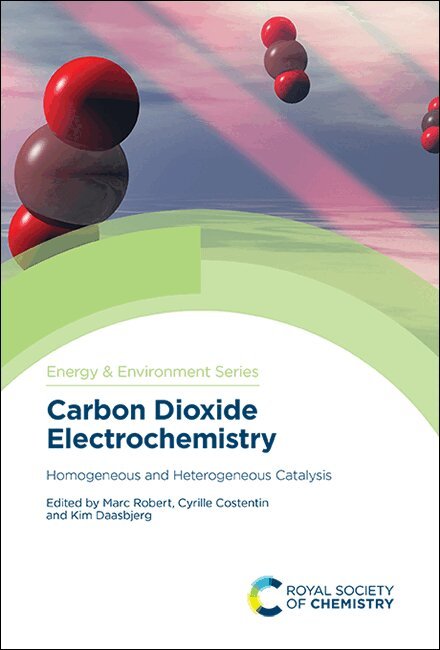
    Carbon Dioxide Electrochemistry

    Homogeneous and Heterogeneous Catalysis

    AvMarc Robert,Cyrille Costentin

    Inbunden, Engelska, 2020

    Del i serien Energy and Environment Series

    3 157 kr

    Beställningsvara. Skickas inom 5-8 vardagar. Fri frakt över 249 kr.

    Beskrivning

    Conversion of light and electricity to chemicals is an important component of a sustainable energy system. The exponential growth in renewable energy generation implies that there will be strong market pull for chemical energy storage technology in the near future, and here carbon dioxide utilization must play a central role. The electrochemical conversion of carbon dioxide is key in achieving these goals. Carbon Dioxide Electrochemistry showcases different advances in the field, and bridges the two worlds of homogeneous and heterogeneous catalysis that are often perceived as in competition in research. Chapters cover homogeneous and heterogeneous electrochemical reduction of CO2, nanostructures for CO2 reduction, hybrid systems for CO2 conversion, electrochemical reactors, theoretical approaches to catalytic reduction of CO2, and photoelectrodes for electrochemical conversion. With internationally well-known editors and authors, this book will appeal to graduate students and researchers in energy, catalysis, chemical engineering and chemistry who work on carbon dioxide.

    Produktinformation

    • Utgivningsdatum:2020-10-20
    • Mått:156 x 234 x 30 mm
    • Vikt:846 g
    • Format:Inbunden
    • Språk:Engelska
    • Serie:Energy and Environment Series
    • Antal sidor:443
    • Förlag:Royal Society of Chemistry
    • ISBN:9781788015462

    Utforska kategorier

    • Fysikalisk kemi inom Naturvetenskap och teknik

    Mer om författaren

    Cyrille Costentin received his undergraduate education at Ecole Normale Supérieure in Cachan. He is, since 2007, Professor at the Université Paris Diderot (now Université de Paris). He was Visiting Scholar at Harvard University from 2016 to 2019. Since 2019 he is working at the Département de Chimie Moléculaire at Université Grenoble Alpes. His interests include mechanisms and reactivity in electron transfer chemistry with particular emphasis on proton-coupled electron transfer processes and molecular catalysis of electrochemical reactions such as small molecules activation.Kim Daasbjerg obtained his MSc (1990) and PhD (1993) at Aarhus University under the supervision of Prof. Henning Lund. Following a post-doctoral visit at the Royal Institute of Technology, Stockholm, Sweden, he returned to Aarhus University as an associate professor in chemistry. He obtained his Doctor of Science degree (2006) and promoted to Professor (MSO) in 2010. Recently, the scientific research has focused on fundamental aspects of graphene and its functionalization to exploit the extraordinary properties of this carbon allotrope in materials science. In addition, the combined expertise in electrochemistry, modification of surfaces, polymer brushes, and carbon materials is employed to meet a scientifically difficult challenge of huge societal importance in terms of converting the greenhouse gas, carbon dioxide, to useful building blocks for the chemical industry or the energy sector.Marc Robert was educated at the Ecole Normale Supérieure (Cachan, France). He received his Ph.D. in 1995 from Université Paris Diderot under the guidance of Jean-Michel Savéant and Claude Andrieux. Following a postdoctoral stay at Ohio State University with Matthew Platz, he started his academic career at Université Paris Diderot in 1997. He is currently Professor of Chemistry at Université de Paris and Senior fellow at Institut Universitaire de France (IUF). His interests include electrochemical, photochemical approaches of electron transfer processes and catalysis. In recent years, his work has been focused on electrochemical and photochemical activation of small molecules, notably CO2 and N2, using metal-organic complexes as catalysts.

    Innehållsförteckning

    • Approaches to Controlling Homogeneous Electrochemical Reduction of Carbon Dioxide;Homogeneous Electrochemical Reduction of CO2: From Homogeneous to Supported Systems;Heterogeneous Electrochemical CO2 Reduction;Nanostructures for CO2 reduction: from theoretical insight to material design;Theoretical Approach to Homogeneous Catalytic Reduction of CO2: Mechanistic Understanding to Build New Catalysts;Bridging Homogeneous and Heterogeneous Systems: Atomically Dispersed Metal Atoms in Carbon Matrices for Electrocatalytic CO2 Reduction;Bridging Homogeneous and Heterogeneous systems: Photoelectrodes for CO2 Electrochemical Conversion;Hybrid Biological-Inorganic Systems for CO2 Conversion to Fuels;In Situ Spectroscopic Methods to Study Electrochemical CO2 Reduction;Electrochemical Reactors