• Fri frakt över 249 kr
  • •
  • Snabba leveranser
  • •
  • Billiga böcker
Kundservice

Du är på sajten för privatpersoner.

Företag, bibliotek eller offentlig verksamhet?

Du handlar på classic.bokus.com, där alla dina funktioner finns intakta.
Till classic.bokus.com
Bokus logotyp. Gå till startsidan.
  • Erbjudanden
  • Nyheter
  • Student
  • Topplistor
  • Barn & ungdom
  • Bokus Play
  • E-böcker
  • Pocketböcker
  • Spel & pussel

10% rabatt på allt med kod NYSTART10 →

Sidfot

Mina sidor

    Hjälp

    • Kundservice
    • Vanliga frågor och svar
    • Frakt och leverans
    • Retur vid ångerrätt
    • Reklamera vara
    • Betalning
    • Köpvillkor
    • Allmänna villkor
    • Information om webbplatsens tillgänglighet

    Om Bokus

    • Om oss
    • Pressrum
    • För studenter
    • För företag
    • För bibliotek och offentlig verksamhet
    • För leverantörer
    • Hållbarhet

    Populärt

    • Aktuella erbjudanden
    • Presentkort
    • Studentlitteratur
    • Nya böcker
    • Topplistor
    • Signerade böcker
    • Engelska böcker

    Inspiration

    • Boktips
    • BookTok
    • Populära bokserier
    • Barnbokskaraktärer
    • Populära författare
    Logotyp för Bokus
    Följ oss på Facebook (extern länk)Följ oss på Instagram (extern länk)Följ oss på YouTube (extern länk)Följ oss på TikTok (extern länk)
    bokus @ CookiesAnpassa cookiesIntegritetspolicyKöpvillkor
    Till Citymail hemsida (extern länk)Till Budbee hemsida (extern länk)Till Postnord hemsida (extern länk)Till Schenker hemsida (extern länk)Till Early Bird hemsida (extern länk)Till Walleys hemsida (extern länk)
    1. Naturvetenskap och teknik
    2. Matematik och naturvetenskap
    3. Kemi
    4. Fysikalisk kemi

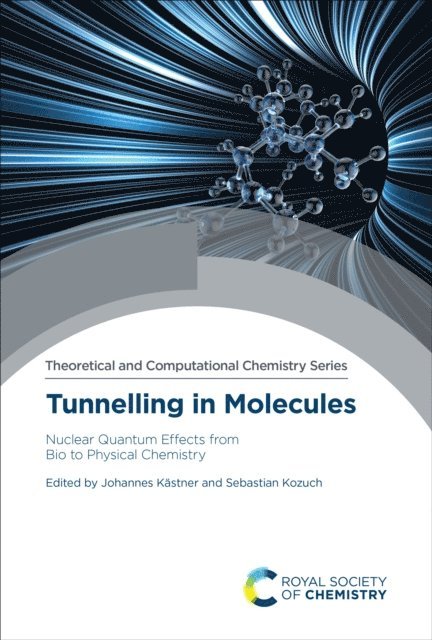
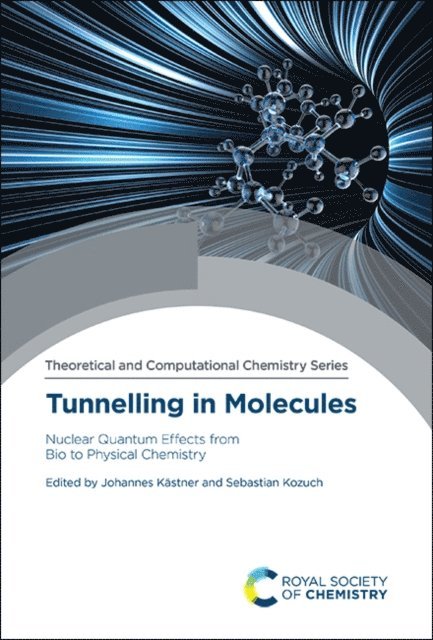
    Tunnelling in Molecules

    Nuclear Quantum Effects from Bio to Physical Chemistry

    AvJohannes Kästner,Sebastian Kozuch

    Inbunden, Engelska, 2020

    Del i serien Theoretical and Computational Chemistry Series

    3 157 kr

    Beställningsvara. Skickas inom 5-8 vardagar. Fri frakt över 249 kr.

    Beskrivning

    Quantum tunnelling is one of the strangest phenomena in chemistry, where we see the wave nature of atoms acting in “impossible” ways. By letting molecules pass through the kinetic barrier instead of over it, this effect can lead to chemical reactions even close to the absolute zero, to atypical spectroscopic observations, to bizarre selectivity, or to colossal isotopic effects. Quantum mechanical tunnelling observations might be infrequent in chemistry, but it permeates through all its disciplines producing remarkable chemical outcomes. For that reason, the 21st century has seen a great increase in theoretical and experimental findings involving molecular tunnelling effects, as well as in novel techniques that permit their accurate predictions and analysis. Including experimental, computational and theoretical chapters, from the physical and organic to the biochemistry fields, from the applied to the academic arenas, this new book provides a broad and conceptual perspective on tunnelling reactions and how to study them. Quantum Tunnelling in Molecules is the obligatory stop for both the specialist and those new to this world.

    Produktinformation

    • Utgivningsdatum:2020-09-30
    • Mått:156 x 234 x 29 mm
    • Vikt:847 g
    • Format:Inbunden
    • Språk:Engelska
    • Serie:Theoretical and Computational Chemistry Series
    • Antal sidor:436
    • Förlag:Royal Society of Chemistry
    • ISBN:9781788018708

    Utforska kategorier

    • Fysikalisk kemi inom Naturvetenskap och teknik
    • Kvantfysik inom Naturvetenskap och teknik

    Mer om författaren

    Sebastian Kozuch got his licentiate in chemistry from the University of Buenos Aires, and his Ph.D. at the Hebrew University of Jerusalem under the supervision of Sason Shaik. He did postdocs at the Weizmann Institute of Sciences with Jan Martin and at the University of North Texas with Weston T. Borden. Since 2014 he is a professor at the Ben-Gurion University of the Negev. His theoretical interests cross over three main fields: (1) Catalysis, kinetics, organometallics, and everything in between, from where he developed the “Energy Span Model”. (2) The chemical bond, especially the theory of hole interactions. (3) Quantum tunnelling, with a fascination for the chemistry of heavy atom tunnelling.Johannes Kästner studied chemistry and got his doctorate in physics.  After research stays at the Max Planck Institute for coal research with Walter Thiel and at Daresbury Laboratory, he became professor for computational chemistry at the University of Stuttgart, Germany. He developed methods for free-energy sampling, umbrella integration, and investigates biochemical processes by force field and QM/MM approaches.  His main focus of research, however, is the calculation of tunnelling rate constants. He is the lead author of DL-FIND, a library to optimize molecular geometries and to calculate rate constants with transition state theory, the small-curvature tunnelling approximation and instanton theory. His developments broadened the scope of instanton theory to make it applicable to many chemical systems, so that it is nowadays used in diverse fields like biochemistry, catalysis, and astrochemistry.

    Innehållsförteckning

    • Direct observation of tunnelling reactions by matrix isolation spectroscopy;Heavy atom tunnelling in organic transformations;Tunnelling instability in molecular systems: an exercise in computational chemistry prediction power;Proton tunnelling and proton-coupled electron transfer in biological systems: theory and experimental analysis;From tunnelling control to controlling tunnelling;From nuclear fluxes during tunnelling to electronic fluxes during charge migration;Tunnelling and parity violation in chiral and achiral molecules: theory and high resolution spectroscopy;Instanton theory to calculate tunnelling rates and tunnelling splittings;Semiclassical multidimensional tunnelling calculations;Evaluation of tunnelling splittings by direct diagonalization methods. An overview.;Quantum-dynamical calculation of rate constants in polyatomic reactions employing the quantum transition state concept;Eigenstate approaches for high resolution spectroscopy of tunnelling in small molecular systems;The tunnelling flight time