• Fri frakt över 249 kr
  • •
  • Snabba leveranser
  • •
  • Billiga böcker
Kundservice

Du är på sajten för privatpersoner.

Företag, bibliotek eller offentlig verksamhet?

Du handlar på classic.bokus.com, där alla dina funktioner finns intakta.
Till classic.bokus.com
Bokus logotyp. Gå till startsidan.
  • Erbjudanden
  • Student
  • Topplistor
  • Barn & ungdom
  • Bokus Play
  • E-böcker
  • Ljudböcker
  • Pocketböcker
  • Spel och pussel

Skapa nya rutiner – hälsoböcker upp till 50% →

Sidfot

Mina sidor

    Hjälp

    • Kundservice
    • Vanliga frågor och svar
    • Frakt och leverans
    • Retur vid ångerrätt
    • Reklamera vara
    • Betalning
    • Köpvillkor
    • Allmänna villkor
    • Information om webbplatsens tillgänglighet

    Om Bokus

    • Om oss
    • Pressrum
    • För studenter
    • För företag
    • För bibliotek och offentlig verksamhet
    • För leverantörer
    • Hållbarhet

    Populärt

    • Aktuella erbjudanden
    • Presentkort
    • Studentlitteratur
    • Nya böcker
    • Topplistor
    • Signerade böcker
    • Engelska böcker

    Inspiration

    • Boktips
    • BookTok
    • Barnbokskaraktärer
    • Populära författare
    Logotyp för Bokus
    Följ oss på Facebook (extern länk)Följ oss på Instagram (extern länk)Följ oss på YouTube (extern länk)Följ oss på TikTok (extern länk)
    bokus @ CookiesAnpassa cookiesIntegritetspolicyKöpvillkor
    Till Citymail hemsida (extern länk)Till Budbee hemsida (extern länk)Till Postnord hemsida (extern länk)Till Schenker hemsida (extern länk)Till Early Bird hemsida (extern länk)Till Walleys hemsida (extern länk)
    1. Ekonomi och Ledarskap
    2. Nationalekonomi

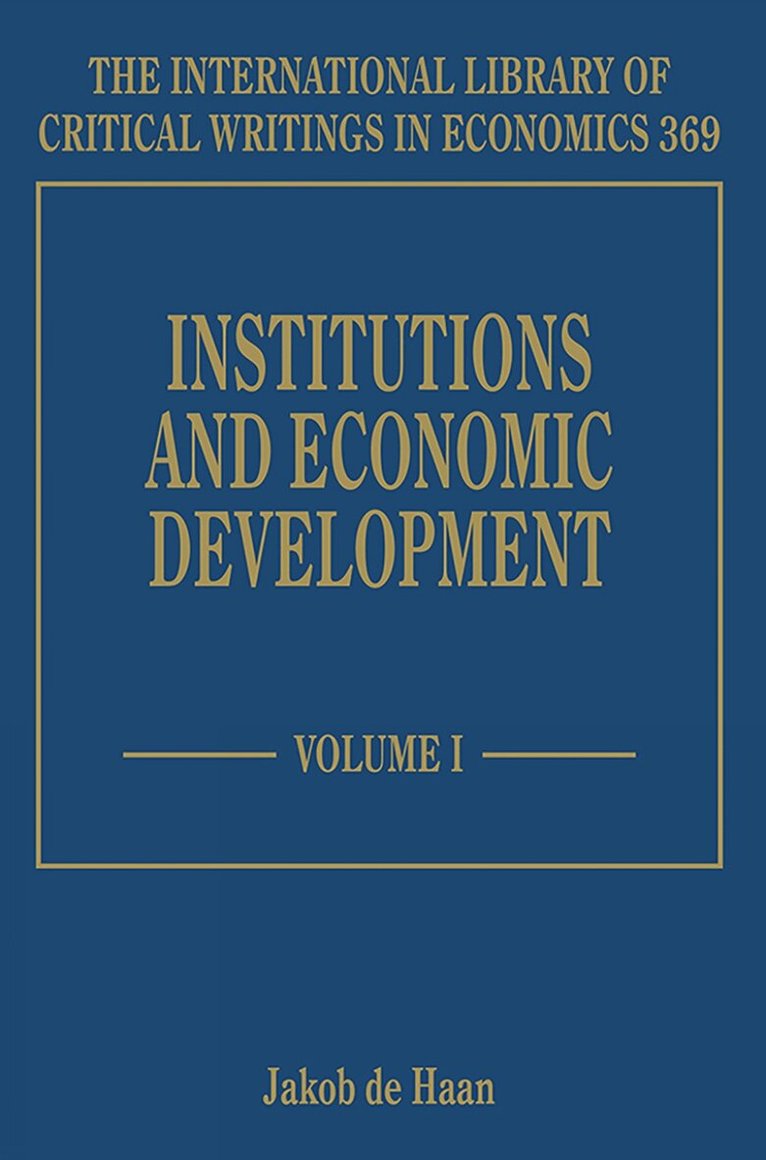
    Institutions and Economic Development

    AvJakob de Haan

    Inbunden, Engelska, 2019

    Del 369 i serien The International Library of Critical Writings in Economics series

    12 311 kr

    Beställningsvara. Skickas inom 5-8 vardagar. Fri frakt över 249 kr.

    Beskrivning

    This essential research review carefully analyses some of the most influential papers focusing on the relationship between economic and political institutions and economic development. Economic institutions shape economic incentives, such the incentives to become educated, to save and invest, to innovate and to adopt new technologies. Although economic institutions are critical for determining whether a country is poor or prosperous, it is politics and political institutions that determine which economic institutions are present in a country. This review explores these critical relationships and the causes of economic growth, whilst bringing forth the legal, colonial and financial factors, which contribute to economic discrepancies across countries. The text will be a valuable tool for economic researchers and scholars interested in this important subject.

    Produktinformation

    • Utgivningsdatum:2019-11-13
    • Mått:169 x 244 x undefined mm
    • Format:Inbunden
    • Språk:Engelska
    • Serie:The International Library of Critical Writings in Economics series
    • Förlag:Edward Elgar Publishing Ltd
    • ISBN:9781788118842

    Utforska kategorier

    • Nationalekonomi inom Ekonomi och Ledarskap
    • Internationell ekonomi inom Ekonomi och Ledarskap

    Mer om författaren

    Edited by Jakob de Haan, Professor of Political Economy, University of Groningen, the Netherlands

    Innehållsförteckning

    • ContentsVolume IAcknowledgements viiIntroduction Jakob de Haan ix1. Daron Acemoglu and Simon Johnson (2005), ‘Unbundling Institutions’, Journalof Political Economy, 113 (5), October, 949–95 12. Daron Acemoglu, Simon Johnson and James A. Robinson (2001), ‘The ColonialOrigins of Comparative Development: An Empirical Investigation’, AmericanEconomic Review, 91 (5), December, 1369–401 483. Daron Acemoglu, Simon Johnson and James A. Robinson (2002), ‘Reversal ofFortune: Geography and Institutions in the Making of the Modern World IncomeDistribution’, Quarterly Journal of Economics, 117 (4), November, 1231–94 814. Daron Acemoglu, Simon Johnson and James A. Robinson (2005), ‘Institutions asa Fundamental Cause of Long-Run Growth’, in Philippe Aghion and Steven N.Durlauf (eds) Handbook of Economic Growth, Chapter 6, Volume 1, Part A,Amsterdam, the Netherlands: Elsevier, 385–472 1455. Daron Acemoglu, Simon Johnson and James Robinson (2005), ‘The Rise ofEurope: Atlantic Trade, Institutional Change, and Economic Growth’, AmericanEconomic Review, 95 (3), June, 546–79 2336. Daron Acemoglu, Simon Johnson and James A. Robinson (2012) ‘The ColonialOrigins of Comparative Development: An Empirical Investigation: Reply’,American Economic Review, 102 (6), October, 3077–110 2677. Daron Acemoglu, Suresh Naidu, Pascual Restrepo and James A. Robinson(2019), ‘Democracy Does Cause Growth’, Journal of Political Economy, 127(1), January, 47–100 3018. Raphael A. Auer (2013), ‘Geography, Institutions, and the Making ofComparative Development’, Journal of Economic Growth, 18 (2), January,179–215 3559. Robert J. Barro (1996), ‘Democracy and Growth’, Journal of Economic Growth,1 (1), March, 1–27 39210. Sjoerd Beugelsdijk (2006), ‘A Note on the Theory and Measurement of Trust inExplaining Differences in Economic Growth’, Cambridge Journal of Economics,30 (3), May, 371–87 41911. Christian Bjørnskov and Pierre-Guillaume Méon (2013), ‘Is Trust the MissingRoot of Institutions, Education, and Development?’, Public Choice, 157 (3–4),December, 641–69 43612. Maarten Bosker and Harry Garretsen (2009), ‘Economic Development and theGeography of Institutions’, Journal of Economic Geography, 9 (3), May,295–328 46513. Kai Carstensen and Erich Gundlach (2006), ‘The Primacy of InstitutionsReconsidered: Direct Income Effects of Malaria Prevalence’, World BankEconomic Review , 20 (3), January, 309–39 49914. Stijn Claessens and Luc Laeven (2003), ‘Financial Development, PropertyRights, and Growth’, Journal of Finance , 58 (6), December, 2401–36 53015. Christopher Clague, Philip Keefer, Stephen Knack and Mancur Olson (1996),‘Property and Contract Rights in Autocracies and Democracies’, Journal ofEconomic Growth , 1 (2), June, 243–76 56616. Jakob De Haan, Susanna Lundström and Jan-Egbert Sturm (2006), ‘Market-Oriented Institutions and Policies and Economic Growth: A Critical Survey’,Journal of Economic Surveys , 20 (2), March, 157–91 60017. Simeon Djankov, Edward Glaeser, Rafael La Porta, Florencio Lopez-de-Silanesand Andrei Shleifer (2003), ‘The New Comparative Economics’, Journal ofComparative Economics , 31 (4), December, 595–619 63518. Hristos Doucouliagos and Mehmet Ali Ulubaşoğlu (2008), ‘Democracy andEconomic Growth: A Meta-Analysis’, American Journal of Political Science , 52(1), January, 61–83 66019. David Dollar and Aart Kraay (2003), ‘Institutions, Trade, and Growth’, Journalof Monetary Economics , 50 (1), January, 133–62 68320. William Easterly and Ross Levine (2003), ‘Tropics, Germs, and Crops: HowEndowments Influence Economic Development’, Journal of MonetaryEconomics , 50 (1), January, 3–39 713Volume IIAcknowledgements viiIntroduction An introduction to both volumes by the editor appears in Volume I1. William Easterly and Ross Levine (2016), ‘The European Origins of EconomicDevelopment’, Journal of Economic Growth, 21 (3), September, 225–57 12. Stanley L. Engerman and Kenneth L. Sokoloff (1997), ‘Factor Endowments,Institutions, and Differential Paths of Growth Among New World Economies’,in Stephen Haber (ed.), How Latin America Fell Behind, Stanford, CA: StanfordUniversity Press, 260–304 343. Theo S. Eicher and Andreas Leukert (2009), ‘Institutions and EconomicPerformance: Endogeneity and Parameter Heterogeneity’, Journal of Money,Credit and Banking, 41 (1), February, 197–219 794. Edward L. Glaeser, Rafael La Porta, Florencio Lopez-de-Silanes and AndreiShleifer (2004), ‘Do Institutions Cause Growth?’, Journal of Economic Growth,9 (3), September, 271–303 1025. Erich Gundlach and Martin Paldam (2009), ‘A Farewell to Critical Junctures:Sorting out Long-Run Causality of Income and Democracy’, European Journalof Political Economy, 25 (3), September, 340–54 1356. James D. Gwartney, Robert A. Lawson and Randall G. Holcombe (1999),‘Economic Freedom and the Environment for Economic Growth’, Journal ofInstitutional and Theoretical Economics, 155 (4), December, 643–63 1507. Robert E. Hall and Charles I. Jones (1999), ‘Why Do Some Countries ProduceSo Much More Output Per Worker Than Others?’, Quarterly Journal ofEconomics, 114 (1), February, 83–116 1718. Jonathan K. Hanson (2013), ‘Growth Paradigms and Congruent Institutions:Estimating Context-Varying Effects of Political Institutions on EconomicPerformance’, Political Science Research and Methods, 1 (2), December,239–62 2059. Ricardo Hausmann, Lant Pritchett and Dani Rodrik (2005), ‘GrowthAccelerations’, Journal of Economic Growth, 10 (4), December, 303–29 22910. Staff of the International Monetary Fund (2003), ‘Growth and Institutions’, in(eds) World Economic Outlook, Chapter III, Washington, DC, United States:International Monetary Fund, 95–128 25611. Richard Jong-A-Pin and Jakob De Haan (2011), ‘Political Regime Change,Economic Liberalization and Growth Accelerations’, Public Choice, 146 (1–2),January, 93–115 29012. Stephen Knack and Philip Keefer (1995), ‘Institutions and EconomicPerformance: Cross-Country Tests Using Alternative Institutional Measures’,Economics and Politics, 7 (3), November, 207–27 31313. Carl Henrik Knutsen (2012), ‘Democracy and Economic Growth: A Survey ofArguments and Results’, International Area Studies Review , 15 (4), December,393–415 33414. Rafael La Porta, Florencio Lopez-de-Silanes, Andrei Shleifer and Robert W.Vishny (1998), ‘Law and Finance’, Journal of Political Economy, 106 (6),December, 1113–55 35715. Rafael La Porta, Florencio Lopez-de-Silanes, Andrei Shleifer and Robert Vishny(1999), ‘The Quality of Government’, Journal of Law, Economics, andOrganisation , 15 (1), March, 222–79 40016. Rafael La Porta, Florencio Lopez-de-Silanes and Andrei Shleifer (2008), ‘TheEconomic Consequences of Legal Origins’, Journal of Economic Literature , 46(2), June, 285–332 45817. Robbert Maseland (2013), ‘Parasitical Cultures? The Cultural Origins ofInstitutions and Development’, Journal of Economic Growth , 18 (2), April,109–36 50618. Mancur Olson Jr., Naveen Sarna and Anand V. Swamy (2000), ‘Governance andGrowth: A Simple Hypothesis Explaining Cross-Country Differences inProductivity Growth’, Public Choice , 102 (3–4), March, 341–64 53419. Torsten Persson and Guido Tabellini (2009), ‘Democratic Capital: The Nexus ofPolitical and Economic Change’, American Economic Journal: Macroeconomics ,1 (2), July, 88–126 55820. Dani Rodrik (1999), ‘Where Did All the Growth Go? External Shocks, SocialConflict, and Growth Collapses’, Journal of Economic Growth , 4 (4), December,385–412 59721. Dani Rodrik (2000), ‘Institutions for High-Quality Growth: What They Are andHow to Acquire Them’, Studies in Comparative International Development , 35(3), September, 3–31 62522. Dani Rodrik, Arvind Subramanian and Francesco Trebbi (2004), ‘InstitutionsRule: The Primacy of Institutions Over Geography and Integration in EconomicDevelopment’, Journal of Economic Growth , 9 (2), June, 131–65 65423. Jeffrey D. Sachs (2003), ‘Institutions Don’t Rule: Direct Effects of Geographyon Per Capita Income’, NBER Working Paper No. 9490 , February, 1–12 68924. Rok Spruk (2016), ‘Institutional Transformation and the Origins of WorldIncome Distribution’, Journal of Comparative Economics , 44 (4), November,936–60 70125. Guido Tabellini (2010), ‘Culture and Institutions: Economic Development in theRegions of Europe’, Journal of the European Economic Association , 8 (4), June,677–716 726Index
    Hoppa över listan

    Du kanske också är intresserad av

    Tom D. Campbell - Library of Essays on Justice - Second Series: 4-Volume Set, Övrigt

    Library of Essays on Justice - Second Series: 4-Volume Set

    Tom D. Campbell

    12 312 kr

    Jakob de Haan, Sylvester C. W. Eijffinger, Sandra Waller - European Central Bank, Inbunden

    European Central Bank

    Jakob de Haan, Sylvester C. W. Eijffinger, Sandra Waller

    Inbunden, 2005

    192 kr

    Christiaan Pattipeilohy, Jakob de Haan - Advanced Introduction to Central Banks and Monetary Policy, E-bok

    Advanced Introduction to Central Banks and Monetary Policy

    Christiaan Pattipeilohy, Jakob de Haan

    E-bok
    2022

    293 kr

    Jakob de Haan, Fabian Amtenbrink, Dariusz Adamski - Cambridge Handbook of European Monetary, Economic and Financial Integration, E-bok

    Cambridge Handbook of European Monetary, Economic and Financial Integration

    Jakob de Haan, Fabian Amtenbrink, Dariusz Adamski

    E-bok
    2023

    2 294 kr

    Jakob de Haan, Christiaan Pattipeilohy - Advanced Introduction to Central Banks and Monetary Policy, Häftad

    Advanced Introduction to Central Banks and Monetary Policy

    Jakob de Haan, Christiaan Pattipeilohy

    Häftad, 2022

    309 kr

    Sylvester Eijffinger, Jakob de Haan - European Monetary and Fiscal Policy, Häftad

    European Monetary and Fiscal Policy

    Sylvester Eijffinger, Jakob de Haan

    Häftad, 2000

    1 139 kr

    Jakob de Haan, Helge Berger - European Central Bank at Ten, Inbunden

    European Central Bank at Ten

    Jakob de Haan, Helge Berger

    Inbunden, 2010

    1 078 kr

    Jakob de Haan, Helge Berger - European Central Bank at Ten, Häftad

    European Central Bank at Ten

    Jakob de Haan, Helge Berger

    Häftad, 2014

    1 078 kr

    A. Joanne Kellermann, Jakob de Haan, Femke de Vries - Financial Supervision in the 21st Century, Inbunden

    Financial Supervision in the 21st Century

    A. Joanne Kellermann, Jakob de Haan, Femke de Vries

    Inbunden, 2013

    1 078 kr

    Jakob de Haan, Dirk Schoenmaker, Peter Wierts - Financial Markets and Institutions, Häftad

    Financial Markets and Institutions

    Jakob de Haan, Dirk Schoenmaker, Peter Wierts

    Häftad, 2020

    708 kr