• Fri frakt över 249 kr
  • •
  • Snabba leveranser
  • •
  • Billiga böcker
Kundservice

Du är på sajten för privatpersoner.

Företag, bibliotek eller offentlig verksamhet?

Du handlar på classic.bokus.com, där alla dina funktioner finns intakta.
Till classic.bokus.com
Bokus logotyp. Gå till startsidan.
  • Erbjudanden
  • Student
  • Topplistor
  • Barn & ungdom
  • Bokus Play
  • E-böcker
  • Ljudböcker
  • Pocketböcker
  • Spel och pussel

5% studentrabatt – använd koden KURSBOK27 →

Sidfot

Mina sidor

    Hjälp

    • Kundservice
    • Vanliga frågor och svar
    • Frakt och leverans
    • Retur vid ångerrätt
    • Reklamera vara
    • Betalning
    • Köpvillkor
    • Allmänna villkor
    • Information om webbplatsens tillgänglighet

    Om Bokus

    • Om oss
    • Pressrum
    • För studenter
    • För företag
    • För bibliotek och offentlig verksamhet
    • För leverantörer
    • Hållbarhet

    Populärt

    • Aktuella erbjudanden
    • Presentkort
    • Studentlitteratur
    • Nya böcker
    • Topplistor
    • Signerade böcker
    • Engelska böcker

    Inspiration

    • Boktips
    • BookTok
    • Barnbokskaraktärer
    • Populära författare
    Logotyp för Bokus
    Följ oss på Facebook (extern länk)Följ oss på Instagram (extern länk)Följ oss på YouTube (extern länk)Följ oss på TikTok (extern länk)
    bokus @ CookiesAnpassa cookiesIntegritetspolicyKöpvillkor
    Till Citymail hemsida (extern länk)Till Budbee hemsida (extern länk)Till Postnord hemsida (extern länk)Till Schenker hemsida (extern länk)Till Early Bird hemsida (extern länk)Till Walleys hemsida (extern länk)
    1. Ekonomi och Ledarskap
    2. Nationalekonomi

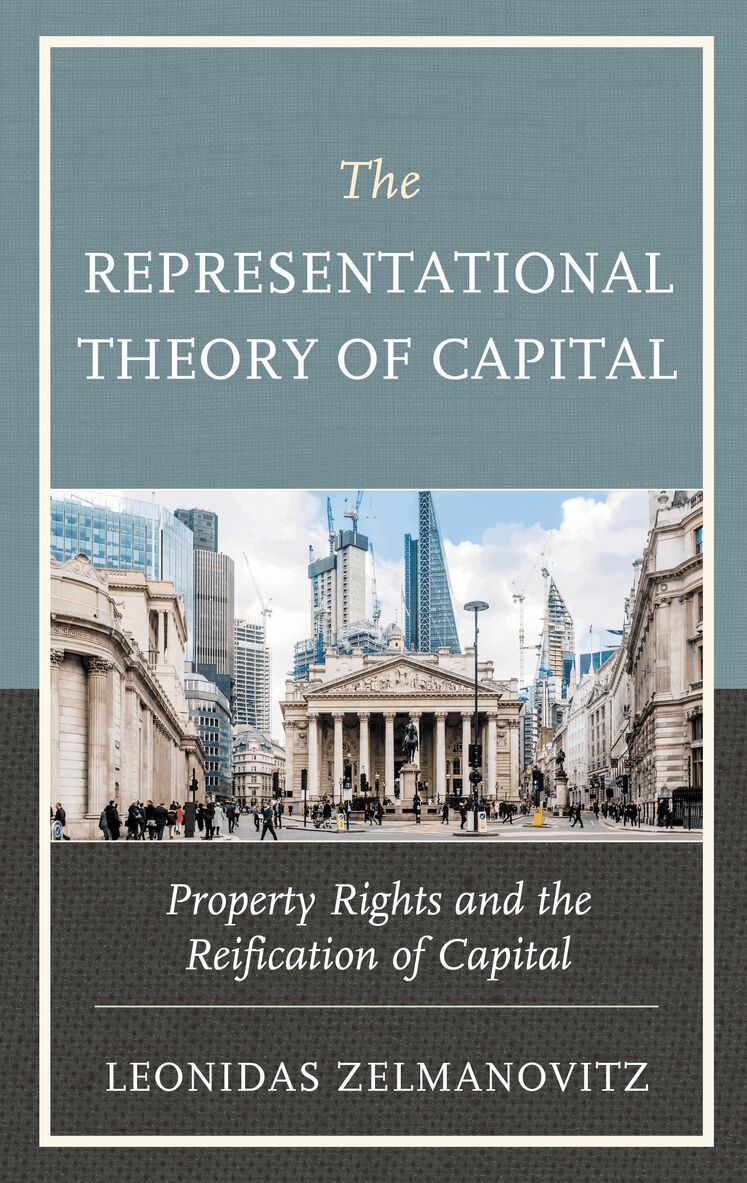
    Representational Theory of Capital

    Property Rights and the Reification of Capital

    AvLeonidas Zelmanovitz

    Häftad, Engelska, 2022

    464 kr

    Beställningsvara. Skickas inom 10-15 vardagar. Fri frakt över 249 kr.

    Beskrivning

    This book proposes a “representational” theory of capital according to which there is a relation between capital goods in the real side of the economy and instruments representative of property claims on those goods in the abstract side. Financial instruments are treated herein as a particularly liquid form of property claim. The relation proposed between these two things is a loose rather than a direct one, and the causes for (and consequences of) the looseness are explored in the book. This book aims not merely to simplify our understanding of the relationship between “things” and “claims to things,” but to make explicit and precise what many current researchers assume implicitly and, consequently, imprecisely. This book will be a tool that researchers can apply to their own research, in the form of a standard by which inconsistencies in the literature on Capital Theory can be identified. Understanding what capital is requires delving into its nature on both the real and the abstract sides. In regard to capital goods, what they actually are is made clearer by the thesis that they exist on a spectrum with respect to consumer goods. In going back to the philosophical and economic basics, no claim is made of being comprehensive. The argument is that a crucial idea for our understanding of what capital is that actual capital goods (and processes, and knowledge) are represented in financial instruments and other property claims. A formal treatment that lays out the philosophical and economic basics is necessary to put this idea across, and the model proposed in the book is a first step in that direction. Further, by laying out the philosophical and economic basics of the theory, the book offers the reader the reasons why having a clearer concept of capital is an important tool for wealth creation, and why wealth creation is, more than never, necessary for our individual wellbeing and the flourishing of our civilization.

    Produktinformation

    • Utgivningsdatum:2022-05-10
    • Mått:155 x 219 x 17 mm
    • Vikt:431 g
    • Format:Häftad
    • Språk:Engelska
    • Antal sidor:264
    • Förlag:Bloomsbury Publishing Plc
    • ISBN:9781793605023

    Utforska kategorier

    • Nationalekonomi inom Ekonomi och Ledarskap
    • Bolags-, handels- och konkurrensrätt inom Juridik
    • Makroekonomi inom Ekonomi och Ledarskap

    Mer om författaren

    Leonidas Zelmanovitz is senior fellow at Liberty Fund.

    Recensioner i media

    Dr. Zelmanovitz's The Representational Theory of Capital advances a theoretical framework that not only helps to explain the relation between capital goods in an economy and certain instruments representative of property claims on those goods in the abstract side of the economy, but also suggests productive directions for future scholarship. Zelmanovitz is not just addressing fellow economist, however. Although this book is certainly not an introductory work, it is readily accesssible to readers who approach economics and political/financial institutions from an interdisciplinary persepctive. As such, Zelmanovitz's contribution is immense. Simply put: this is one of the most important and original books in decades.

    Innehållsförteckning

    • List of FiguresList of Tables Preface Acknowledgments Part IChapter 1: IntroductionChapter 2: Austrian Capital Theory, Legal Rights, and Capital RepresentationPart IIChapter 3—The Reification of Capital, the Representational Theory of Capital and Its ModelChapter 4 - The Epistemological Problem of CapitalPart IIIChapter 5—The Real SideChapter 6 – The Spatial Dimension of CapitalPart IVChapter 7—The Abstract SideChapter 8—Financial InstrumentsChapter 9 - A Dynamic ModelChapter 10—The Relation Between Money and the Structure of ProductionPart VChapter 11—ConclusionEpilogueGlossaryBibliographyIndexIndex of Terms in the ModelAbout the Author