• Fri frakt över 249 kr
  • •
  • Snabba leveranser
  • •
  • Billiga böcker
Kundservice

Du är på sajten för privatpersoner.

Företag, bibliotek eller offentlig verksamhet?

Du handlar på classic.bokus.com, där alla dina funktioner finns intakta.
Till classic.bokus.com
Bokus logotyp. Gå till startsidan.
  • Erbjudanden
  • Nyheter
  • Student
  • Topplistor
  • Barn & ungdom
  • Bokus Play
  • E-böcker
  • Pocketböcker
  • Spel & pussel

10% rabatt på allt med kod: NYSTART10 →

Sidfot

Mina sidor

    Hjälp

    • Kundservice
    • Vanliga frågor och svar
    • Frakt och leverans
    • Retur vid ångerrätt
    • Reklamera vara
    • Betalning
    • Köpvillkor
    • Allmänna villkor
    • Information om webbplatsens tillgänglighet

    Om Bokus

    • Om oss
    • Pressrum
    • För studenter
    • För företag
    • För bibliotek och offentlig verksamhet
    • För leverantörer
    • Hållbarhet

    Populärt

    • Aktuella erbjudanden
    • Presentkort
    • Studentlitteratur
    • Nya böcker
    • Topplistor
    • Signerade böcker
    • Engelska böcker

    Inspiration

    • Boktips
    • BookTok
    • Populära bokserier
    • Barnbokskaraktärer
    • Populära författare
    Logotyp för Bokus
    Följ oss på Facebook (extern länk)Följ oss på Instagram (extern länk)Följ oss på YouTube (extern länk)Följ oss på TikTok (extern länk)
    bokus @ CookiesAnpassa cookiesIntegritetspolicyKöpvillkor
    Till Citymail hemsida (extern länk)Till Budbee hemsida (extern länk)Till Postnord hemsida (extern länk)Till Schenker hemsida (extern länk)Till Early Bird hemsida (extern länk)Till Walleys hemsida (extern länk)
    1. Naturvetenskap och teknik
    2. Teknik och industri
    3. Energiteknik

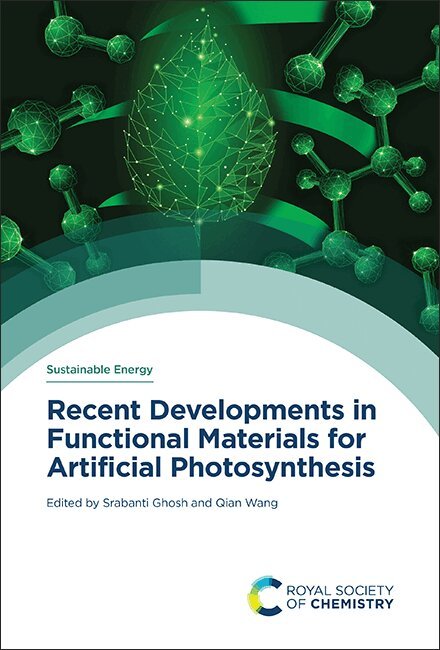
    Recent Developments in Functional Materials for Artificial Photosynthesis

    AvSrabanti Ghosh,Qian Wang

    Inbunden, Engelska, 2023

    Del i serien Sustainable Energy

    3 201 kr

    Beställningsvara. Skickas inom 5-8 vardagar. Fri frakt över 249 kr.

    Beskrivning

    Artificial photosynthesis is the process of converting solar energy into useful fuels and represents a significant achievement in the production of clean energy for the planet. In the process, energy is generated from water and CO2 reduction using solar-powered photocatalysis. This book provides a comprehensive overview of recently developed, multifunctional materials as visible light-driven catalysts, their mechanisms and applications in solar energy utilisation and conversion. Chapters highlight the use of different approaches such as molecular catalysis, nanomaterials systems, as well as thin-films for solar-driven evolution of renewable fuels, such as hydrogen. This is the first book to give an overview of this area, with chapters specifically interesting for those looking towards industrial applications. With in-depth discussions ranging from understanding, to engineering of materials and applied devices, it will be suitable for industry professionals, researchers and students interested in understanding of the current state of photocatalysis research and its possible applications in the energy domain.

    Produktinformation

    • Utgivningsdatum:2023-03-08
    • Mått:156 x 234 x 23 mm
    • Vikt:711 g
    • Format:Inbunden
    • Språk:Engelska
    • Serie:Sustainable Energy
    • Antal sidor:368
    • Förlag:Royal Society of Chemistry
    • ISBN:9781839164422

    Utforska kategorier

    • Energiteknik inom Naturvetenskap och teknik
    • Fysikalisk kemi inom Naturvetenskap och teknik

    Mer om författaren

    Dr. Srabanti Ghosh presently working as Senior Scientist, Energy Materials & Devices Division, in CSIR - Central Glass and Ceramic Research Institute, Kolkata, India. She received her PhD degree in Chemistry from UGC-DAE Consortium for Scientific Research, Kolkata Centre, and Jadavpur University, India and completed postdoctoral programs at the University of Paris SUD, France (Marie Curie Cofund). She worked as GOT ENERGY TALENT Cofund Marie Curie Fellow Researcher in UNIVERSIDAD DE ALCALA, Spain. Her main research interests include synthesis, characterization of functional materials at nanoscale and their photoelectrochemical properties for energy conversion devices, photocatalysts, electrocatalysts, fuel cells and biosensors applications.  She co-authored 80 publications in international scientific journals, 2 patent, edited 4 books and contributed 19 book chapters covering the large fields of photocatalysis, conjugated polymer, heterostructure nanomaterials, and water treatment. She routinely acts as a reviewer of SCI Journals from different editorials (RSC, ACS, ELSEVIER, Wiley, Springer Nature, MDPI, among others). Her current research work is focused on nanohybrid materials, conducting polymer nanostructures for solar light harvesting, photocatalysis applications.Qian Wang is currently an Associate Professor at Nagoya University, Japan. She obtained her Ph.D. in 2014 at the University of Tokyo, Japan, where she worked on the development of perovskite-type oxide photocatalysts for visible-light-driven water splitting. She then worked as a postdoctoral researcher at the Japan Technological Research Association of Artificial Photosynthetic Chemical Processes (ARPChem) on the development of standalone photocatalyst devices for overall water splitting. In 2018, she became a Marie Sklodowska-Curie Research Fellow at the University of Cambridge to develop inorganic-organic hybrid photocatalysts. She joined Nagoya University as an Associate Professor in May 2021 and established her research group, which is currently developing new materials, approaches, and technologies for solar energy storage in the form of renewable fuels via artificial photosynthesis.

    Innehållsförteckning

    • Multidisciplinary Approaches to Solar-driven Water Splitting and Carbon Dioxide Conversion;SrTiO3-based Perovskite Photocatalysts for Efficient Solar-driven Overall Water Splitting and CO2 Reduction;Recent Developments in (Oxy)nitride Photocatalysts With Narrow Bandgaps for Solar-driven Water Splitting;Recent Advances in (Oxy)sulfide Photocatalysts for Solar-driven Water Splitting and CO2 Reduction;Efficacy of Bismuth Oxyhalides (BiOX-based) Materials for Enhanced Photocatalysis;Molecular Catalysts Immobilised on Photocathodes for Solar Fuel Generation;Recent Advances in the Development of Metal–Organic Frameworks-based Photocatalysts for Water Splitting and CO2 Reduction;2D Nanomaterials-based Heterostructures for H2O Splitting and CO2 Reduction;Role of Co-catalysts for Photocatalytic H2O Splitting and CO2 Reduction;Semiconductor Quantum Dots for Water Splitting and CO2 Photoreduction;Computational Approaches to Materials Design for Enhanced Photocatalytic Activity;Scaling Up Photocatalysts and New Devices for Solar Water Splitting and CO2 Reduction