• Fri frakt över 249 kr
  • •
  • Snabba leveranser
  • •
  • Billiga böcker
Kundservice

Du är på sajten för privatpersoner.

Företag, bibliotek eller offentlig verksamhet?

Du handlar på classic.bokus.com, där alla dina funktioner finns intakta.
Till classic.bokus.com
Bokus logotyp. Gå till startsidan.
  • Erbjudanden
  • Nyheter
  • Student
  • Topplistor
  • Barn & ungdom
  • Bokus Play
  • E-böcker
  • Pocketböcker
  • Spel & pussel

10% rabatt på allt med kod: NYSTART10 →

Sidfot

Mina sidor

    Hjälp

    • Kundservice
    • Vanliga frågor och svar
    • Frakt och leverans
    • Retur vid ångerrätt
    • Reklamera vara
    • Betalning
    • Köpvillkor
    • Allmänna villkor
    • Information om webbplatsens tillgänglighet

    Om Bokus

    • Om oss
    • Pressrum
    • För studenter
    • För företag
    • För bibliotek och offentlig verksamhet
    • För leverantörer
    • Hållbarhet

    Populärt

    • Aktuella erbjudanden
    • Presentkort
    • Studentlitteratur
    • Nya böcker
    • Topplistor
    • Signerade böcker
    • Engelska böcker

    Inspiration

    • Boktips
    • BookTok
    • Populära bokserier
    • Barnbokskaraktärer
    • Populära författare
    Logotyp för Bokus
    Följ oss på Facebook (extern länk)Följ oss på Instagram (extern länk)Följ oss på YouTube (extern länk)Följ oss på TikTok (extern länk)
    bokus @ CookiesAnpassa cookiesIntegritetspolicyKöpvillkor
    Till Citymail hemsida (extern länk)Till Budbee hemsida (extern länk)Till Postnord hemsida (extern länk)Till Schenker hemsida (extern länk)Till Early Bird hemsida (extern länk)Till Walleys hemsida (extern länk)
    1. Naturvetenskap och teknik
    2. Teknik och industri
    3. Energiteknik

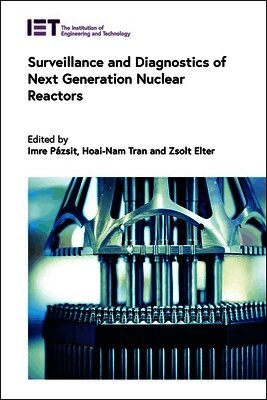
    Surveillance and Diagnostics of Next Generation Nuclear Reactors

    AvImre Pázsit,Imre Pázsit

    Inbunden, Engelska, 2026

    Del i serien Energy Engineering

    1 623 kr

    Beställningsvara. Skickas inom 3-6 vardagar. Fri frakt över 249 kr.

    Beskrivning

    Next generation nuclear reactors are expected to contribute to the future energy mix, forming part of the transition to an emission-free energy system. Diagnostics and monitoring are a necessary part of the design, development and operation of the new generation of nuclear power plants.Reactor diagnostics, particularly methods based on neutron noise analysis, have been used for traditional light and heavy water reactors, and offer benefits for early detection, identification and quantification of incipient failures. Diagnostic techniques will be useful for the next generation of power plants, including small, medium and small modular reactors (SMR), which use alternative coolant types.To expedite the planning of effective diagnostics, one needs knowledge of what problems might occur, and what methods are suitable for detecting and quantifying those problems. This book conveys a thorough study of the dynamic transfer properties of the main Gen-IV and SMR types; it also serves as a handbook for two-group power reactor noise theory for both traditional and fast systems.Chapters cover principles of reactor diagnostics and noise analysis for both thermal and fast systems, the structure of the core response in basic planned Gen-IV types and SMRs to some basic perturbations, a survey of dynamic core transfer calculational codes, zero power noise methods, instrumentation and control systems, and worldwide activities in design and planned diagnostics of SMRs.Surveillance and Diagnostics of Next Generation Nuclear Reactors is a concise and logically-structured reference for nuclear scientists, researchers and engineers involved in exploring new reactor concepts and developing designs for the coming generation of nuclear power plants.

    Produktinformation

    • Utgivningsdatum:2026-02-03
    • Mått:156 x 234 x 19 mm
    • Vikt:626 g
    • Format:Inbunden
    • Språk:Engelska
    • Serie:Energy Engineering
    • Antal sidor:318
    • Förlag:Institution of Engineering and Technology
    • ISBN:9781839537080

    Utforska kategorier

    • Energiteknik inom Naturvetenskap och teknik

    Mer om författaren

    Imre Pázsit is a professor at the Division of Subatomic, High Energy and Plasma Physics, Department of Physics at Chalmers University of Technology, Sweden, and an adjunct professor at the Department of Nuclear Engineering & Radiological Sciences of the University of Michigan, Ann Arbor, USA. His research interests include fluctuations in neutron transport, reactor diagnostics and the theory of multiplicity in nuclear safeguards. He has published over 200 articles in international journals and, together with L. Pál, is the author of the book Neutron Fluctuations - A Treatise on the Physics of Branching Processes. He is a fellow of the American Nuclear Society, a member of the Royal Swedish Academy of Engineering Sciences and the Royal Society of the Arts and Sciences in Gothenburg, and an Honorary Doctor at the Budapest University of Technology and Economics. He is also the holder of the Leo Szilárd Medal of the Hungarian Nuclear Society, the Order of the Rising Sun from the Japanese government, and the E.P. Wigner Reactor Physicist Award and the Don Miller Award from the American Nuclear Society.Hoai-Nam Tran is a professor at the Institute for Advanced Study, Phenikaa University, Vietnam. Professor Tran's research focuses on burning strategies and fuelling schemes for various reactor types, including high-temperature gas reactors and pebble bed modular reactors, their neutron characteristics and calibration, and diagnostics. Past positions include Chalmers University of Technology, Nagoya University and Tokyo Institute of Technology, Japan.Zsolt Elter works as a reactor physicist in the Swedish nuclear industry and is part-time employed as a researcher at the Division of Applied Nuclear Physics at Uppsala University, Sweden, where he teaches reactor physics. He earned his PhD in nuclear engineering under the supervision of Prof. Imre Pázsit from Chalmers University of Technology. His professional interests include Monte Carlo-based neutronics and radiation shielding simulations, as well as deterministic lattice physics methods.

    Innehållsförteckning

    • Chapter 1: IntroductionChapter 2: Principles of traditional reactor diagnostics and noise analysisChapter 3: A basic study of the structure of the core response in the basic planned Gen-IV types (metal-cooled, gas-cooled and molten salt reactors)Chapter 4: A basic study of the structure of the core response in the basic planned SMRsChapter 5: A survey of the dynamic core transfer calculational codes by the various groups worldwide, their principles, potentials for applications in Gen-IV systems and SMRsChapter 6: Developments of zero-power noise methods for fast reactor systemsChapter 7: Instrumentation and control systems diagnostics for next generation of nuclear reactorsChapter 8: Worldwide activities in design and planned diagnostics of SMRsChapter 9: Conclusions and future directionsAppendix A