• Fri frakt över 249 kr
  • •
  • Snabba leveranser
  • •
  • Billiga böcker
Kundservice

Du är på sajten för privatpersoner.

Företag, bibliotek eller offentlig verksamhet?

Du handlar på classic.bokus.com, där alla dina funktioner finns intakta.
Till classic.bokus.com
Bokus logotyp. Gå till startsidan.
  • Erbjudanden
  • Nyheter
  • Student
  • Topplistor
  • Barn & ungdom
  • Bokus Play
  • E-böcker
  • Pocketböcker
  • Spel & pussel

10% rabatt på allt med kod: NYSTART10 →

Sidfot

Mina sidor

    Hjälp

    • Kundservice
    • Vanliga frågor och svar
    • Frakt och leverans
    • Retur vid ångerrätt
    • Reklamera vara
    • Betalning
    • Köpvillkor
    • Allmänna villkor
    • Information om webbplatsens tillgänglighet

    Om Bokus

    • Om oss
    • Pressrum
    • För studenter
    • För företag
    • För bibliotek och offentlig verksamhet
    • För leverantörer
    • Hållbarhet

    Populärt

    • Aktuella erbjudanden
    • Presentkort
    • Studentlitteratur
    • Nya böcker
    • Topplistor
    • Signerade böcker
    • Engelska böcker

    Inspiration

    • Boktips
    • BookTok
    • Populära bokserier
    • Barnbokskaraktärer
    • Populära författare
    Logotyp för Bokus
    Följ oss på Facebook (extern länk)Följ oss på Instagram (extern länk)Följ oss på YouTube (extern länk)Följ oss på TikTok (extern länk)
    bokus @ CookiesAnpassa cookiesIntegritetspolicyKöpvillkor
    Till Citymail hemsida (extern länk)Till Budbee hemsida (extern länk)Till Postnord hemsida (extern länk)Till Schenker hemsida (extern länk)Till Early Bird hemsida (extern länk)Till Walleys hemsida (extern länk)
    1. Ekonomi och Ledarskap
    2. Nationalekonomi
    3. Ekonomisk historia

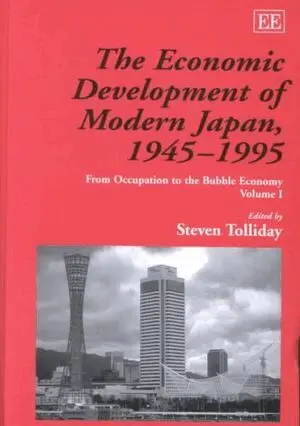
    Economic Development of Modern Japan, 1945–1995

    From Occupation to the Bubble Economy

    AvSteven Tolliday

    Inbunden, Engelska, 2001

    Del i serien Elgar Mini Series

    11 867 kr

    Beställningsvara. Skickas inom 5-8 vardagar. Fri frakt över 249 kr.

    Beskrivning

    This important collection throws light on the historical development and evolution of the economy, society and institutions in post-war Japan.It covers trends in economic development and looks at areas such as the debate on the role and significance of industrial policy; the evolution of financial and banking systems; the changing patterns of labour relations; land reform and agricultural change; and the broader economic and social structures of modern Japan.This two-volume set brings together the significant articles around these themes, including less well-known work first published in Japan. It will be an essential reference work for scholars and students of history, economics, political science and Asian studies.

    Produktinformation

    • Utgivningsdatum:2001-11-28
    • Mått:169 x 244 x undefined mm
    • Format:Inbunden
    • Språk:Engelska
    • Serie:Elgar Mini Series
    • Förlag:Edward Elgar Publishing Ltd
    • ISBN:9781840645859

    Utforska kategorier

    • Ekonomisk historia inom Ekonomi och Ledarskap
    • Internationell ekonomi inom Ekonomi och Ledarskap

    Mer om författaren

    Edited by Steven Tolliday, Professor of Economic and Social History, University of Leeds, UK

    Recensioner i media

    'Steven Tolliday has produced an excellent sequel to his earlier work with a similar title. . .'

    Innehållsförteckning

    • Contents:Volume I :AcknowledgementsIntroduction Steven TollidayPART ITRENDS IN ECONOMIC DEVELOPMENT1. Yasukichi Yasuba (1991), ‘Japan’s Post-war Growth in Historical Perspective’2. Charles Yuji Horioka (1994), ‘Japan’s Consumption and Saving in International Perspective’PART IITHE INDUSTRIAL POLICY DEBATE 3. Gregory W. Noble (1989), ‘The Japanese Industrial Policy Debate’4. Yutaka Kosai (1995), ‘Government-Business Relations and Competitiveness: The Japanese Case’ACases5. Dennis J. Encarnation and Mark Mason (1990), ‘Neither MITI nor America: The Political Economy of Capital Liberalization in Japan’6. Marie Anchordoguy (1988), ‘Mastering the Market: Japanese Government Targeting of the Computer Industry’7. Chalmers Johnson (1989), ‘MITI, MPT and the Telecom Wars: How Japan Makes Policy for High Technology’8. Michael R. Reich (1990), ‘Why the Japanese Don’t Export More Pharmaceuticals: Health Policy as Industrial Policy’9. Mark Tilton (1994), ‘Informal Market Governance in Japan’s Basic Materials Industries’PART IIIKEIRETSU AND CORPORATE GROUPS 10. Juro Hashimoto (1996), ‘How and When Japanese Economic and Enterprise Systems Were Formed’11. Hideaki Miyajima (1994), ‘The Transformation of Zaibatsu to Postwar Corporate Groups – From Hierarchically Integrated Groups to Horizontally Integrated Groups’12. Kunio Suzuki (1997), ‘From Zaibatsu to Corporate Complexes’13. Takeo Kikkawa (1995), ‘Enterprise Groups, Industry Associations, and Government: The Case of the Petrochemical Industry in Japan’14. Ronald J. Gilson and Mark J. Roe (1993), ‘Understanding the Japanese Keiretsu: Overlaps Between Corporate Governance and Industrial Organization’15. Michael L. Gerlach (1992), ‘Twilight of the Keiretsu? A Critical Assessment’PART IVSMALL BUSINESS AND SUBCONTRACTING16. Hugh T. Patrick and Thomas P. Rohlen (1987), ‘Small-Scale Family Enterprises’17. Michael J. Smitka (1990), ‘The Invisible Handshake: The Development of the Japanese Automotive Parts Industry’18. Kazuo Wada (1991), ‘The Development of Tiered Inter-firm Relationships in the Automobile Industry: A Case Study of Toyota Motor Corporation’PART VTHE DEVELOPMENT OF JAPANESE MANAGEMENT 19. Otake Hideo(1987), ‘The Zaikai Under the Occupation: The Formation and Transformation of Managerial Councils’20. Hideaki Miyajima (1993), ‘Postwar Reform in Enterprise Management: Managerial Revolution from Above and the Emergence of the "Japanese-type" Firm’21. William M. Tsutsui (1996), ‘W. Edwards Deming and the Origins of Quality Control in Japan’22. D. Eleanor Westney (1994), ‘The Evolution of Japan’s Industrial Research and Development’Name IndexVolume II: AcknowledgementsIntroduction Steven TollidayPART IINDUSTRIAL STRATEGY 1. Seiichiro Yonekura (1991), ‘The Postwar Japanese Iron and Steel Industry: Continuity and Discontinuity’2. Shin Goto (1994), ‘Competitive Advantage in the Japanese Shipbuilding Industry: the Case of IHI’3. Karel Williams, Colin Haslam, Sukhdev Johal, John Williams, Andy Adcroft and Robert Willis (1995), ‘Management Practice or Structural Factors: The Case of America versus Japan in the Car Industry’4. Haruhito Shiomi (1995), ‘The Formation of Assembler Networks in the Automobile Industry: The Case of Toyota Motor Company (1955–1980)’5. Nobuo Kawabe (1993), ‘The Development of the Retailing Industry in Japan’6. Mira Wilkins (1990), ‘Japanese Multinationals in the United States: Continuity and Change, 1879–1990’7. Mark Mason (1992), ‘The Origins and Evolution of Japanese Direct Investment in Europe’PART IIMONEY AND BANKING8. Chikage Hidaka (1997), ‘A Re-examination of Japan’s Post-War Financing System’9. Tetsuji Okazaki (1995), ‘The Evolution of the Financial System in Post-War Japan’10. Takeo Hoshi (1994), ‘The Economic Role of Corporate Grouping and the Main Bank System’11. Frances McCall Rosenbluth (1993), ‘Financial Deregulation and Interest Intermediation’PART IIILABOUR 12. Katzutoshi Koshiro (1983), ‘Development of Collective Bargaining in Postwar Japan’13. Sheldon M. Garon (1984), ‘The Imperial Bureaucracy and Labor Policy in Postwar Japan’14. Shinji Sugayama (1995), ‘Work Rules, Wages, and Single Status: The Shaping of the "Japanese Employment System"’15. Ikuo Kume (1988), ‘Changing Relations Among the Government, Labor, and Business in Japan After the Oil Crisis’16. Lonny E. Carlile (1994), ‘Sohyo versus Domei: Competing Labour Movement Strategies in the Era of High Growth in Japan’17. Kazuo Koike (1983), ‘Internal Labor Markets: Workers in Large Firms’PART IVLAND AND AGRICULTURE 18. Toshihiko Kawagoe (1993), ‘Land Reform in Postwar Japan’19. Toshihiko Kawagoe (1993), ‘Deregulation and Protectionism in Japanese Agriculture’20. Aurelia George and Eric Saxon (1986), ‘The Politics of Agricultural Protection in Japan’PART VEDUCATION AND HUMAN CAPITAL 21. Akiko Chimoto (1993), ‘The Improvement of School Education and the Development of Personnel Management in Post-Meiji Japan’22. Tamotsu Nishizawa (1997), ‘Education Change and In-Firm Training in Post-War Japan’PART VIGENDER AND SOCIETY23. Robert J. Smith (1987), ‘Gender Inequality in Contemporary Japan’24. Omori Maki (1993), ‘Gender and the Labor Market’Name Index