• Fri frakt över 249 kr
  • •
  • Snabba leveranser
  • •
  • Billiga böcker
Kundservice

Du är på sajten för privatpersoner.

Företag, bibliotek eller offentlig verksamhet?

Du handlar på classic.bokus.com, där alla dina funktioner finns intakta.
Till classic.bokus.com
Bokus logotyp. Gå till startsidan.
  • Erbjudanden
  • Nyheter
  • Student
  • Topplistor
  • Barn & ungdom
  • Bokus Play
  • E-böcker
  • Pocketböcker
  • Spel & pussel

10% rabatt på allt med kod NYSTART10 →

Sidfot

Mina sidor

    Hjälp

    • Kundservice
    • Vanliga frågor och svar
    • Frakt och leverans
    • Retur vid ångerrätt
    • Reklamera vara
    • Betalning
    • Köpvillkor
    • Allmänna villkor
    • Information om webbplatsens tillgänglighet

    Om Bokus

    • Om oss
    • Pressrum
    • För studenter
    • För företag
    • För bibliotek och offentlig verksamhet
    • För leverantörer
    • Hållbarhet

    Populärt

    • Aktuella erbjudanden
    • Presentkort
    • Studentlitteratur
    • Nya böcker
    • Topplistor
    • Signerade böcker
    • Engelska böcker

    Inspiration

    • Boktips
    • BookTok
    • Populära bokserier
    • Barnbokskaraktärer
    • Populära författare
    Logotyp för Bokus
    Följ oss på Facebook (extern länk)Följ oss på Instagram (extern länk)Följ oss på YouTube (extern länk)Följ oss på TikTok (extern länk)
    bokus @ CookiesAnpassa cookiesIntegritetspolicyKöpvillkor
    Till Citymail hemsida (extern länk)Till Budbee hemsida (extern länk)Till Postnord hemsida (extern länk)Till Schenker hemsida (extern länk)Till Early Bird hemsida (extern länk)Till Walleys hemsida (extern länk)
    1. Psykologi och pedagogik
    2. Psykologi

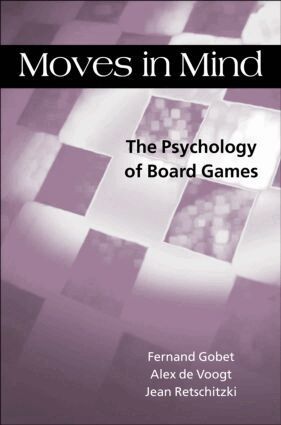
    Moves in Mind

    The Psychology of Board Games

    AvFernand Gobet,Jean Retschitzki

    Inbunden, Engelska, 2004

    2 354 kr

    Beställningsvara. Skickas inom 10-15 vardagar. Fri frakt över 249 kr.

    Fler format och utgåvor

    Häftad

    853 kr

    Beskrivning

    Board games have long fascinated as mirrors of intelligence, skill, cunning, and wisdom. While board games have been the topic of many scientific studies, and have been studied for more than a century by psychologists, there was until now no single volume summarizing psychological research into board games. This book, which is the first systematic study of psychology and board games, covers topics such as perception, memory, problem solving and decision making, development, intelligence, emotions, motivation, education, and neuroscience. It also briefly summarizes current research in artificial intelligence aiming at developing computers playing board games, and critically discusses how current theories of expertise fare with board games. Finally, it shows that the information provided by board game research, both data and theories, have a wider relevance for the understanding of human psychology in general.

    Produktinformation

    • Utgivningsdatum:2004-08-05
    • Mått:156 x 234 x 20 mm
    • Vikt:690 g
    • Format:Inbunden
    • Språk:Engelska
    • Antal sidor:288
    • Förlag:Taylor & Francis Ltd
    • ISBN:9781841693361

    Utforska kategorier

    • Psykologi inom Psykologi och pedagogik
    • Brädspel och strategispel inom Sport, fritid och hobby

    Mer om författaren

    Ferdnand Gobet is Professor of Psychology at Brunel University, West London. He is an International Master of the International Chess Federation and has played for several years with the Swiss national team.Alex de Voogt is at the University of Leiden and Managing Editor of the journal Board Game Studies. Jean Retschitzki is Professor of Psychology at the University of Fribourg. He was elected as President of the Swiss Society of Psychology in 1998

    Innehållsförteckning

    • Part 1: Introduction.Moves in Mind. Board Games and Cognitive Psychology. The Role of Board Games in Science. The Role of Board Games in Psychology. Structure of the Book. Part 2: Formal Analyses of Board Games. Fundamental Concepts. Board Games in Computer Science and Artificial Intelligence. Information and Complexity Analysis. Game Theory and the Concept of Error. Conclusion. Part 3: Theories of Board-game Psychology. A Brief History of Board-game Psychology. Theories of Chess Skill. Influences from Other Theories of Cognition. Theories of Development and Environment. Conclusion. Part 4: Perception and Categorization. Low-level Perception. High-level Perception and Categorization. Conclusion. Part 5: Memory, Knowledge, and Representations. Memory for Board Positions. Recall of Sequences of Moves and of Games. Estimation of the Number of Chunks in LTM. Mode of Representation. Representations Used in Blindfold Playing. Knowledge and Memory Schemata. Discussion. Conclusion. Part 6: Problem Solving and Decision Making. Empirical Data on Search Behaviour. Empirical Data on the Role of Perception in Problem Solving. Empirical Data on the Role of Knowledge in Problem Solving. Analogy Formation in Novice Players. Theoretical Accounts. Discussion. Conclusion. Part 7: Learning, Development and Ageing. Early Stages of Learning. Development of Play and Game Behaviour. Developmental Studies of Specific Board Games. Ageing. Conclusion. Part 8: Education and Training. Introduction. Board Game Instruction and the Transfer of Skill. Teaching the Rules and Basic Instruction. Training and Coaching at an Advanced Level. Conclusion. Part 9: Individual Differences and the Neuropsychology of Talent.Intelligence and Visuo-spatial Abilities. Personality. Emotions and Motivation. Board Games and Neuroscience. Overall Conclusion. Part 10: Methodology and Research Designs. Definitions of Expertise. Game Specificity. Illiterate Games. Ecological Validity. Cross-cultural Aspects. The Creation and Use of Archives and Databases. Observations and Natural Experiments. Interviews and Questionnaires. Introspection and Retrospection. Protocol Analysis. Standard Experimental Manipulations. Neuroscientific Approaches. Typical Research Designs. Mathematical and Computational Modelling. Weaknesses and Strengths of Methodologies Used in Board-game Research. Part 11: Conclusion. Board Game Complexity. Landscape of Board Games. Impact of Board-game Research. Future. References. Appendix 1: Rules of Board Games. Appendix 2: Measures of Expertise in Board Games. Appendix 3: Example of Protocol Analysis.