• Fri frakt över 249 kr
  • •
  • Snabba leveranser
  • •
  • Billiga böcker
Kundservice

Du är på sajten för privatpersoner.

Företag, bibliotek eller offentlig verksamhet?

Du handlar på classic.bokus.com, där alla dina funktioner finns intakta.
Till classic.bokus.com
Bokus logotyp. Gå till startsidan.
  • Erbjudanden
  • Nyheter
  • Student
  • Topplistor
  • Barn & ungdom
  • Bokus Play
  • E-böcker
  • Pocketböcker
  • Spel & pussel

10% rabatt på allt med kod NYSTART10 →

Sidfot

Mina sidor

    Hjälp

    • Kundservice
    • Vanliga frågor och svar
    • Frakt och leverans
    • Retur vid ångerrätt
    • Reklamera vara
    • Betalning
    • Köpvillkor
    • Allmänna villkor
    • Information om webbplatsens tillgänglighet

    Om Bokus

    • Om oss
    • Pressrum
    • För studenter
    • För företag
    • För bibliotek och offentlig verksamhet
    • För leverantörer
    • Hållbarhet

    Populärt

    • Aktuella erbjudanden
    • Presentkort
    • Studentlitteratur
    • Nya böcker
    • Topplistor
    • Signerade böcker
    • Engelska böcker

    Inspiration

    • Boktips
    • BookTok
    • Populära bokserier
    • Barnbokskaraktärer
    • Populära författare
    Logotyp för Bokus
    Följ oss på Facebook (extern länk)Följ oss på Instagram (extern länk)Följ oss på YouTube (extern länk)Följ oss på TikTok (extern länk)
    bokus @ CookiesAnpassa cookiesIntegritetspolicyKöpvillkor
    Till Citymail hemsida (extern länk)Till Budbee hemsida (extern länk)Till Postnord hemsida (extern länk)Till Schenker hemsida (extern länk)Till Early Bird hemsida (extern länk)Till Walleys hemsida (extern länk)
    1. Psykologi och pedagogik
    2. Psykologi

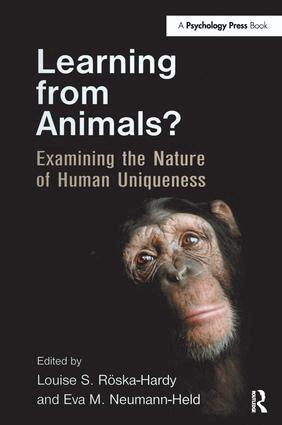
    Learning from Animals?

    Examining the Nature of Human Uniqueness

    AvLouise S. Röska-Hardy,Eva M. Neumann-Held

    Inbunden, Engelska, 2008

    2 355 kr

    Beställningsvara. Skickas inom 10-15 vardagar. Fri frakt över 249 kr.

    Beskrivning

    Human language, cognition, and culture are unique; they are unparalleled in the animal kingdom. The claim that we can learn what makes us human by studying other animal species provokes vigorous reactions and many deny that comparative research can shed any light on the origins and character of human distinctive capacities. However, Learning from Animals? presents empirical research and an analysis of comparative approaches for an understanding of human uniqueness, arguing that we cannot know what capacities are uniquely human until we learn what other species can do.This interdisciplinary volume explores the prospects and problems of comparative approaches for understanding modern humans’ abilities by presenting: (1) the latest findings and theoretical approaches in primatology, comparative psychology, linguistics, and philosophy; (2) methodological reflections on the prospects and challenges of understanding human capacities through comparative research strategies; and (3) discussions of conceptual and ethical issues. This is the first book to address the issues raised by comparative research from such a diverse perspective. It will therefore be of great interest to students, researchers, and professionals in comparative psychology, linguistics, primatology, biology, and philosophy.

    Produktinformation

    • Utgivningsdatum:2008-10-17
    • Mått:156 x 234 x 26 mm
    • Vikt:566 g
    • Format:Inbunden
    • Språk:Engelska
    • Antal sidor:280
    • Förlag:Taylor & Francis Ltd
    • ISBN:9781841697079

    Utforska kategorier

    • Psykologi inom Psykologi och pedagogik

    Mer om författaren

    Louise S. Röska-Hardy studied philosophy and linguistics, before taking her doctorate in philosophy, sociology, and linguistics in Frankfurt am Main. She has taught philosophy and linguistics at universities in Germany, Switzerland, and the USA.Eva M. Neumann-Held studied biology and philosophy. As researcher and lecturer she participated in numerous biophilosophical projects, among them "Genome and Organisms: Philosophical Interpretations of Developmental Biology". Currently she lectures in philosophy and biophilosophy at the University of Witten-Herdecke, Germany.Röska-Hardy and Neumann-Held are among the founders of the interdisciplinary research group "What are human beings? Culture—Language—Nature" (University of Dortmund and KWI).

    Recensioner i media

    "The editors of Learning from Animals? approached the question of comparative cognition from a novel perspective. ... They challenged contributors to use what we know about animals to better understand ourselves. ...We can learn much from that perspective." - Thomas R. Zentall, University of Kentucky, USA, in The Psychological Record"This is a comprehensive introduction to the field for newcomers, and a helpful tool for exemplifying where collaboration between traditionally separate methodological approached would provide a benefit." - Ruth Wiseman, World Society for the Protection of Animals, in Animal Welfare "Anyone with an interest in the origins of human intelligence will find this book of considerable interest. The wide-ranging and admirably clear chapters are by an impressive array of experts who present a scholarly review of how language, culture and cognition in humans is different from that in other animals." - John M. Pearce, School of Psychology, Cardiff University"Written by experts in the relevant fields, this book provides an engaging and informative introduction to the theoretical and methodological issues surrounding our attempts to learn about how animals, and humans, think. For those interested in comparative psychology, ethology, psycholinguistics, and related disciplines, this book makes essential reading." - Britta Osthaus, Canterbury Christ Church University

    Innehållsförteckning

    • J. Call, Foreword. Acknowledgements. L.S. Röska-Hardy, Introduction - Issues and Themes in Comparative Studies: Language, Cognition, and Culture. Part 1. Language. W. T. Fitch, Prolegomena to a Science of Biolinguistics. W. Wildgen, Sketch of an Evolutionary Grammar Based on Comparative Biolinguistics. A. Meguerditchian, J. Vauclair, Vocal and Gestural Communication in Nonhuman Primates and the Question of the Origin of Language. Part 2. Cognition. K.A. Bard, D.A. Leavens, Socioemotional Factors in the Development of Joint Attention in Human and Ape Infants. H. Rakoczy, Collective Intentionality and the Roots of Human Societal Life. J.-M. Burkart, Socio-cognitive Abilities and Cooperative Breeding. Z. Virányi, F. Range, L. Huber, Attentiveness Toward Others and Social Learning in Domestic Dogs. I. Brinck, From Similarity to Uniqueness: Method and Theory in Comparative Psychology. Part 3. Culture. C.A. Caldwell, Experimental Approaches to the Study of Culture in Primates. W. C. McGrew, How the Chimpanzee Stole Culture, or Lessons Learned from Labours in Cultural Primatology. D. Jamieson, Great Apes and the Human Resistance to Equality. M. Kettner, Apes and Human Dignity. L.S. Röska-Hardy, Postscript: Human Uniqueness in a Comparative Perspective.