• Fri frakt över 249 kr
  • •
  • Snabba leveranser
  • •
  • Billiga böcker
Kundservice

Du är på sajten för privatpersoner.

Företag, bibliotek eller offentlig verksamhet?

Du handlar på classic.bokus.com, där alla dina funktioner finns intakta.
Till classic.bokus.com
Bokus logotyp. Gå till startsidan.
  • Erbjudanden
  • Nyheter
  • Student
  • Topplistor
  • Barn & ungdom
  • Bokus Play
  • E-böcker
  • Pocketböcker
  • Spel & pussel

10% studentrabatt med kod TERM26

Sidfot

Mina sidor

    Hjälp

    • Kundservice
    • Vanliga frågor och svar
    • Frakt och leverans
    • Retur vid ångerrätt
    • Reklamera vara
    • Betalning
    • Köpvillkor
    • Allmänna villkor
    • Information om webbplatsens tillgänglighet

    Om Bokus

    • Om oss
    • Pressrum
    • För studenter
    • För företag
    • För bibliotek och offentlig verksamhet
    • För leverantörer
    • Hållbarhet

    Populärt

    • Aktuella erbjudanden
    • Presentkort
    • Studentlitteratur
    • Nya böcker
    • Topplistor
    • Signerade böcker
    • Engelska böcker

    Inspiration

    • Boktips
    • BookTok
    • Populära bokserier
    • Barnbokskaraktärer
    • Populära författare
    Logotyp för Bokus
    Följ oss på Facebook (extern länk)Följ oss på Instagram (extern länk)Följ oss på YouTube (extern länk)Följ oss på TikTok (extern länk)
    bokus @ CookiesAnpassa cookiesIntegritetspolicyKöpvillkor
    Till Citymail hemsida (extern länk)Till Budbee hemsida (extern länk)Till Postnord hemsida (extern länk)Till Schenker hemsida (extern länk)Till Early Bird hemsida (extern länk)Till Walleys hemsida (extern länk)
    1. Samhälle och politik
    2. Politik och statsskick

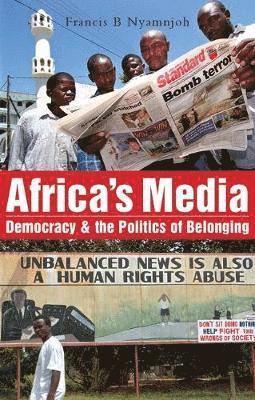
    Africa's Media, Democracy and the Politics of Belonging

    AvFrancis B. Nyamnjoh

    Häftad, Engelska, 2005

    507 kr

    Beställningsvara. Skickas inom 10-15 vardagar. Fri frakt över 249 kr.

    Beskrivning

    This major study explores the role of the mass media in promoting democracy and empowering civil society in Africa. The author contextualizes Africa within in the rapidly changing global media and shows how patterns of media ownership and state control have evolved and the huge difficulties under which most African media workers labour. The author also explores the whole question of media ethics and professionalism in Africa. The general analysis is supported by a very detailed unique case study of Cameroon. Nyamnjoh is critical of the Western-derived institutional framework for multi-party democracy that overlooks the social realities of African citizens‘ multiple identities, and their cultural orientation to communal values. He also concludes that African governments have gone very little way in encouraging independent media, but that the media themselves must also share some of the blame.

    Produktinformation

    • Utgivningsdatum:2005-05-17
    • Mått:140 x 216 x 19 mm
    • Vikt:453 g
    • Format:Häftad
    • Språk:Engelska
    • Antal sidor:320
    • Förlag:Bloomsbury Publishing PLC
    • ISBN:9781842775837

    Utforska kategorier

    • Politik och statsskick inom Samhälle och politik

    Mer om författaren

    Dr Francis B. Nyamnjoh is associate professor of sociology and head of publications and communications with the Council for the Development of Social Science Research in Africa (CODESRIA).

    Recensioner i media

    'This is an exceptionally rich and thought-provoking work. Nyamnjoh gives us a vivid, well researched picture of the new African media landscape, while asking probing questions about both journalistic practice and the meaning of democracy. Refusing to settle for either a simplistic celebration of "democracy in Africa" or a facile denunciation of its failures, he instead asks a series of hard questions - questions directed both to those African journalists whose standards of conduct he sometimes finds wanting, and to those outsiders who confidently promote and prescribe a Western liberal model of democracy that allows little room for the relationships and solidarities within which actual media workers must make their choices.'James Ferguson, Department of Cultural and Social Anthropology, Stanford University‘Nyamnjoh‘s analysis innovatively develops a new conceptual framework in assessing studies on, and the state of, African media and how people use them. His theoretical achievement is to critique African essentialism on the one hand, while developing an indigenised critical theory on the other. He speaks from Africa, about Africa, in an engagement with Western theory, assumptions and policies. This study is a breakthrough.'Keyan G. Tomaselli, University of KwaZulu-Natal and President, South African Communication Association'Nyamnjoh's book is a worthwhile addition to the growing body of knowledge on African communication and politics. It is creatively rendered in a descriptive and critical style that combines the anthropologist‘s eyes for patterned behaviour and the journalist's nose for social criticism. The result is a delicious rendition on the complex role of communication in democracy. This should be required reading in journalism, political science, and sociology.'Charles Okigbo, Department of Communication, North Dakota State University'This latest work by Professor Francis Nyamnjoh raises the level of the debate on the media and the democratization agenda in Africa to a very high level with perceptive and insightful analysis of the problematic. The work is informed, detailed, useful, and meaningful. It serves as an outstanding contribution and source for scholars, professionals and top-level decision makers in the area of media and democracy in Africa. It is a "must" text for all students of mass media and development in Africa.Cecil Blake, Chair, Africana Studies Department, University of Pittsburgh‘Well written - a must read. This book presents a detailed analysis of the role and place of Africa‘s media in its search for democratisation and cultural identities. Francis Nyamnjoh is neither apologetic nor defensive about the major problems Africa faces. Contrary to many of his compatriots, he doesn‘t join the Western power-bashers either. In a well-documented and balanced way Nyamnjoh advocates genuine communication and democracy in a broad and participatory sense. This book should be core reading for anyone with an interest in Africa.'Jan Servaes, editor-in-chief, Communication for Development and Social Change: The Global Journal‘Francis Nyamnjoh's work is a welcome arrival in the global context where there are relatively few African contributions to media and communication studies literature. Readers interested in media and democracy in African contexts will benefit from Nyamnjoh's book.'Lucky Madikiza, Development Bank of Southern Africa'Provokes a debate on how Africa's media combine the ideals of liberal democracy with other models of democracy informed by its historical experiences and cultural, economic and indigenous political realities...the book thoroughly investigates the practice of journalism as a profession in Africa. Indeed, it articulates the divergent attitudes of acceptance of the profession by civil society in Africa and its contribution to democratization as a whole.'Political Studies Review'An informative and quite comprehensive overview of the media situation in Africa, especially as it relates to the ongoing process of democratization...rich in facts and details.'Political Science Quarterly‘These studies provide valuable insights into the operation of the media in Africa, at least in some parts of it.'African Studies Review

    Innehållsförteckning

    • 1. In the Name of Democracy: The Press and Its Predicaments2. Media Ethics, Professionalism and Training in Africa3. Multiparty Politics in Cameroon4. The Official Media, Belonging and Democratisation5. The Legal Framework and the Private Press6. Professionalism and Ethics in the Private Press in Cameroon7. Creative Appropriation of ICTs, Rumour, Press Cartoons and Politics8. Liberal Democracy: Victim of a Partisan and Ethnic Press9. Communication Policies in Africa: Lessons from the West