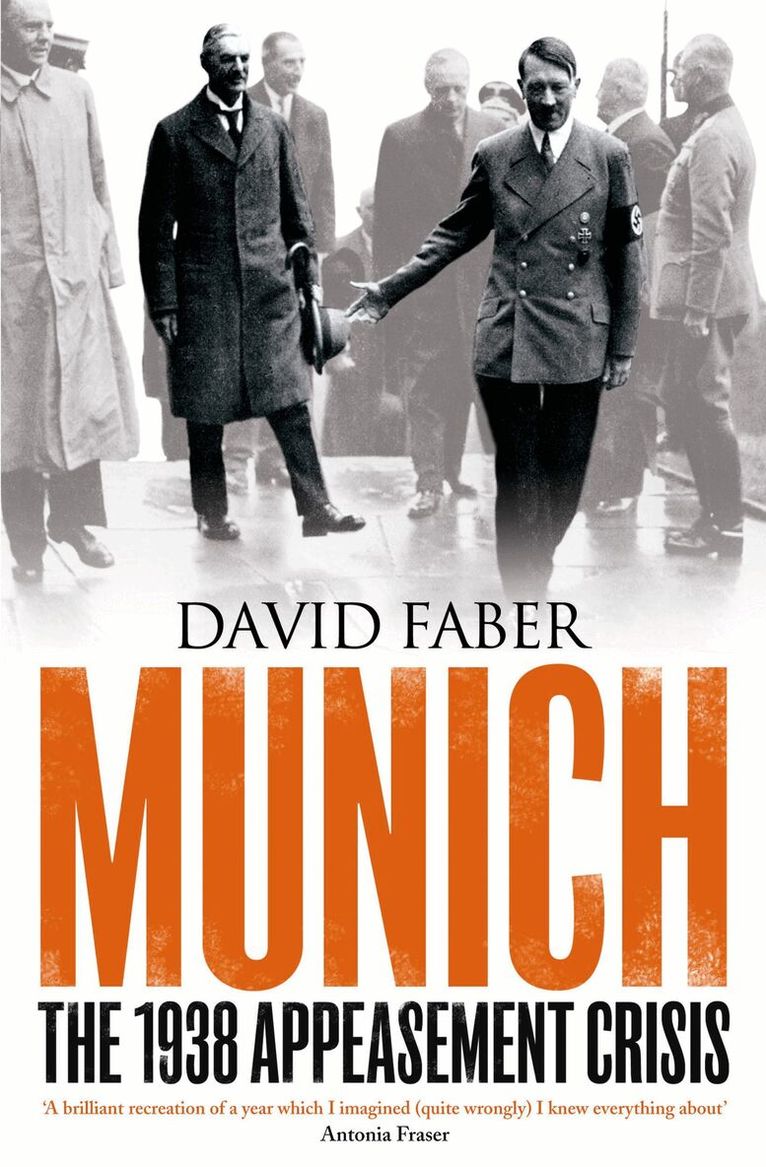
'A masterwork of advocacy' Daily Mail 5/9 'Faber has made an important contribution to our understanding of the diplomatic debacle which signalled the start of the Second World War' John Crossland, Independent on Sunday 21/9 'David Faber's account of the Munich crisis has been published to mark the 70th anniversary of the four-power conference that made appeasement a dirty word. But it is timely as well as commemorative. True, the recent comparisons drawn between Hitler and Putin are misplaced. Nonetheless, Western politicians are finding themselves debating the same sort of issues over Georgia - with Ukraine and the Baltic States to follow - that divided their forebears over Hitler's Czechoslovakian demands in 1938. Are national boundaries inviolate or subject to revision along ethnic grounds? Would offering guarantees to small countries protect them or make confrontation from their big neighbour more certain? Most fundamental of all, to what extent should concessions be forced from what Neville Chamberlain once called 'people of whom we know nothing' in order to preserve the peace and quiet of the rest of us? ... Faber has written a compelling work of narrative history' The Spectator 27/9 'Given how indispensable an insult "appeasement" has since become in our political discourse, it's eerie to find, in Faber's absorbing account, just how thoroughly at ease so many people were with the idea back in the 1930s. While there were some who saw through it -- most notably Churchill, of course -- it's a shock to see how happy most people appear to have been to let themselves be fooled, and to accept the claim that this was "peace with honour"' The Scotsman 27/9 Historians analyse; novelists dramatise. But a historian who wants to be widely read must also possess the novelist's verve and brio. David Faber, grandson of Harold Macmillan, belongs to that very select number. He proves it unequivocally in his magnificent study of the Munich crisis publishedin September to mark its seventieth anniversary ... Faber takes us on a superb historical tour - from London to the cities of Berlin, Vienna, Rome, Paris and Prague - to explain how Chamberlain reached this moment of glory which was to turn so rapidly to dust ... For most of the last seventy years Munich has inspired deep, moral revulsion. It is time for a more measured judgment. If you read only one book of political history this year, read this one' My book of the year - Munich 70 years on Alistair Cooke, Sunday, November 2 2008 'Faber's account is lucid and absorbing. Drawing on a wide range of sources, he is able to flesh out a vivid depiction of the episode and its chief protagonists - Chamberlain, Mussolini, and, of course, Hitler himself' Family History Monthly, Nov issue 'Offers a day-by-day - and, in its later stages, an hour-by-hour - narrative of the diplomatic shenanigans that preceded Hitler's two-phased invasion of Czechoslovakia' Daily Telegraph 15/11 '[Munich] offers compelling character sketches of leading dramatis personae such as Sir Neville Henderson, whom a fellow diplomat described as 'Hitler's ambassador to us, rather than ours to Hitler.' It provides some new details culled from wide reading and archival research. It even contains a photograph of the Swastika being raised over Cardiff's City Hall on Oct 2nd, 1938, by order of the Lord Mayor, to celebrate Neville Chamberlain's triumph' History Today, Dec issue 'Faber tells a lively story ... fleshed out with a lot of informative, sometimes amusing detail ... thorough, well-researched and easy to read' Literary Review 'A brilliant recreation of a year which I imagined (quite wrongly) I knew everything about. It is interesting to note that Chamberlain comes out of it even worse that the traditional view, Churchill better and most of the other politicians badly, with the exception of Duff Cooper and, of course, Anthony Eden' Antonia Fraser, History Today, Dec issue 'David Faber adds to his already considerable reputation as a shrewd analyst of twentieth century politics with this new study of the Munich Crisis. Firmly based on primary sources, some previously unused, the book is a sparkling and perceptive account of events that still resonate seventy years on.' D. R. Thrope 'A fascinating reconstruction of one of the most squalid events in European diplomatic history. After reading his book it is to be hoped that apologists for Chamberlain will stop apologising' Ronald Harwood, Books of the Year, Sunday Telegraph 30/11