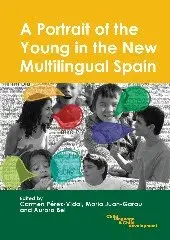
Häftad, Engelska, 2007
Portrait of the Young in the New Multilingual Spain
Av Carmen Pérez-Vidal, Maria Juan-Garau, Aurora Bel
Del 9 i serien Child Language and Child Development
514 kr
Beställningsvara. Skickas inom 5-8 vardagar. Fri frakt över 249 kr.
Beskrivning
Produktinformation
- Utgivningsdatum: 2007-11-12
- Mått: 148 x 210 x 17 mm
- Vikt: 398 g
- Format: Häftad
- Språk: Engelska
- Serie: Child Language and Child Development
- Antal sidor: 312
- Förlag: Channel View Publications Ltd
- ISBN: 9781847690227
Utforska kategorier
Mer om författaren
Carmen Pérez Vidal received her MA in Applied Linguistics from the University of Reading, UK, and her PhD in English linguistics from the University of Barcelona (Spain). She is Associate Professor in English Linguistics and Language Acquisition at Pompeu Fabra University (Barcelona, Spain), where she is Vicerector of Languages and coordinator of the ALLENCAM and SALA projects. Her research interests and recent publications deal with bilingual, second and foreign language acquisition in different contexts of learning: natural, formal, immersion and stay abroad. She has specialised in writing and the age factor, content and language integrated learning and input effects.Maria Juan-Garau is Associate Professor in English and Vicedean of the Faculty of Philosophy and Arts at the Universitat de les Illes Balears (Spain), where she currently teaches courses in Applied Linguistics and Language Acquisition research methods. She has also taught EFL at secondary and tertiary level and has been involved in language teacher education. Her research interests and publications include bilingual first language acquisition, with a focus on the pragmatic aspects of mixing, the linguistic analysis of specialized language corpora, and the influence of learning context in foreign language acquisition, with special attention to the effects of study abroad.Aurora Bel is Associate Professor at the Universitat Pompeu Fabra (Barcelona, Spain). She currently teaches Language Acquisition and Psycholinguistics. Her interests comprise the acquisition of Spanish and Catalan as first and second languages in multilingual environments, particularly the acquisition of morphosyntax and semantics. Her latest publications include the acquisition of agreement and the study of the knowledge and factors that explain the use of grammatical subjects by different populations of learners (L1, L2). Recently she is also focusing on the abnormal development of language and the language of translators.
Recensioner i media
"It is no surprise that a large amount of interesting contemporary work on all aspects of bi-tri-and multilingualism emanates from Spain. A portrait of the young in the new multilingual Spain provides a rich example of this work, covering many aspects, both internal and external, of a multi-faceted phenomenon. Factors taken into account include the context of acquisition linguistic input, the "critical mass" hypothesis, the role of the classroom "personal factors" learners with SLI, learners of different ages, the role of literacy and the nature of bilingual linguistic competence: Grosjean's "the bilingual is not two monolinguals in one person". From the grammatical point of view this last factor finds an almost ideal testing ground in Spain, with the availability of bilinguals speaking closely-related languages (Spanish and Catalan) and non-related languages (Basque and Spanish), a fact reflected in this book. Finally, and above all, this book is a striking example of the way attitudes to bi-and multilingualism have changed."
Betyg & recensioner
0 recensioner
Inga recensioner tillgängliga.