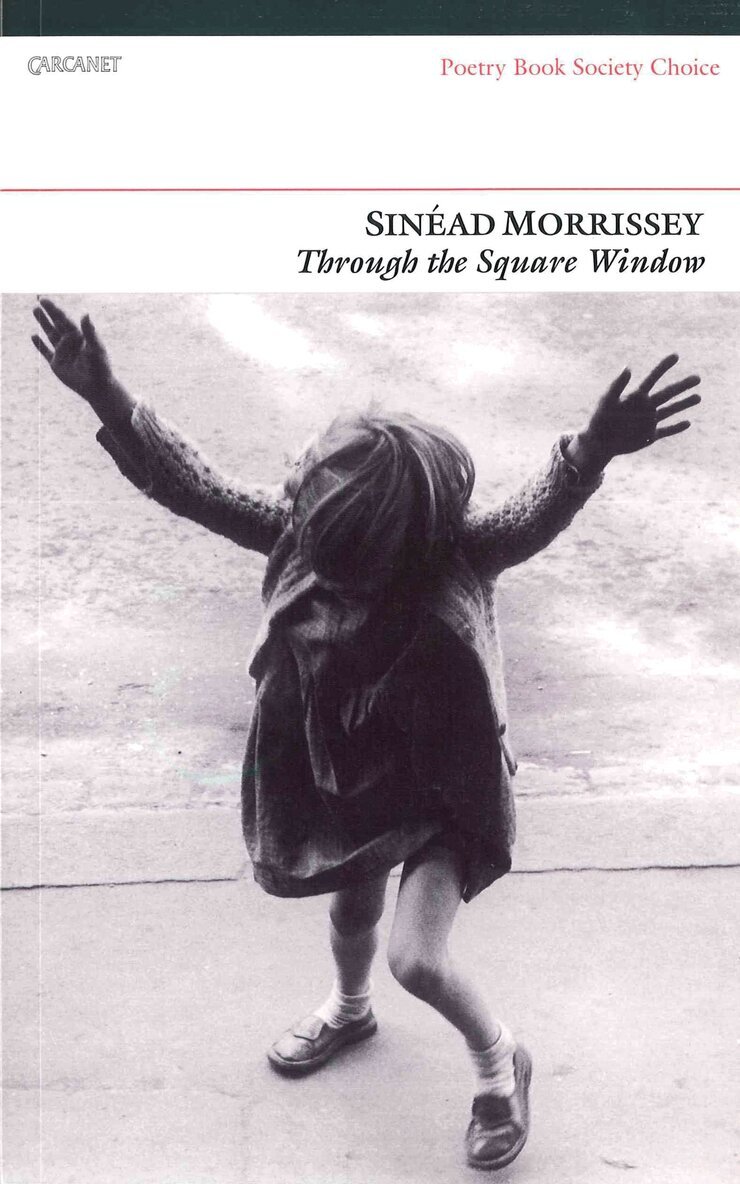
Through the Square Window
127 kr
Skickas . Fri frakt över 249 kr.
Du är på sajten för privatpersoner.
127 kr
Skickas . Fri frakt över 249 kr.
Sinéad Morrissey was born in Northern Ireland in 1972 and educated at Trinity College, Dublin. She has published six collections with Carcanet as well as a selected poems, Found Architecture (2020). Her awards include a Lannan Literary Fellowship (2007), First Prize in the UK National Poetry Competition (2007), the Irish Times Award (2009, 2013) and the T S Eliot Prize for her fifth collection, Parallax, in 2013. In 2016 she received the E M Forster Award from the American Academy of Arts and Letters. Her latest collection, On Balance (2017) was awarded the Forward Prize and was a Poetry Book Society Choice. In 2020 Sinéad Morrissey was named the European Poet of Freedom by the City of Gdańsk, Poland and in 2024 she was the recipient of the Seamus Heaney Award (Japan). She has served as Belfast Poet Laureate and in 2019 was elected a Fellow of the Royal Society of Literature. She is currently Professor of Creative Writing at Newcastle University. Sinéad Morrissey is a frequent contributor to PN Review.Author photo credit: Clare Bowles
Avoiding the lure of the idyll - Fiona Sampson Sinead Morrissey's Through the Square Window is already a Poetry Book Society Choice and short-listed for the TS Eliot Prize: and rightly so. This grown-up, serious volume dares, as writing in these islands rarely does, to range from European history ('a territory so seeming rich /and decorous') to motherhood, by way of speculations on the nature of Matter, and dark 'found' stories, from Arkansas or 'our back door'. Though one might expect a Belfast writer to deal with political history (is there any other kind?) and, as a woman, in family narratives, it is a mark of Morrissey's poetic authority that she gives no sense of going through the usual confessional motions. This collection is authentic, instead, to a confident, inquiring intelligence that makes itself felt on every page.In Electric Edwardians, boldly revisiting the territory of Philip Larkin's great MCMXIV, Morrissey notices children 'simply staring back at us, across the lens's promise, //as though we still held Passchendaele in our pockets /and could find a way to save them'. Her poems of pregnancy deliver an equal existential drop. In the extraordinary Matter, which moves through 'the laws of spontaneous generation' to observe a contemporary conception, 'I still think /of our lovemaking as a kind of door /to wherever you were, waiting in matter, /spooled into a form I have not yet been shown'. This slip into abstraction is executed with such grace that we believe we're reading about empirical science – then find we've imagined conception afresh.'Love, the night-watch . . .' is equally generous in the world it recruits to make sense of the moments of birth: from radio call-signs to its metaphor of the mother as a haystack 'collapsing almost imperceptibly /at first, then caving in spectacularly'. Nothing compromises the beautiful diction of this touching poem – and yet there is a wry self-knowing, akin to humour, on display. The Hanging Hare, which might have settled for straight observation of the creature's 'foxglove fur', instead shows us what it stands for – a capacious vision 'of unimpeded air, /of whitethorn-quartered fields'. A sequence of dark parables – Vanity Fair, The Innocents, Fairground Music, Telegraph: none of these titles innocent of resonance – confirms that all is not sweetness and light in Morrissey’s imaginary; and with this new dark note, threat or promise, the collection promises yet more for the future.
Du är på sajten för privatpersoner.
127 kr
Skickas . Fri frakt över 249 kr.
Sinéad Morrissey was born in Northern Ireland in 1972 and educated at Trinity College, Dublin. She has published six collections with Carcanet as well as a selected poems, Found Architecture (2020). Her awards include a Lannan Literary Fellowship (2007), First Prize in the UK National Poetry Competition (2007), the Irish Times Award (2009, 2013) and the T S Eliot Prize for her fifth collection, Parallax, in 2013. In 2016 she received the E M Forster Award from the American Academy of Arts and Letters. Her latest collection, On Balance (2017) was awarded the Forward Prize and was a Poetry Book Society Choice. In 2020 Sinéad Morrissey was named the European Poet of Freedom by the City of Gdańsk, Poland and in 2024 she was the recipient of the Seamus Heaney Award (Japan). She has served as Belfast Poet Laureate and in 2019 was elected a Fellow of the Royal Society of Literature. She is currently Professor of Creative Writing at Newcastle University. Sinéad Morrissey is a frequent contributor to PN Review.Author photo credit: Clare Bowles
Avoiding the lure of the idyll - Fiona Sampson Sinead Morrissey's Through the Square Window is already a Poetry Book Society Choice and short-listed for the TS Eliot Prize: and rightly so. This grown-up, serious volume dares, as writing in these islands rarely does, to range from European history ('a territory so seeming rich /and decorous') to motherhood, by way of speculations on the nature of Matter, and dark 'found' stories, from Arkansas or 'our back door'. Though one might expect a Belfast writer to deal with political history (is there any other kind?) and, as a woman, in family narratives, it is a mark of Morrissey's poetic authority that she gives no sense of going through the usual confessional motions. This collection is authentic, instead, to a confident, inquiring intelligence that makes itself felt on every page.In Electric Edwardians, boldly revisiting the territory of Philip Larkin's great MCMXIV, Morrissey notices children 'simply staring back at us, across the lens's promise, //as though we still held Passchendaele in our pockets /and could find a way to save them'. Her poems of pregnancy deliver an equal existential drop. In the extraordinary Matter, which moves through 'the laws of spontaneous generation' to observe a contemporary conception, 'I still think /of our lovemaking as a kind of door /to wherever you were, waiting in matter, /spooled into a form I have not yet been shown'. This slip into abstraction is executed with such grace that we believe we're reading about empirical science – then find we've imagined conception afresh.'Love, the night-watch . . .' is equally generous in the world it recruits to make sense of the moments of birth: from radio call-signs to its metaphor of the mother as a haystack 'collapsing almost imperceptibly /at first, then caving in spectacularly'. Nothing compromises the beautiful diction of this touching poem – and yet there is a wry self-knowing, akin to humour, on display. The Hanging Hare, which might have settled for straight observation of the creature's 'foxglove fur', instead shows us what it stands for – a capacious vision 'of unimpeded air, /of whitethorn-quartered fields'. A sequence of dark parables – Vanity Fair, The Innocents, Fairground Music, Telegraph: none of these titles innocent of resonance – confirms that all is not sweetness and light in Morrissey’s imaginary; and with this new dark note, threat or promise, the collection promises yet more for the future.