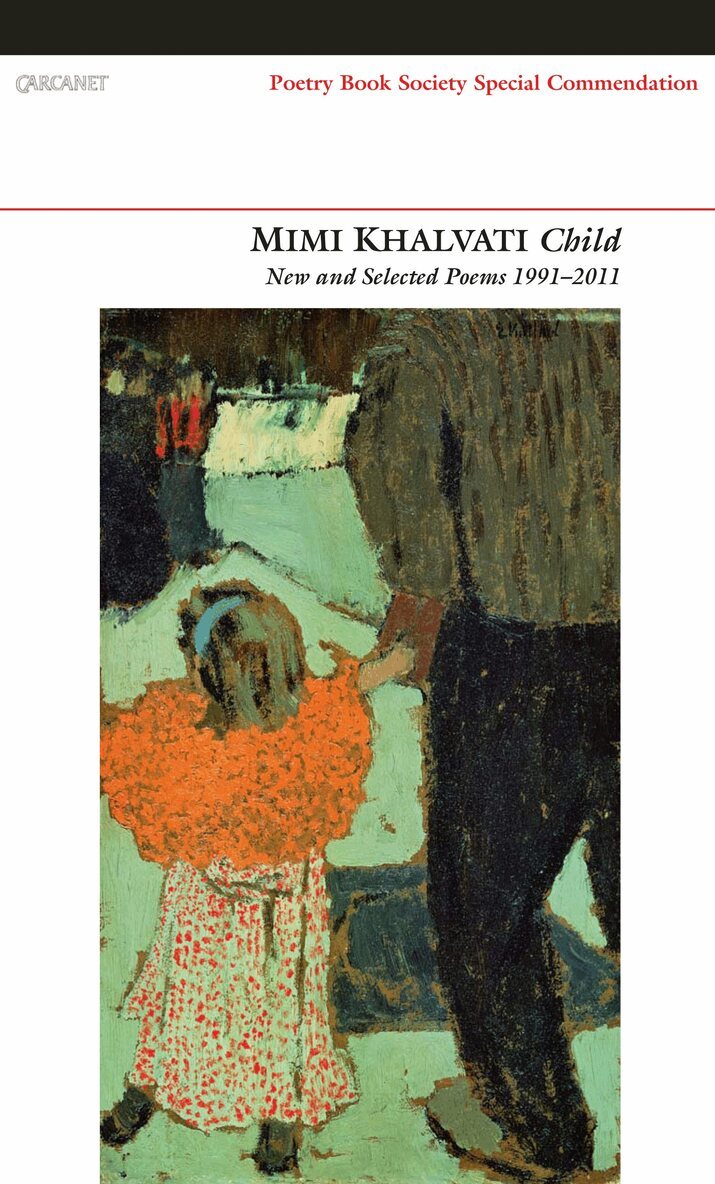
Child
New and Selected Poems 1991-2011
162 kr
Skickas . Fri frakt över 249 kr.
Du är på sajten för privatpersoner.
162 kr
Skickas . Fri frakt över 249 kr.
Mimi Khalvati was born in Tehran, Iran, and grew up on the Isle of Wight. She has lived most of her life in London. After training at Drama Centre London, she worked as an actor in the UK and as a director at the Theatre Workshop Tehran and on the fringe in London. She has published nine poetry collections with Carcanet Press, including The Meanest Flower, shortlisted for the T.S. Eliot Prize 2007, Child: New and Selected Poems 1991-2011, a Poetry Book Society Special Commendation, The Weather Wheel, a PBS Commendation and a book of the year in The Independent, and Afterwardness, a book of the year in The Sunday Times and The Guardian. She was a co-winner of the Poetry Business Pamphlet Competition 1989 and her Very Selected Poems appeared from Smith/Doorstop in 2017. She has been Poet in Residence at the Royal Mail and has held fellowships at the International Writing Program in Iowa as the recipient of the William B. Quarton International Writing Program Scholarship, at the American School in London and at the Royal Literary Fund, City University. She is the founder of The Poetry School and has co-edited its three anthologies of new writing published by Enitharmon Press. Her awards include a Cholmondeley Award from the Society of Authors, a major Arts Council Award and she is a Fellow of the Royal Society of Literature and of The English Society. In 2023 she was awarded the King's Gold Medal for Poetry.
This wonderful selection, drawing on Khalvati's five previous books as well as new material, is full of moving, quietly insightful meditations on family and domestic spaces, on routines and daily rhythms.One of the outstanding pieces, 'Sundays', has a typically accomplished intimacy and directness. There's a sense here of poetry as something restorative, a means of gauging a fragile balance between safety and threat ('And suddenly / there's sunshine, brightness and a bounce / and his fingers are dancing. Voices / might bedevil him but voices also // save him').Other more wide-ranging poems provide explorations of history and nationality, but these are frequently rooted in the near at hand, the glimpse of sudden, elusive perspectives. The sonnet sequence 'The Meanest Flower', for example, relishes such shifting intimate dynamics as it swerves between images of childhood and motherhood.The book is divided into five parts, the first four ordered autobiographically (rather than by date of composition). And it is the pieces about Khalvati's childhood on the Isle of Wight that, in many ways, are the most successful – the isolation conjured in 'Writing Home' and 'Writing Letters', the use of landscape and careful symbolism in 'The Chine', the clarity and poise of 'Rubaiyat', an elegy for her grandmother.'Iowa Daybreak', one of the more recent works from the book's last section, provides a sustained and thoughtful exploration of Khalvati's approach. The lyricism has a tremendous delicacy and self-awareness. At its centre she contrasts her own close-range aesthetic with Emily Dickinson's visions of 'the dark and deep' - 'Depths were never truths I reached. / More, the quiet monotony I never // thought of as monotony / but peace. Nothing I loved more / than making torn things whole.'
Du är på sajten för privatpersoner.
162 kr
Skickas . Fri frakt över 249 kr.
Mimi Khalvati was born in Tehran, Iran, and grew up on the Isle of Wight. She has lived most of her life in London. After training at Drama Centre London, she worked as an actor in the UK and as a director at the Theatre Workshop Tehran and on the fringe in London. She has published nine poetry collections with Carcanet Press, including The Meanest Flower, shortlisted for the T.S. Eliot Prize 2007, Child: New and Selected Poems 1991-2011, a Poetry Book Society Special Commendation, The Weather Wheel, a PBS Commendation and a book of the year in The Independent, and Afterwardness, a book of the year in The Sunday Times and The Guardian. She was a co-winner of the Poetry Business Pamphlet Competition 1989 and her Very Selected Poems appeared from Smith/Doorstop in 2017. She has been Poet in Residence at the Royal Mail and has held fellowships at the International Writing Program in Iowa as the recipient of the William B. Quarton International Writing Program Scholarship, at the American School in London and at the Royal Literary Fund, City University. She is the founder of The Poetry School and has co-edited its three anthologies of new writing published by Enitharmon Press. Her awards include a Cholmondeley Award from the Society of Authors, a major Arts Council Award and she is a Fellow of the Royal Society of Literature and of The English Society. In 2023 she was awarded the King's Gold Medal for Poetry.
This wonderful selection, drawing on Khalvati's five previous books as well as new material, is full of moving, quietly insightful meditations on family and domestic spaces, on routines and daily rhythms.One of the outstanding pieces, 'Sundays', has a typically accomplished intimacy and directness. There's a sense here of poetry as something restorative, a means of gauging a fragile balance between safety and threat ('And suddenly / there's sunshine, brightness and a bounce / and his fingers are dancing. Voices / might bedevil him but voices also // save him').Other more wide-ranging poems provide explorations of history and nationality, but these are frequently rooted in the near at hand, the glimpse of sudden, elusive perspectives. The sonnet sequence 'The Meanest Flower', for example, relishes such shifting intimate dynamics as it swerves between images of childhood and motherhood.The book is divided into five parts, the first four ordered autobiographically (rather than by date of composition). And it is the pieces about Khalvati's childhood on the Isle of Wight that, in many ways, are the most successful – the isolation conjured in 'Writing Home' and 'Writing Letters', the use of landscape and careful symbolism in 'The Chine', the clarity and poise of 'Rubaiyat', an elegy for her grandmother.'Iowa Daybreak', one of the more recent works from the book's last section, provides a sustained and thoughtful exploration of Khalvati's approach. The lyricism has a tremendous delicacy and self-awareness. At its centre she contrasts her own close-range aesthetic with Emily Dickinson's visions of 'the dark and deep' - 'Depths were never truths I reached. / More, the quiet monotony I never // thought of as monotony / but peace. Nothing I loved more / than making torn things whole.'