• Fri frakt över 249 kr
  • •
  • Snabba leveranser
  • •
  • Billiga böcker
Kundservice

Du är på sajten för privatpersoner.

Företag, bibliotek eller offentlig verksamhet?

Du handlar på classic.bokus.com, där alla dina funktioner finns intakta.
Till classic.bokus.com
Bokus logotyp. Gå till startsidan.
  • Erbjudanden
  • Nyheter
  • Student
  • Topplistor
  • Barn & ungdom
  • Bokus Play
  • E-böcker
  • Pocketböcker
  • Spel & pussel

10% rabatt på allt med kod: NYSTART10 →

Sidfot

Mina sidor

    Hjälp

    • Kundservice
    • Vanliga frågor och svar
    • Frakt och leverans
    • Retur vid ångerrätt
    • Reklamera vara
    • Betalning
    • Köpvillkor
    • Allmänna villkor
    • Information om webbplatsens tillgänglighet

    Om Bokus

    • Om oss
    • Pressrum
    • För studenter
    • För företag
    • För bibliotek och offentlig verksamhet
    • För leverantörer
    • Hållbarhet

    Populärt

    • Aktuella erbjudanden
    • Presentkort
    • Studentlitteratur
    • Nya böcker
    • Topplistor
    • Signerade böcker
    • Engelska böcker

    Inspiration

    • Boktips
    • BookTok
    • Populära bokserier
    • Barnbokskaraktärer
    • Populära författare
    Logotyp för Bokus
    Följ oss på Facebook (extern länk)Följ oss på Instagram (extern länk)Följ oss på YouTube (extern länk)Följ oss på TikTok (extern länk)
    bokus @ CookiesAnpassa cookiesIntegritetspolicyKöpvillkor
    Till Citymail hemsida (extern länk)Till Budbee hemsida (extern länk)Till Postnord hemsida (extern länk)Till Schenker hemsida (extern länk)Till Early Bird hemsida (extern länk)Till Walleys hemsida (extern länk)
    1. Naturvetenskap och teknik
    2. Geovetenskap
    3. Geovetenskap

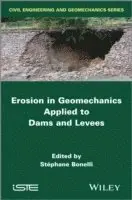
    Erosion in Geomechanics Applied to Dams and Levees

    AvStephane Bonelli

    Inbunden, Engelska, 2013

    1 753 kr

    Tillfälligt slut

    Beskrivning

    Erosion is the most common cause of failures at earth-dams, dikes and levees, whether through overtopping and overflowing, or internal erosion and piping. This book is dedicated to the phenomenon of internal erosion and piping. It is not intended to be exhaustive on the subject, but brings together some of the latest international research and advances. Emphasis is placed on physical processes, how they can be studied in the laboratory, and how test results can be applied to levees and dams. The results from several research projects in Australia, France, the Netherlands and the United States are covered by the authors. Our aim has been to share our most recent findings with students, researchers and practitioners. Understanding the failure of an earth-dam or a levee by erosion in a unified framework, whether internal erosion or surface erosion, requires continuous research in this field. We hope that the reader will gain knowledge from this book that leads to further progress in the challenging field of the safety of levees and dams.Contents1. State of The Art on the Likelihood of Internal Erosion of Dams and Levees by Means of Testing, Robin Fell and Jean-Jacques Fry.2. Contact Erosion, Pierre Philippe, Rémi Beguin and Yves-Henri Faure.3. Backward Erosion Piping, Vera Van Beek, Adam Bezuijen and Hans Sellmeijer.4. Concentrated Leak Erosion, Stéphane Bonelli, Robin Fell and Nadia Benahmed.5. Relationship between the Erosion Properties of Soils and Other Parameters, Robin Fell, Gregory Hanson, Gontran Herrier, Didier Marot and Tony Wahl.About the AuthorsStéphane Bonelli is a Research Professor at Irstea (French Environmental Sciences and Technologies Research Institute) in Aix-en-Provence, France. He has over 20 years of teaching and research experience, and has been a member of the ICOLD (International Commission on Large Dams) European Working Group on Internal Erosion since 2005. He has participated in 19 large dam reviews in France (visual inspection, monitoring data analysis and numerical modeling). His current activities include research, teaching and consultancy, focusing on soil erosion and the processes of levee breach.

    Produktinformation

    • Utgivningsdatum:2013-03-15
    • Mått:161 x 241 x 36 mm
    • Vikt:780 g
    • Format:Inbunden
    • Språk:Engelska
    • Antal sidor:416
    • Förlag:ISTE Ltd and John Wiley & Sons Inc
    • ISBN:9781848214095

    Utforska kategorier

    • Geovetenskap inom Naturvetenskap och teknik
    • Byggnadsteknik inom Naturvetenskap och teknik

    Mer om författaren

    Stéphane Bonelli is a Research Professor at Irstea (French Environmental Sciences and Technologies Research Institute). He has over 20 years of teaching and research experience, and has been a member of the ICOLD (International Commission on Large Dams) European Working Group on Internal Erosion since 2005. He has participated to 19 large dam reviews in France (visual inspection, monitoring data analysis and numerical modeling). His current activities include research, teaching and consultancy, focusing on soil erosion and the processes of levee breach.

    Innehållsförteckning

    • Foreword  xiiiJean-Louis BRIAUDIntroduction  xvStéphane BONELLIChapter 1. State of The Art on the Likelihood of Internal Erosion of Dams and Levees by Means of Testing 1Robin FELL and Jean-Jacques FRY1.1. An overview of the internal erosion process as it affects dams and levees 11.1.1. A description of the overall process 11.1.2. The four mechanisms of initiation and progression of internal erosion 21.1.3. Concentrated leak erosion 61.1.4. Backward erosion 71.1.5. Contact erosion 81.1.6. Suffusion 91.2. Concentrated leak erosion 111.2.1. Situations where concentrated leaks may occur 111.2.2. Estimation of crack width and depthc of cracking 231.2.3. The mechanics of erosion in concentrated leaks 231.2.4. Commentary on the state of the art and the role of laboratory testing in assessing concentrated leak erosion 351.3. Backward erosion piping 371.3.1. The mechanics of backward erosion piping 371.3.2. Soils that are subject to backward erosion piping 401.3.3. Methods available for assessing whether backward erosion piping will initiate and progress 431.3.4. Some field observations 511.3.5. Global backward erosion 521.3.6. Commentary on the state of the art and the role of laboratory testing in assessing backward erosion piping and global backward erosion 531.4. Suffusion 571.4.1. The mechanics of suffusion 571.4.2. Methods of identifying soils that are internally unstable and potentially subject to suffusion (geometric criterion) 581.4.3. Hydraulic conditions where soils are internally unstable and potentially subject to suffusion 691.4.4. Commentary on the state of the art and the role of laboratory testing in assessing suffusion 711.5. Contact erosion 741.5.1. The mechanics of contact erosion 741.5.2. Methods available to assess the likelihood of contact erosion 761.5.3. Contact erosion or “scour” at the interface between open joints in rock foundations and the core of dams 821.5.4. Commentary on the state of the art and the role of laboratory testing in assessing contact erosion 831.6. Bibliography 85Chapter 2. Contact Erosion 101Pierre PHILIPPE, Rémi BEGUIN and Yves-Henri FAURE2.1. Introduction 1012.2. General presentation 1032.2.1. Typical conditions of occurrence 1032.2.2. Specific nature of CE 1072.3. At sample scale: quantification of the CE threshold and kinetics 1102.3.1. Influence of geometry on the occurrence of CE 1112.3.2. Direct configuration 1122.3.3. Inverse configuration 1292.3.4. Summary 1332.4. At pore scale: local hydrodynamics of CE and statistical modeling 1342.4.1. Experimental characterization of local hydrodynamics 1352.4.2. Integration at macroscopic scale 1432.4.3. Contribution made by the local scale study 1582.5. At hydraulic structure scale: identification of failure scenarios by CE and scale effects 1622.5.1. Reasons for a study at this scale 1622.5.2. Description of the experimental rig and instrumentation 1632.5.3. Test protocol and the results obtained 1672.5.4. Proposed interpretation and description of the erosion process 1722.5.5. Scale effect 1762.5.6. Summary 1792.6. Conclusion and outlook 1792.6.1. Description of CE mechanisms 1802.6.2. Impact on the safety of hydraulic structures 1822.7. Bibliography 186Chapter 3. Backward Erosion Piping 193Vera VAN BEEK, Adam BEZUIJEN and Hans SELLMEIJER3.1. Introduction 1933.2. Phases leading to failure due to backward erosion 1973.2.1. Seepage 1983.2.2. Backward erosion – initiation and progression 1993.2.3. Widening 2043.2.4. Failure 2053.3. Backward erosion in the laboratory – overview and setup 2063.3.1. Overview of experimental research 2073.3.2. Setup 2083.4. Backward erosion piping in the laboratory – erosion mechanism 2143.4.1. Single grain transport 2153.4.2. Sand boiling phase 2163.4.3. Regressive or equilibrium phase 2173.4.4. Progressive phase 2203.4.5. Which process will occur when? 2213.5. Backward erosion in the laboratory – critical gradient 2263.5.1. Initiation of backward erosion piping 2263.5.2. Progression of backward erosion piping 2343.5.3. Progression of pipes for vertical seepage paths 2403.6. Analysis tools 2453.6.1. Initiation of the pipe 2463.6.2. Progression of the pipe 2503.6.3. Progression for structures 2563.6.4. Summary 2583.7. From laboratory to field – challenges for the future 2593.7.1. Scale effects 2593.7.2. Heterogeneity 2623.7.3. Uncertainties 2633.8. Conclusion 2643.9. Bibliography 264Chapter 4. Concentrated Leak Erosion  271Stéphane BONELLI, Robin FELL and Nadia BENAHMED4.1. Introduction 2714.2. Theoretical background 2754.2.1. Assumptions 2754.2.2. The model for pipe flow with erosion 2764.2.3. The singular head loss factor 2784.2.4. The momentum loss factor 2794.2.5. Characteristic values 2804.2.6. Closed-form solution in the case of a constant pressure drop 2814.2.7. Closed-form solution in the case of a constant flow rate 2824.3. The HET: testing procedure 2834.3.1. The HET apparatus 2834.3.2. Preparation of the specimen 2854.3.3. Determination of the final hole diameter 2884.4. The HET: method of interpretation 2894.4.1. Determination of the pipe radius and the wall shear stress 2894.4.2. Determination of the friction coefficient 2914.4.3. Determination of the head loss coefficient 2924.4.4. Determination of the parameters of erosion 2944.4.5. Examples of results 2944.4.6. Slaking at upstream or downstream faces of sample of HET 2964.5. Mechanically based relations for time to failure and peak flow 2994.5.1. A simplified approach 2994.5.2. Onset of erosion in the pipe 3014.5.3. Visual detection of the leak 3024.5.4. Enlargement of the pipe 3034.6. Dam and levee break modeling 3074.6.1. Order of magnitude on case studies 3074.6.2. A model for dam- and levee-break due to concentrated leak erosion 3114.6.3. Application to the failure of a homogeneous moraine dam by piping 3134.6.4. Model analysis 3174.7. Modeling concentrated leak erosion statistically 3194.7.1. The probabilistic approach 3194.7.2. The probability density function of the stress ratio 3214.7.3. Probabilistic description of erosion 3234.7.4. Order of magnitude of the relative intensity of the shear stress fluctuations 3254.7.5. Order of magnitude of the coefficient of variation of the soil critical stress 3264.7.6. A stochastic erosion law for cohesive soils 3274.8. Comments 3294.8.1. Comment on the friction coefficient 3294.8.2. Comment on the linearity of the erosion law 3334.9. Bibliography 335Chapter 5. Relationship between the Erosion Properties of Soils and Other Parameters 343Robin FELL, Gregory HANSON, Gontran HERRIER, Didier MAROT and Tony WAHL5.1. Introduction 3435.2. Definitions of soil erosion properties and the relationships between them 3445.3. Effects of test methods on soil erosion properties 3465.3.1. Effect of testing methods on erosion rate 3465.3.2. Effect of testing methods on critical shear stress (τc) 3505.3.3. Correlation between critical shear stress and erosion rate index 3535.4. Relationship to field performance 3555.4.1. JET tests done in the laboratory and in the field 3555.4.2. Assessment of rates of erosion from JET and large-scale laboratory tests 3555.5. Effects of the type of soil 3585.5.1. General trends 3585.5.2. Relationship to soil classification 3595.5.3. Effects of soil structure 3605.6. Effects of compaction parameters 3605.6.1. Relationship to compaction parameters 3605.6.2. Relationship to degree of saturation after compaction 3645.7. Effects of dispersivity and slaking 3665.7.1. Effects of dispersivity on erosion rate and critical shear stress 3665.7.2. Effects of slaking on erosion rate and critical shear stress 3695.8. Modifications of soil erosion properties 3715.8.1. Modification by lime 3715.8.2. Modification by cement 3765.9. Bibliography 376List of Authors 383Index 387