• Fri frakt över 249 kr
  • •
  • Snabba leveranser
  • •
  • Billiga böcker
Kundservice

Du är på sajten för privatpersoner.

Företag, bibliotek eller offentlig verksamhet?

Du handlar på classic.bokus.com, där alla dina funktioner finns intakta.
Till classic.bokus.com
Bokus logotyp. Gå till startsidan.
  • Erbjudanden
  • Nyheter
  • Student
  • Topplistor
  • Barn & ungdom
  • Bokus Play
  • E-böcker
  • Pocketböcker
  • Spel & pussel

10% rabatt på allt med kod NYSTART10 →

Sidfot

Mina sidor

    Hjälp

    • Kundservice
    • Vanliga frågor och svar
    • Frakt och leverans
    • Retur vid ångerrätt
    • Reklamera vara
    • Betalning
    • Köpvillkor
    • Allmänna villkor
    • Information om webbplatsens tillgänglighet

    Om Bokus

    • Om oss
    • Pressrum
    • För studenter
    • För företag
    • För bibliotek och offentlig verksamhet
    • För leverantörer
    • Hållbarhet

    Populärt

    • Aktuella erbjudanden
    • Presentkort
    • Studentlitteratur
    • Nya böcker
    • Topplistor
    • Signerade böcker
    • Engelska böcker

    Inspiration

    • Boktips
    • BookTok
    • Populära bokserier
    • Barnbokskaraktärer
    • Populära författare
    Logotyp för Bokus
    Följ oss på Facebook (extern länk)Följ oss på Instagram (extern länk)Följ oss på YouTube (extern länk)Följ oss på TikTok (extern länk)
    bokus @ CookiesAnpassa cookiesIntegritetspolicyKöpvillkor
    Till Citymail hemsida (extern länk)Till Budbee hemsida (extern länk)Till Postnord hemsida (extern länk)Till Schenker hemsida (extern länk)Till Early Bird hemsida (extern länk)Till Walleys hemsida (extern länk)
    1. Naturvetenskap och teknik
    2. Teknik och industri
    3. Elektronik och kommunikationer

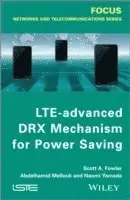
    LTE-Advanced DRX Mechanism for Power Saving

    AvScott A. Fowler,Abdelhamid Mellouk

    Inbunden, Engelska, 2013

    1 801 kr

    Beställningsvara. Skickas inom 5-8 vardagar. Fri frakt över 249 kr.

    Beskrivning

    Resource allocation and power optimization is a new challenge in multimedia services in cellular communication systems. To provide a better end-user experience, the fourth generation (4G) standard Long Term Evolution/Long Term Evolution-Advanced (LTE/LTE-Advanced) has been developed for high-bandwidth mobile access to accommodate today’s data-heavy applications. LTE/LTE-Advanced has adopted discontinuous reception (DRX) to extend the user equipment’s battery lifetime, thereby further supporting various services and large amounts of data transmissions.By introducing the basics of mathematical analysis and performance evaluation of power-saving mechanisms in 3rd generation partnership project (3GPP) LTE and LTE-Advanced networks, the authors of this book aim to describe novel algorithms which could have better performance capabilities than previous methods.Chapter 1 gives the basic theory description of the 3GPP LTE network and 3GPP DRX power saving mechanism, empirical measurements of LTE network traffic and an overview of the basic LTE DRX model in the field of power saving techniques.Chapter 2 provides steps for deriving a 2-state analytical model up to a 4-state DRX model. The third and final chapter summarizes alternative methods for the implementation of LTE DRX.

    Produktinformation

    • Utgivningsdatum:2013-08-27
    • Mått:160 x 241 x 18 mm
    • Vikt:386 g
    • Format:Inbunden
    • Språk:Engelska
    • Antal sidor:128
    • Förlag:ISTE Ltd and John Wiley & Sons Inc
    • ISBN:9781848215320

    Utforska kategorier

    • Elektronik och kommunikationer inom Naturvetenskap och teknik

    Mer om författaren

    Scott A. Fowler is Associate Professor at Linköping University, Sweden, working with the Mobile Telecommunication (MT) group. He has served on several IEEE conferences/workshops as TPC to Chair, including Special Interest Groups coordinator for IEEE Communications Software (CommSoft) Technical Committee since 2012. His research interests include Quality of Service (QoS) support over heterogeneous networks, computer networks (wired, wireless), energy management, mobile computing, pervasive/ubiquitous, performance evaluation of networks and security.Abdelhamid Mellouk is Full Professor at the University of Paris-Est Créteil VdM (UPEC, ex. Paris 12), Networks & Telecommunications (N&T) Department (IUT C/V) and LiSSi Laboratory in France. He is a founder of the Network Control Research activity with extensive international academic and industrial collaborations. His general area of research is in adaptive real-time control for high-speed new generation dynamic wired/wireless networking in order to maintain acceptable Quality of Service/Experience for added-value services.Naomi Yamada is a research associate at Linköping University, Sweden.

    Innehållsförteckning

    • PREFACE ixINTRODUCTION xiCHAPTER 1. BASIC THEORY 11.1. LTE overview 21.2. Scheduling in LTE 51.2.1. Quality of Service parameters 61.2.2. Channel quality indicator 81.2.3. Buffer state and resource allocation history 101.3. LTE Traffic measurements 111.3.1. Testing environment 121.3.2. VoIP preliminary capacity 131.3.3. Video conversation preliminary capacity 141.3.4. Post video and live video preliminary capacity 151.3.5. Summary on the LTE Traffic measurements 181.4. User equipment power saving in LTE 181.4.1. DRX cycle 181.5. Models for LTE Power Saving 241.5.1. 3GPP power consumption model 251.5.2. Characteristics of NokiaTM power consumption model 261.6. Conclusion 291.7. Bibliography 30CHAPTER 2. ANALYTICAL SEMI-MARKOV POWER-SAVING MODELS  332.1. Introduction of bursty packet data traffic 332.2. Designing a simple Two-state DRX model using semi-Markov 362.2.1. State 1 to state 1 and state 1 to state 2 382.2.2. Transition probability matrix 392.2.3. How we obtain equation [2.4] 392.2.4. Holding states 402.2.5. State H1 402.2.6. Sleep states H2 422.2.7. DRX cycles in basic 3GPP LTE 432.2.8. Wake-up delay 432.2.9. Power-saving factor (PS) 442.2.10. Numerical results 442.3. Three-state fixed model 472.3.1. State 1 to state 1 and state 1 to state 2 492.3.2. State 2 to state 1 and state 2 to state 3 492.3.3. Transition probability matrix 502.3.4. State H1 512.3.5. Sleep states H2 and H3 512.3.6. Power-saving factor (PS) 522.3.7. Numerical results 542.3.8. Summary of the Three-state model 592.4. Four-state fixed model 602.4.1. State 1 to state 1, state 1 to state 2 and state 1 to state 3 612.4.2. State 2 to state 1, state 2 to state 2 and state 2 to state 3 612.4.3. State 3 to state 1, state 3 to state 2 and state 3 to state 4 622.4.4. State 4 to state 1 and state 4 to state 2 632.4.5. Transition probability matrix 632.4.6. Sleep states H3 and H4 652.4.7. Power-saving factor (PS) 662.4.8. Numerical results 682.5. Conclusion 692.6. Bibliography 69CHAPTER 3. OTHER APPROACHES FOR LTE POWER SAVING  713.1. Scheduling schemes 713.2. DRX power-saving method 743.3. Analytical work 783.4. Analytical Adjustable-DRX Three-state model 793.4.1. Adjustable DRX timer state for light sleep 793.4.2. State 2 to state 1 and state 2 to state 3 803.4.3. Transition probability matrix 813.4.4. Adjustable DRX cycles in 3GPP LTE 823.4.5. Sleep states H2 and H3 833.4.6. Power-saving factor (PS) 843.4.7. Numerical results 863.5. Conclusion 923.6. Bibliography 92ACRONYMS AND NOTATIONS 95INDEX 101