• Fri frakt över 249 kr
  • •
  • Snabba leveranser
  • •
  • Billiga böcker
Kundservice

Du är på sajten för privatpersoner.

Företag, bibliotek eller offentlig verksamhet?

Du handlar på classic.bokus.com, där alla dina funktioner finns intakta.
Till classic.bokus.com
Bokus logotyp. Gå till startsidan.
  • Erbjudanden
  • Student
  • Topplistor
  • Barn & ungdom
  • Bokus Play
  • E-böcker
  • Ljudböcker
  • Pocketböcker
  • Spel och pussel

Pocketfynda! Hundratals böcker för 49 kr/st →

Sidfot

Mina sidor

    Hjälp

    • Kundservice
    • Vanliga frågor och svar
    • Frakt och leverans
    • Retur vid ångerrätt
    • Reklamera vara
    • Betalning
    • Köpvillkor
    • Allmänna villkor
    • Information om webbplatsens tillgänglighet

    Om Bokus

    • Om oss
    • Pressrum
    • För studenter
    • För företag
    • För bibliotek och offentlig verksamhet
    • För leverantörer
    • Hållbarhet

    Populärt

    • Aktuella erbjudanden
    • Presentkort
    • Studentlitteratur
    • Nya böcker
    • Topplistor
    • Signerade böcker
    • Engelska böcker

    Inspiration

    • Boktips
    • BookTok
    • Barnbokskaraktärer
    • Populära författare
    Logotyp för Bokus
    Följ oss på Facebook (extern länk)Följ oss på Instagram (extern länk)Följ oss på YouTube (extern länk)Följ oss på TikTok (extern länk)
    bokus @ CookiesAnpassa cookiesIntegritetspolicyKöpvillkor
    Till Citymail hemsida (extern länk)Till Budbee hemsida (extern länk)Till Postnord hemsida (extern länk)Till Schenker hemsida (extern länk)Till Early Bird hemsida (extern länk)Till Walleys hemsida (extern länk)
    1. Naturvetenskap och teknik
    2. Teknik och industri
    3. Byggnadsteknik

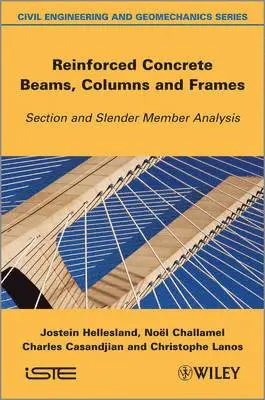
    Reinforced Concrete Beams, Columns and Frames

    Section and Slender Member Analysis

    AvJostein Hellesland,Noël Challamel

    Inbunden, Engelska, 2013

    1 925 kr

    Beställningsvara. Skickas inom 11-20 vardagar. Fri frakt över 249 kr.

    Fler format och utgåvor

    E-bok

    2 193 kr

    E-bok

    2 193 kr

    Beskrivning

    This book is focused on the theoretical and practical design of reinforced concrete beams, columns and frame structures. It is based on an analytical approach of designing normal reinforced concrete structural elements that are compatible with most international design rules, including for instance the European design rules – Eurocode 2 – for reinforced concrete structures. The book tries to distinguish between what belongs to the structural design philosophy of such structural elements (related to strength of materials arguments) and what belongs to the design rule aspects associated with specific characteristic data (for the material or loading parameters). A previous book, entitled Reinforced Concrete Beams, Columns and Frames – Mechanics and Design, deals with the fundamental aspects of the mechanics and design of reinforced concrete in general, both related to the Serviceability Limit State (SLS) and the Ultimate Limit State (ULS), whereas the current book deals with more advanced ULS aspects, along with instability and second-order analysis aspects. Some recent research results including the use of non-local mechanics are also presented. This book is aimed at Masters-level students, engineers, researchers and teachers in the field of reinforced concrete design. Most of the books in this area are very practical or code-oriented, whereas this book is more theoretically based, using rigorous mathematics and mechanics tools.

    Produktinformation

    • Utgivningsdatum:2013-01-18
    • Mått:161 x 241 x 23 mm
    • Vikt:612 g
    • Format:Inbunden
    • Språk:Engelska
    • Antal sidor:320
    • Förlag:ISTE Ltd and John Wiley & Sons Inc
    • ISBN:9781848215696

    Utforska kategorier

    • Byggnadsteknik inom Naturvetenskap och teknik

    Mer om författaren

    Jostein Hellesland has been Professor of Structural Mechanics at the University of Oslo, Norway since January 1988. His contribution to the field of stability has been recognized and magnified by many high-quality papers in famous international journals such as Engineering Structures, Thin-Walled Structures, Journal of Constructional Steel Research and Journal of Structural Engineering.Noël Challamel is Professor in Civil Engineering at UBS, University of South Brittany in France and chairman of the EMI-ASCE Stability committee. His contributions mainly concern the dynamics, stability and inelastic behavior of structural components, with special emphasis on Continuum Damage Mechanics (more than 70 publications in International peer-reviewed journals).Charles Casandjian was formerly Associate Professor at INSA (French National Institute of Applied Sciences), Rennes, France and the chairman of the course on reinforced concrete design. He has published work on the mechanics of concrete and is also involved in creating a web experience for teaching reinforced concrete design – BA-CORTEX.Christophe Lanos is Professor in Civil Engineering at the University of Rennes 1 in France. He has mainly published work on the mechanics of concrete, as well as other related subjects. He is also involved in creating a web experience for teaching reinforced concrete design – BA-CORTEX.

    Innehållsförteckning

    • Preface  ixChapter 1. Advanced Design at Ultimate Limit State (ULS)  11.1. Design at ULS – simplified analysis 11.1.1. Simplified rectangular behavior – rectangular cross-section 11.1.2. Simplified rectangular behavior – T-cross-section 161.1.3. Comparison of design between serviceability limit state and ultimate limit state 221.1.4. Biaxial bending of a rectangular cross-section 281.2. ULS – extended analysis 371.2.1. Bilinear constitutive law for concrete – rectangular cross-section 371.2.2. Parabola–rectangle constitutive law for concrete – rectangular cross-section 441.2.3. T-cross-section – general resolution for bilinear or parabola–rectangle laws for concrete 531.2.4. T-cross-section – general equations for composed bending with normal forces 661.3. ULS – interaction diagram 821.3.1. Theoretical formulation of the interaction diagram 821.3.2. Approximation formulations 941.3.3. Graphical results for general cross-sections 98Chapter 2. Slender Compression Members – Mechanics and Design 1032.1. Introduction 1032.2. Analysis methods 1032.2.1. General 1032.2.2. Requirements to second-order analysis 1052.3. Member and system instability 1052.3.1. Elastic critical load and effective (buckling) length 1052.3.2. System instability principles 1102.3.3. Concrete column instability – limit load 1102.4. First- and second-order load effects 1122.4.1. Global and local second-order effects 1122.4.2. Single members 1132.4.3. Frame mechanics – braced and bracing columns 1152.4.4. Moment equilibrium at joints 1192.5. Maximum moment formation 1202.5.1. Maximum first- and second-order moment at the same section 1202.5.2. Maximum first- and second-order moment at different sections 1242.5.3. Curvature-based maximum moment expression 1362.5.4. Unbraced frame application example 1412.6. Local and global slenderness limits 1442.6.1. Local, lower slenderness limits – general 1442.6.2. EC2 – local lower slenderness limits 1482.6.3. NS-EC2 – Local lower slenderness limits 1502.6.4. Comparison of the EC2 and NS-EC2 limits 1552.6.5. Local upper slenderness limit 1562.6.6. Global lower slenderness limit 1592.7. Effect of creep deformations 1632.7.1. General 1632.7.2. Effects on load and deformation capacity 1652.7.3. Approximate calculation of creep effects 1692.8. Geometric imperfections 1762.8.1. Imperfection inclination 1762.8.2. Stiffening structural elements 1762.8.3. Stiffened and isolated structural elements 1802.9. Elastic analysis methods 1812.9.1. Principles, equilibrium and compatibility 1812.9.2. Equilibrium and compatibility at multiple sections 1832.9.3. Optimization 1852.10. Practical linear elastic analysis 1872.10.1. Stiffness assumptions 1872.10.2. EC2 approach 1892.10.3. ACI 318 approach 1902.11. Simplified analysis and design methods 1912.11.1. General 1912.11.2. Simplified second-order analysis 1922.11.3. Method based on nominal stiffness 1942.11.4. Method based on nominal curvature 2002.12. ULS design 2042.12.1. Simplified design methods 2042.12.2. Alternative design methods 2052.12.3. Design example – framed column 207Chapter 3. Approximate Analysis Methods 2133.1. Effective lengths 2133.1.1. Definition and exact member analysis 2133.1.2. EC2 effective length of isolated members 2183.1.3. Alternative effective length expressions 2193.1.4. Columns with beam restraints 2223.2. Method of means 2273.2.1. General 2273.2.2. Method of means – typical steps 2273.2.3. Application of the method of means 2303.3. Global buckling of unbraced or partially braced systems 2363.3.1.General considerations 2363.3.2. Flexibility factors 2403.3.3. System instability and “system” effective lengths 2433.3.4. Instability of partially braced column – example 2483.3.5. Instability of partially braced frame – example 2513.3.6. Sway buckling of unbraced multistory frames 2563.4. Story sway and moment magnification 2623.4.1. General 2623.4.2. Partially braced column – example 2643.4.3. Partially braced frame – example 2663.4.4. Sway magnifier prediction of frames with single curvature regions 2683.4.5. Iterative elastic analysis method 2713.4.6. Global magnifiers for sway and moments 272Appendix 1. Cardano’s Method 279A1.1. Introduction 279A1.2. Roots of a cubic function – method of resolution 280A1.2.1. Canonical form 280A1.2.2. Resolution – one real and two complex roots 281A1.2.3. Resolution – two real roots 283A1.2.4. Resolution – three real roots 283A1.3. Roots of a cubic function – synthesis 285A1.3.1. Summary of Cardano’s method 285A1.3.2. Resolution of a cubic equation – example 286A1.4. Roots of a quartic function – principle of resolution 287Appendix 2. Steel Reinforcement Table 289Bibliography 291Index 305