• Fri frakt över 249 kr
  • •
  • Snabba leveranser
  • •
  • Billiga böcker
Kundservice

Du är på sajten för privatpersoner.

Företag, bibliotek eller offentlig verksamhet?

Du handlar på classic.bokus.com, där alla dina funktioner finns intakta.
Till classic.bokus.com
Bokus logotyp. Gå till startsidan.
  • Erbjudanden
  • Nyheter
  • Student
  • Topplistor
  • Barn & ungdom
  • Bokus Play
  • E-böcker
  • Pocketböcker
  • Spel & pussel

10% rabatt på allt med kod NYSTART10 →

Sidfot

Mina sidor

    Hjälp

    • Kundservice
    • Vanliga frågor och svar
    • Frakt och leverans
    • Retur vid ångerrätt
    • Reklamera vara
    • Betalning
    • Köpvillkor
    • Allmänna villkor
    • Information om webbplatsens tillgänglighet

    Om Bokus

    • Om oss
    • Pressrum
    • För studenter
    • För företag
    • För bibliotek och offentlig verksamhet
    • För leverantörer
    • Hållbarhet

    Populärt

    • Aktuella erbjudanden
    • Presentkort
    • Studentlitteratur
    • Nya böcker
    • Topplistor
    • Signerade böcker
    • Engelska böcker

    Inspiration

    • Boktips
    • BookTok
    • Populära bokserier
    • Barnbokskaraktärer
    • Populära författare
    Logotyp för Bokus
    Följ oss på Facebook (extern länk)Följ oss på Instagram (extern länk)Följ oss på YouTube (extern länk)Följ oss på TikTok (extern länk)
    bokus @ CookiesAnpassa cookiesIntegritetspolicyKöpvillkor
    Till Citymail hemsida (extern länk)Till Budbee hemsida (extern länk)Till Postnord hemsida (extern länk)Till Schenker hemsida (extern länk)Till Early Bird hemsida (extern länk)Till Walleys hemsida (extern länk)
    1. Naturvetenskap och teknik
    2. Teknik och industri
    3. Elektronik och kommunikationer

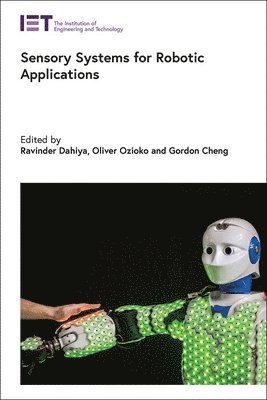
    Sensory Systems for Robotic Applications

    AvRavinder Dahiya,Oliver Ozioko

    Inbunden, Engelska, 2023

    Del i serien Control, Robotics and Sensors

    1 672 kr

    Beställningsvara. Skickas inom 3-6 vardagar. Fri frakt över 249 kr.

    Beskrivning

    Robots have come a long way thanks to advances in sensing and computer vision technologies and can be found today in healthcare, medicine and industry. Researchers have been looking at providing them with senses such as the ability to see, smell, hear and perceive touch in order to mimic and interact with humans and their surrounding environments.Topics covered in this edited book include various types of sensors used in robotics, sensing schemes (e-skin, tactile skin, e-nose, neuromorphic vision and touch), sensing technologies and their applications including healthcare, prosthetics, robotics and wearables.This book will appeal to researchers, scientists, engineers, and graduate and advanced students working in robotics, sensor technologies and electronics, and their applications in robotics, haptics, prosthetics, wearable and interactive systems, cognitive engineering, neuro-engineering, computational neuroscience, medicine and healthcare technologies.

    Produktinformation

    • Utgivningsdatum:2023-02-15
    • Mått:156 x 234 x 20 mm
    • Vikt:680 g
    • Format:Inbunden
    • Språk:Engelska
    • Serie:Control, Robotics and Sensors
    • Antal sidor:330
    • Förlag:Institution of Engineering and Technology
    • ISBN:9781849199483

    Utforska kategorier

    • Elektronik och kommunikationer inom Naturvetenskap och teknik
    • Biomedicinsk teknik inom Medicin

    Mer om författaren

    Ravinder Dahiya is Professor in Electrical and Computer Engineering Department at Northeastern University, Boston, USA. His group (Bendable Electronics and Sustainable Technologies (BEST)) conducts fundamental research in electronic skin, flexible printed electronics and their applications in robotics, prosthetics, wearables, augmented/virtual reality and similar interactive systems. He has authored or co-authored more than 500 publications, books and submitted/granted patents and disclosures. He has led or contributed to many international projects. Prof. Dahiya is President of IEEE Sensors Council. He is the Founding Editor-in-Chief of IEEE Journal on Flexible Electronics (J-FLEX). He has been recipient of EPSRC Fellowship, Marie Curie Fellowship and Japanese Monbusho Fellowship. He has received several awards, including Technical Achievement award from IEEE Sensors Council, Young Investigator Award from Elsevier, and 12 best journal/conference paper awards as author/co-author. He is Fellow of IEEE and the Royal Society of Edinburgh.Oliver Ozioko is a lecturer in electrical and electronic engineering at the University of Derby, UK. Prior to joining the University of Derby, he worked as a postdoctoral researcher at the University of Glasgow. He holds a PhD Degree in Electrical and Electronic Engineering from the University of Glasgow. His research focuses on sensors and intelligent systems, electronic skin, haptics, assistive technologies, smart systems, as well as self-powered wearable and portable systems. He has authored or co-authored over 29 technical publications. He is the 2023 YP chair for IEEE Sensors council.Gordon Cheng is chair professor and director of the Institute for Cognitive Systems and is the coordinator of the Center of Competence Neuro-Engineering, Technical University of Munich, Germany. He is also the founding director of the Elite Master of Science program in Neuroengineering (MSNE) of the Elite Network of Bavaria, Germany. For more than 20 years, he has made pioneering contributions in humanoid robotics, neuroengineering and artificial intelligence. He founded the department of humanoid robotics and computational neuroscience at the Institute for Advanced Telecommunications Research in Kyoto, Japan, where he was department head from 2003 to 2008. In addition, from 2007 to 2008 he was a project manager at the National Institute of Information and Communications Technology, Japan, and the Japanese Science and Technology Agency, where he was responsible for the Computational Brain project (2004-2008). He is the co-inventor of 20 patents and co-authored over 350 technical publications. He was acknowledged as an IEEE Fellow in 2017 for his "contributions in humanoid robotic systems and neurorobotics". He holds a Doctorate Degree in Systems Engineering from The Australian National University.

    Innehållsförteckning

    • Chapter 1: Development of tactile sensors for intelligent robotics researchChapter 2: Developmental soft roboticsChapter 3: Three-axis tactile sensor using optical transduction mechanismChapter 4: Strain sensors for soft robotic applicationsChapter 5: Neuromorphic principles for large-scale robot skinChapter 6: Soft three-axial tactile sensors with integrated electronics for robot skinChapter 7: A review of tactile sensing in e-skin, wearable device, robotic, and medical serviceChapter 8: Neuroengineering approaches for cognitive hearing technologyChapter 9: Mobile robot olfaction state-of-the-art and research challengesChapter 10: Vision sensors for robotic perceptionChapter 11: Audio sensorsChapter 12: Audio and gas sensors