• Fri frakt över 249 kr
  • •
  • Snabba leveranser
  • •
  • Billiga böcker
Kundservice

Du är på sajten för privatpersoner.

Företag, bibliotek eller offentlig verksamhet?

Du handlar på classic.bokus.com, där alla dina funktioner finns intakta.
Till classic.bokus.com
Bokus logotyp. Gå till startsidan.
  • Erbjudanden
  • Student
  • Topplistor
  • Barn & ungdom
  • Bokus Play
  • E-böcker
  • Ljudböcker
  • Pocketböcker
  • Spel och pussel

Pocketfynda! Hundratals böcker för 49 kr/st →

Sidfot

Mina sidor

    Hjälp

    • Kundservice
    • Vanliga frågor och svar
    • Frakt och leverans
    • Retur vid ångerrätt
    • Reklamera vara
    • Betalning
    • Köpvillkor
    • Allmänna villkor
    • Information om webbplatsens tillgänglighet

    Om Bokus

    • Om oss
    • Pressrum
    • För studenter
    • För företag
    • För bibliotek och offentlig verksamhet
    • För leverantörer
    • Hållbarhet

    Populärt

    • Aktuella erbjudanden
    • Presentkort
    • Studentlitteratur
    • Nya böcker
    • Topplistor
    • Signerade böcker
    • Engelska böcker

    Inspiration

    • Boktips
    • BookTok
    • Barnbokskaraktärer
    • Populära författare
    Logotyp för Bokus
    Följ oss på Facebook (extern länk)Följ oss på Instagram (extern länk)Följ oss på YouTube (extern länk)Följ oss på TikTok (extern länk)
    bokus @ CookiesAnpassa cookiesIntegritetspolicyKöpvillkor
    Till Citymail hemsida (extern länk)Till Budbee hemsida (extern länk)Till Postnord hemsida (extern länk)Till Schenker hemsida (extern länk)Till Early Bird hemsida (extern länk)Till Walleys hemsida (extern länk)
    1. Data och IT
    2. Systemvetenskap och AI

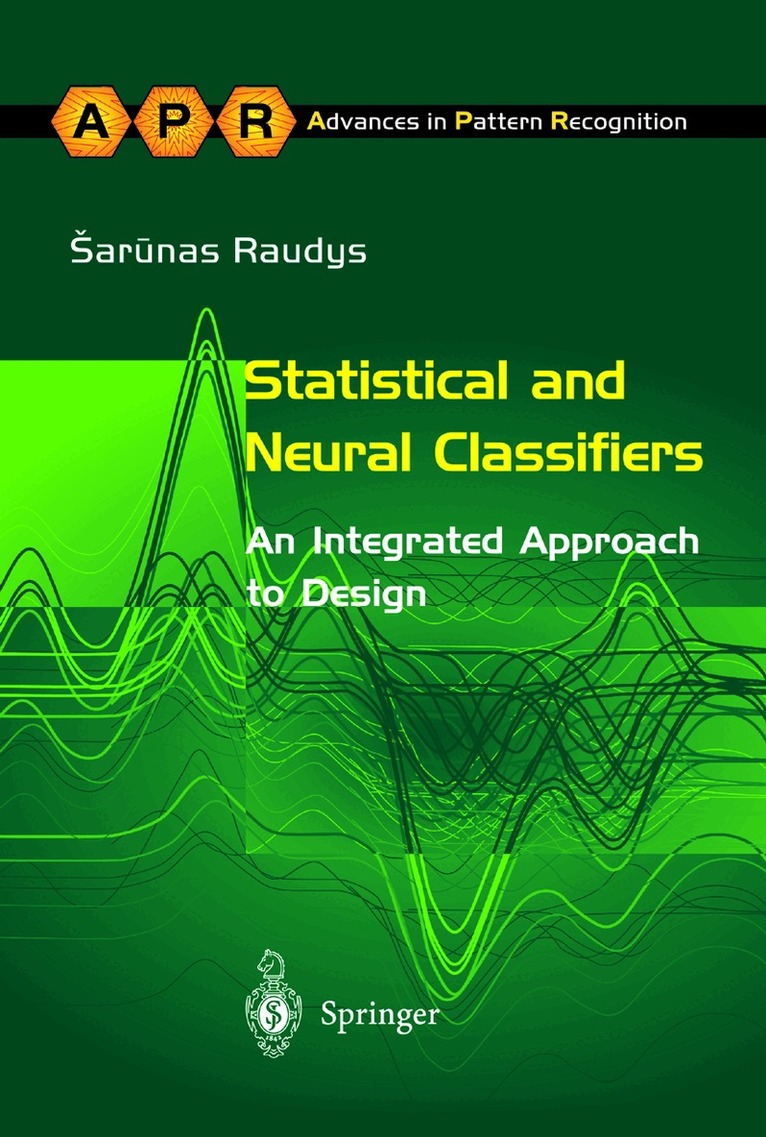
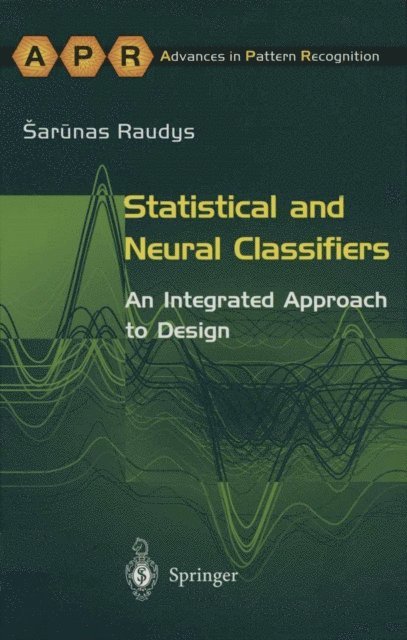
    Statistical and Neural Classifiers

    An Integrated Approach to Design

    AvSarunas Raudys

    Inbunden, Engelska, 2001

    Del i serien Advances in Computer Vision and Pattern Recognition

    1 662 kr

    Beställningsvara. Skickas inom 10-15 vardagar. Fri frakt över 249 kr.

    Fler format och utgåvor

    E-bok

    1 617 kr

    Häftad

    1 220 kr

    Beskrivning

    Automatic (machine) recognition, description, classification, and groupings of patterns are important problems in a variety of engineering and scientific disciplines such as biology, psychology, medicine, marketing, computer vision, artificial intelligence, and remote sensing. Given a pattern, its recognition/classification may consist of one of the following two tasks: (1) supervised classification (also called discriminant analysis); the input pattern is assigned to one of several predefined classes, (2) unsupervised classification (also called clustering); no pattern classes are defined a priori and patterns are grouped into clusters based on their similarity. Interest in the area of pattern recognition has been renewed recently due to emerging applications which are not only challenging but also computationally more demanding (e. g. , bioinformatics, data mining, document classification, and multimedia database retrieval). Among the various frameworks in which pattern recognition has been traditionally formulated, the statistical approach has been most intensively studied and used in practice. More recently, neural network techniques and methods imported from statistical learning theory have received increased attention. Neural networks and statistical pattern recognition are two closely related disciplines which share several common research issues. Neural networks have not only provided a variety of novel or supplementary approaches for pattern recognition tasks, but have also offered architectures on which many well-known statistical pattern recognition algorithms can be mapped for efficient (hardware) implementation. On the other hand, neural networks can derive benefit from some well-known results in statistical pattern recognition.


    Produktinformation

    • Utgivningsdatum:2001-01-29
    • Mått:161 x 241 x 27 mm
    • Vikt:620 g
    • Format:Inbunden
    • Språk:Engelska
    • Serie:Advances in Computer Vision and Pattern Recognition
    • Antal sidor:295
    • Upplaga:2001
    • Förlag:Springer London Ltd
    • ISBN:9781852332976

    Utforska kategorier

    • Systemvetenskap och AI inom Data och IT

    Innehållsförteckning

    • 1. Quick Overview.- 1.1 The Classifier Design Problem.- 1.2 Single Layer and Multilayer Perceptrons.- 1.3 The SLP as the Euclidean Distance and the Fisher Linear Classifiers.- 1.4 The Generalisation Error of the EDC and the Fisher DF.- 1.5 Optimal Complexity — The Scissors Effect.- 1.6 Overtraining in Neural Networks.- 1.7 Bibliographical and Historical Remarks.- 2. Taxonomy of Pattern Classification Algorithms.- 2.1 Principles of Statistical Decision Theory.- 2.2 Four Parametric Statistical Classifiers.- 2.3 Structures of the Covariance Matrices.- 2.4 The Bayes Predictive Approach to Design Optimal Classification Rules.- 2.5. Modifications of the Standard Linear and Quadratic DF.- 2.6 Nonparametric Local Statistical Classifiers.- 2.7 Minimum Empirical Error and Maximal Margin Linear Classifiers.- 2.8 Piecewise-Linear Classifiers.- 2.9 Classifiers for Categorical Data.- 2.10 Bibliographical and Historical Remarks.- 3. Performance and the Generalisation Error.- 3.1 Bayes, Conditional, Expected, and Asymptotic Probabilities of Misclassification.- 3.2 Generalisation Error of the Euclidean Distance Classifier.- 3.3 Most Favourable and Least Favourable Distributions of the Data.- 3.4 Generalisation Errors for Modifications of the Standard Linear Classifier.- 3.5 Common Parameters in Different Competing Pattern Classes.- 3.6 Minimum Empirical Error and Maximal Margin Classifiers.- 3.7 Parzen Window Classifier.- 3.8 Multinomial Classifier.- 3.9 Bibliographical and Historical Remarks.- 4. Neural Network Classifiers.- 4.1 Training Dynamics of the Single Layer Perceptron.- 4.2 Non-linear Decision Boundaries.- 4.3 Training Peculiarities of the Perceptrons.- 4.4 Generalisation of the Perceptrons.- 4.5 Overtraining and Initialisation.- 4.6 Tools to Control Complexity.- 4.7 TheCo-Operation of the Neural Networks.- 4.8 Bibliographical and Historical Remarks.- 5. Integration of Statistical and Neural Approaches.- 5.1 Statistical Methods or Neural Nets?.- 5.2 Positive and Negative Attributes of Statistical Pattern Recognition.- 5.3 Positive and Negative Attributes of Artificial Neural Networks.- 5.4 Merging Statistical Classifiers and Neural Networks.- 5.5 Data Transformations for the Integrated Approach.- 5.6 The Statistical Approach in Multilayer Feed-forward Networks.- 5.7 Concluding and Bibliographical Remarks.- 6. Model Selection.- 6.1 Classification Errors and their Estimation Methods.- 6.2 Simplified Performance Measures.- 6.3 Accuracy of Performance Estimates.- 6.4 Feature Ranking and the Optimal Number of Feature.- 6.5 The Accuracy of the Model Selection.- 6.6 Additional Bibliographical Remarks.- Appendices.- A.1 Elements of Matrix Algebra.- A.2 The First Order Tree Type Dependence Model.- A.3 Temporal Dependence Models.- A.4 Pikelis Algorithm for Evaluating Means and Variances of the True, Apparent and Ideal Errors in Model Selection.- A.5 Matlab Codes (the Non-Linear SLP Training, the First Order Tree Dependence Model, and Data Whitening Transformation).- References.