• Fri frakt över 249 kr
  • •
  • Snabba leveranser
  • •
  • Billiga böcker
Kundservice

Du är på sajten för privatpersoner.

Företag, bibliotek eller offentlig verksamhet?

Du handlar på classic.bokus.com, där alla dina funktioner finns intakta.
Till classic.bokus.com
Bokus logotyp. Gå till startsidan.
  • Erbjudanden
  • Nyheter
  • Student
  • Topplistor
  • Barn & ungdom
  • Bokus Play
  • E-böcker
  • Pocketböcker
  • Spel & pussel

10% rabatt på allt med kod: NYSTART10 →

Sidfot

Mina sidor

    Hjälp

    • Kundservice
    • Vanliga frågor och svar
    • Frakt och leverans
    • Retur vid ångerrätt
    • Reklamera vara
    • Betalning
    • Köpvillkor
    • Allmänna villkor
    • Information om webbplatsens tillgänglighet

    Om Bokus

    • Om oss
    • Pressrum
    • För studenter
    • För företag
    • För bibliotek och offentlig verksamhet
    • För leverantörer
    • Hållbarhet

    Populärt

    • Aktuella erbjudanden
    • Presentkort
    • Studentlitteratur
    • Nya böcker
    • Topplistor
    • Signerade böcker
    • Engelska böcker

    Inspiration

    • Boktips
    • BookTok
    • Populära bokserier
    • Barnbokskaraktärer
    • Populära författare
    Logotyp för Bokus
    Följ oss på Facebook (extern länk)Följ oss på Instagram (extern länk)Följ oss på YouTube (extern länk)Följ oss på TikTok (extern länk)
    bokus @ CookiesAnpassa cookiesIntegritetspolicyKöpvillkor
    Till Citymail hemsida (extern länk)Till Budbee hemsida (extern länk)Till Postnord hemsida (extern länk)Till Schenker hemsida (extern länk)Till Early Bird hemsida (extern länk)Till Walleys hemsida (extern länk)
    1. Data och IT
    2. Människa – datorinteraktion

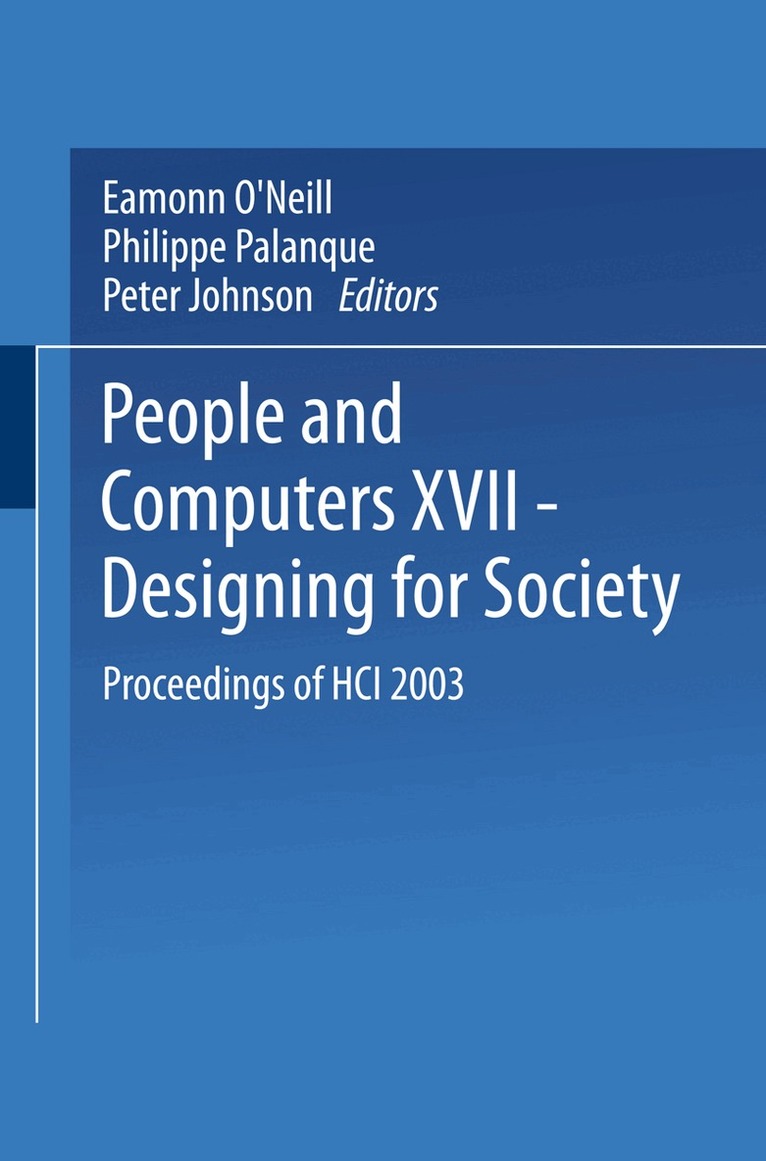
    People and Computers XVII — Designing for Society

    Proceedings of HCI 2003

    AvEamonn O'Neill,Philippe Palanque

    Häftad, Engelska, 2003

    563 kr

    Beställningsvara. Skickas inom 10-15 vardagar. Fri frakt över 249 kr.

    Beskrivning

    HCI is a fundamental and multidisciplinary research area. It is fundamental to the development and use of computing technologies. Without good HCI, computing technologies provide less benefit to society. We often fail to notice good HCI. Good HCI passes us by without comment or surprise. The technology lets you do what you want without causing you any further work, effort or thought. You load a DVD into your DVD player and it works: why shouldn't it? You take a photograph with your digital camera and without any surprise you easily transfer and view these on your computer. You seamlessly connect to networks and devices with a common interface and interaction style. Yet when HCI is wrong the technology becomes useless, unusable, disrupts our work, inhibits our abilities and constrains our achievements. Witness the overuse and inconsistent use of hierarchical menus on mobile phones; or the lack of correspondence between call statistics on the phone handset itself and the billed call time on the account bill; or the lack of interoperability between file naming conventions on different operating systems running applications and files of the same type (e. g. the need for explicit filename suffixes on some operating systems). Those programmers, designers and developers who know no better, believe that HCI is just common sense and that their designs are obviously easy to use.

    Produktinformation

    • Utgivningsdatum:2003-08-20
    • Mått:155 x 235 x 24 mm
    • Vikt:657 g
    • Format:Häftad
    • Språk:Engelska
    • Antal sidor:418
    • Upplaga:3001
    • Förlag:Springer London Ltd
    • ISBN:9781852337667

    Utforska kategorier

    • Människa – datorinteraktion inom Data och IT

    Innehållsförteckning

    • Doing the Right Thing in the Right Place: Technology, Theory and Design for Multiple and Group Activities.- Understanding Task Grouping Strategies.- Two Phenomenological Studies of Place.- The Interaction Character of Computers in Co-located Collaboration.- Information Retrieval.- How Knowledge Workers Gather Information from the Web: Implications for Peer-to-Peer File Sharing Tools.- Evaluation of a Prototype Interface for Structured Document Retrieval.- Comparing Speed-dependent Automatic Zooming with Traditional Scroll, Pan and Zoom Methods.- Design Methods and Principles.- The Application of Urban Design Principles to Navigation of Information Spaces.- A Method for Organizational Culture Analysis as a Basis for the Implementation of User-Centred Design into Organizations.- Evaluation Methods.- Changing Analysts’ Tunes: The Surprising Impact of a New Instrument for Usability Inspection Method Assessment.- Ontological Sketch Models: Highlighting User-System Misfits.- Interaction Techniques: Looking, Listening, Pointing, Stroking.- Improving the Acquisition of Small Targets.- A Directional Stroke Recognition Technique for Mobile Interaction in a Pervasive Computing World.- Look or Listen: Discovering Effective Techniques for Accessing Speech Data.- E-commerce.- Social and Cultural Obstacles to the (B2C) E-Commerce Experience.- Trust at First Sight? A Test of Users’ Ability to Identify Trustworthy E-commerce Sites.- ‘On the Move’: Mobile Interaction.- MovieLens Unplugged: Experiences with a Recommender System on Four Mobile Devices.- Effective Web Searching on Mobile Devices.- M-RSVP: Mobile Web Browsing on a PDA.- Accessibility.- Fancy Graphics Can Deter Older Users: A Comparison of Two Interfaces for Exploring Healthy Lifestyle Options.- Towards VoiceXMLDialogue Design for Older Adults.- WebTouch: An Audio-tactile Browser for Visually Handicapped People.- Two Falls out of Three in the Automated Accessibility Assessment of World Wide Web Sites: A-Prompt vs. Bobby.- ‘Look at Me’: Emotions, Faces and Eyes.- Expressive Image Generator for an Emotion Extraction Engine.- An Exploration of Facial Expression Tracking in Affective HCI.- Could I have the Menu Please? An Eye Tracking Study of Design Conventions.- Author Index.- Keyword Index.