• Fri frakt över 249 kr
  • •
  • Snabba leveranser
  • •
  • Billiga böcker
Kundservice

Du är på sajten för privatpersoner.

Företag, bibliotek eller offentlig verksamhet?

Du handlar på classic.bokus.com, där alla dina funktioner finns intakta.
Till classic.bokus.com
Bokus logotyp. Gå till startsidan.
  • Erbjudanden
  • Nyheter
  • Student
  • Topplistor
  • Barn & ungdom
  • Bokus Play
  • E-böcker
  • Pocketböcker
  • Spel & pussel

10% rabatt på allt med kod NYSTART10 →

Sidfot

Mina sidor

    Hjälp

    • Kundservice
    • Vanliga frågor och svar
    • Frakt och leverans
    • Retur vid ångerrätt
    • Reklamera vara
    • Betalning
    • Köpvillkor
    • Allmänna villkor
    • Information om webbplatsens tillgänglighet

    Om Bokus

    • Om oss
    • Pressrum
    • För studenter
    • För företag
    • För bibliotek och offentlig verksamhet
    • För leverantörer
    • Hållbarhet

    Populärt

    • Aktuella erbjudanden
    • Presentkort
    • Studentlitteratur
    • Nya böcker
    • Topplistor
    • Signerade böcker
    • Engelska böcker

    Inspiration

    • Boktips
    • BookTok
    • Populära bokserier
    • Barnbokskaraktärer
    • Populära författare
    Logotyp för Bokus
    Följ oss på Facebook (extern länk)Följ oss på Instagram (extern länk)Följ oss på YouTube (extern länk)Följ oss på TikTok (extern länk)
    bokus @ CookiesAnpassa cookiesIntegritetspolicyKöpvillkor
    Till Citymail hemsida (extern länk)Till Budbee hemsida (extern länk)Till Postnord hemsida (extern länk)Till Schenker hemsida (extern länk)Till Early Bird hemsida (extern länk)Till Walleys hemsida (extern länk)
    1. Naturvetenskap och teknik
    2. Teknik och industri
    3. Maskinteknik och material

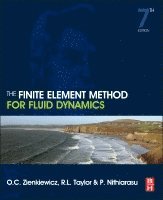
    The Finite Element Method for Fluid Dynamics

    AvO. C. Zienkiewicz,R. L. Taylor

    Inbunden, Engelska, 2013

    Del i serien Finite Element Method

    1 299 kr

    Beställningsvara. Skickas inom 10-15 vardagar. Fri frakt över 249 kr.

    Beskrivning

    The Finite Element Method for Fluid Dynamics offers a complete introduction the application of the finite element method to fluid mechanics. The book begins with a useful summary of all relevant partial differential equations before moving on to discuss convection stabilization procedures, steady and transient state equations, and numerical solution of fluid dynamic equations.

    The character-based split (CBS) scheme is introduced and discussed in detail, followed by thorough coverage of incompressible and compressible fluid dynamics, flow through porous media, shallow water flow, and the numerical treatment of long and short waves. Updated throughout, this new edition includes new chapters on:

    • Fluid-structure interaction, including discussion of one-dimensional and multidimensional problems
    • Biofluid dynamics, covering flow throughout the human arterial system

    Focusing on the core knowledge, mathematical and analytical tools needed for successful computational fluid dynamics (CFD), The Finite Element Method for Fluid Dynamics is the authoritative introduction of choice for graduate level students, researchers and professional engineers.


    • A proven keystone reference in the library of any engineer needing to understand and apply the finite element method to fluid mechanics
    • Founded by an influential pioneer in the field and updated in this seventh edition by leading academics who worked closely with Olgierd C. Zienkiewicz
    • Features new chapters on fluid-structure interaction and biofluid dynamics, including coverage of one-dimensional flow in flexible pipes and challenges in modeling systemic arterial circulation

    Produktinformation

    • Utgivningsdatum:2013-12-17
    • Mått:191 x 235 x undefined mm
    • Vikt:1 330 g
    • Format:Inbunden
    • Språk:Engelska
    • Serie:Finite Element Method
    • Antal sidor:584
    • Upplaga:7
    • Förlag:Elsevier Science
    • ISBN:9781856176354

    Utforska kategorier

    • Maskinteknik och material inom Naturvetenskap och teknik

    Mer om författaren

    Professor O.C. Zienkiewicz, CBE, FRS, FREng died on 2 January 2009. Prior to his death he was Professor Emeritus at the Civil and Computational Engineering Centre, University of Wales Swansea and previously was Director of the Institute for Numerical Methods in Engineering at the University of Wales Swansea, UK. He also held the UNESCO Chair of Numerical Methods in Engineering at the Technical University of Catalunya, Barcelona, Spain. He was the head of the Civil Engineering Department at the University of Wales Swansea between 1961 and 1989. During this period he established that department as one of the primary centres of finite element research. In 1968 he became the Founder Editor of the International Journal for Numerical Methods in Engineering which still remains today the major journal in this field. The recipient of 27 honorary degrees and many medals, Professor Zienkiewicz was a member of five academies – an honour he received for his many contributions to the fundamental developments of the finite element method. In 1978, he became a Fellow of the Royal Society and the Royal Academy of Engineering. This was followed by his election as a foreign member to the US National Academy of Engineering (1981), the Polish Academy of Science (1985), the Chinese Academy of Sciences (1998), and the National Academy of Science, Italy (Academia dei Lincei) (1999). He published the first edition of this book in 1967 and it remained the only book on the subject until 1971. Professor R.L. Taylor has more than 60 years of experience in the modelling and simulation of structures and solid continua including eighteen years in industry. He is Professor of the Graduate School and the Emeritus T.Y. and Margaret Lin Professor of Engineering at the University of California, Berkeley and also Corporate Fellow at Dassault Systèmes Americas Corp. in Johnston, Rhode Island. In 1991 he was elected to membership in the US National Academy of Engineering in recognition of his educational and research contributions to the field of computational mechanics. Professor Taylor is a Fellow of the US Association for Computational Mechanics – USACM (1996) and a Fellow of the International Association of Computational Mechanics – IACM (1998). He has received numerous awards including the Berkeley Citation, the highest honour awarded by the University of California, Berkeley, the USACM John von Neumann Medal, the IACM Gauss–Newton Congress Medal and a Dr.-Ingenieur ehrenhalber awarded by the Technical University of Hannover, Germany. Professor Taylor has written several computer programs for finite element analysis of structural and non-structural systems, one of which, FEAP, is used world-wide in education and research environments. A personal version, FEAPpv, available on GitHub, is incorporated into this book. P. Nithiarasu is Professor at Zienkiewicz Institute for Modelling, Data and AI and Associate Dean for Research, Innovation and Impact, Faculty of Science and Engineering, Swansea University. Previously he has served as the Head of Zienkiewicz Centre for Computational Engineering, Deputy Head of College of Engineering and Dean of Academic Leadership. He was awarded the Zienkiewicz silver medal from the ICE London in 2002, the ECCOMAS Young Investigator award in 2004, and the prestigious EPSRC Advanced Fellowship in 2006.

    Recensioner i media

    Reviews from the previous edition:"...this is a book that you simply cannot afford to be without." --INTERNATIONAL JOURNAL OF NUMERICAL METHODS IN ENGINEERING

    Innehållsförteckning

    • 1. Introduction to the Equations of Fluid Dynamics and the Finite Element Approximation2. Convection-Dominated Problems: Finite Element Approximations to the Convection-Diffusion-Reaction Equation3. The Characteristic-Based Split (CBS) Algorithm: A General Procedure for Compressible and Incompressible Flow4. Incompressible Newtonian Laminar Flows5. Incompressible Non-Newtonian Flows6. Free Surface and Buoyancy Driven Flows7. Compressible High-Speed Gas Flow8. Turbulent Flows9. Generalized Flow and Heat Transfer in Porous Media10. Shallow-Water Problems11. Long and Medium Waves12. Short Waves13. Fluid–Structure Interaction14. Biofluid Dynamics15. Computer Implementation of the CBS Algorithm