• Fri frakt över 249 kr
  • •
  • Snabba leveranser
  • •
  • Billiga böcker
Kundservice

Du är på sajten för privatpersoner.

Företag, bibliotek eller offentlig verksamhet?

Du handlar på classic.bokus.com, där alla dina funktioner finns intakta.
Till classic.bokus.com
Bokus logotyp. Gå till startsidan.
  • Erbjudanden
  • Nyheter
  • Student
  • Topplistor
  • Barn & ungdom
  • Bokus Play
  • E-böcker
  • Pocketböcker
  • Spel & pussel

10% rabatt på allt med kod: NYSTART10 →

Sidfot

Mina sidor

    Hjälp

    • Kundservice
    • Vanliga frågor och svar
    • Frakt och leverans
    • Retur vid ångerrätt
    • Reklamera vara
    • Betalning
    • Köpvillkor
    • Allmänna villkor
    • Information om webbplatsens tillgänglighet

    Om Bokus

    • Om oss
    • Pressrum
    • För studenter
    • För företag
    • För bibliotek och offentlig verksamhet
    • För leverantörer
    • Hållbarhet

    Populärt

    • Aktuella erbjudanden
    • Presentkort
    • Studentlitteratur
    • Nya böcker
    • Topplistor
    • Signerade böcker
    • Engelska böcker

    Inspiration

    • Boktips
    • BookTok
    • Populära bokserier
    • Barnbokskaraktärer
    • Populära författare
    Logotyp för Bokus
    Följ oss på Facebook (extern länk)Följ oss på Instagram (extern länk)Följ oss på YouTube (extern länk)Följ oss på TikTok (extern länk)
    bokus @ CookiesAnpassa cookiesIntegritetspolicyKöpvillkor
    Till Citymail hemsida (extern länk)Till Budbee hemsida (extern länk)Till Postnord hemsida (extern länk)Till Schenker hemsida (extern länk)Till Early Bird hemsida (extern länk)Till Walleys hemsida (extern länk)
    1. Ekonomi och Ledarskap
    2. Nationalekonomi

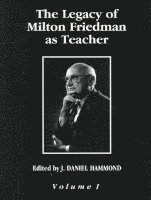
    Legacy of Milton Friedman as Teacher

    AvJ. D. Hammond

    Inbunden, Engelska, 1999

    Del 2 i serien Intellectual Legacies in Modern Economics series

    9 786 kr

    Beställningsvara. Skickas inom 5-8 vardagar. Fri frakt över 249 kr.

    Beskrivning

    Milton Friedman is beyond question the most famous living economist of the 20th century. He is closely associated with the doctrine of 'monetarism' which has been adopted by many governments around the world.This important two volume collection presents a major study of Milton Friedman's outstanding contribution to economics as a teacher at the University of Chicago. It shows how Friedman's distinctive ideas about money, markets and economic theory, communicated in the classroom and in thesis committees, influenced an entire generation of economists. It also reveals his influence on graduate-education practices at the University of Chicago and elsewhere.

    Produktinformation

    • Utgivningsdatum:1999-08-26
    • Mått:169 x 244 x undefined mm
    • Format:Inbunden
    • Språk:Engelska
    • Serie:Intellectual Legacies in Modern Economics series
    • Förlag:Edward Elgar Publishing Ltd
    • ISBN:9781858984230

    Utforska kategorier

    • Nationalekonomi inom Ekonomi och Ledarskap
    • Makroekonomi inom Ekonomi och Ledarskap

    Mer om författaren

    Edited by J. Daniel Hammond, Professor of Economics, Wake Forest University, US

    Recensioner i media

    'Hammond's introduction is learned, balanced and insightful, and, in conjunction with the Dwyer, Fand, Timberlake and Becker contributions, it provides a broad background from which to interpret Friedman's pedagogical impact.'

    Innehållsförteckning

    • Contents:Acknowledgements • IntroductionVolume I:Part I: Students’ Reflections on their Teacher1. Gerald P. Dwyer, Jr. (1999), ‘How was Milton Friedman Distinctive as a Teacher?’2. David I. Fand (1999), ‘Friedman’s Price Theory: Economics 300 at the University of Chicago in 1947–1951’3. Richard H. Timberlake (1999), ‘Observations on a Constant Teacher by a Graduate Student Emeritus’4. Gary S. Becker (1991), ‘Milton Friedman 1912–’Part II: The Legacy in Students’ Scholarship5. G. Warren Nutter (1969), ‘Growth of Monopoly: 1899–1939’6. E.J. Mishan (1952), ‘Toward a General Theory of Price, Income, and Money’7. William Hamburger (1955), ‘The Relation of Consumption to Wealth and the Wage Rate’8. Phillip Cagan (1956), ‘The Monetary Dynamics of Hyperinflation’9. Eugene M. Lerner (1955), ‘Money, Prices, and Wages in the Confederacy, 1861–65’10. Richard T. Selden (1956), ‘Monetary Velocity in the United States’11. Gary S. Becker (1957), ‘The Forces Determining Discrimination in the Market Place’ and ‘Effective Discrimination’12. John J. Klein (1960), ‘Price-Level and Money-Denomination Movements’13. Norman V. Breckner (1958), ‘Liquidity and Farm Investment Outlays’14. Boris P. Pesek (1958), ‘Monetary Reforms and Monetary Equilibrium’15. George Macesich (1960), ‘Sources of Monetary Disturbances in the United States’16. James K. Kindahl (1961), ‘Economic Factors in Specie Resumption: The United States, 1865–79’17. Richard H. Timberlake (1993), ‘The Specie Circular and the Distribution of the Surplus’18. John V. Deaver (1970), ‘The Chilean Inflation and the Demand for Money’19. A. James Meigs (1962), ‘Development of the Hypotheses’20. David Meiselman (1962), ‘An Operational Test of the Expectations Hypotheses’Name IndexVolume II: 1. Edgar L. Feige (1964), ‘Estimation of Demand Functions for Financial Assets’2. George R. Morrison (1966), ‘The Theory and its Implementation’3. Sam Peltzman (1965), ‘Entry in Commercial Banking’4. Adolfo Cesar Diz (1970), ‘Money and Prices in Argentina, 1935–1962’5. Michael W. Keran (1970), ‘Monetary Policy and the Business Cycle in Postwar Japan’6. Morris Perlman (1970), ‘International Differences in Liquid Assets Portfolios’7. Miguel Sidrauski (1967), ‘Rational Choice and Patterns of Growth in a Monetary Economy’8. William E. Gibson (1970), ‘Interest Rates and Monetary Policy’9. Douglas K. Adie (1970), ‘English Bank Deposits before 1844’10. Benjamin Klein (1974), ‘Competitive Interest Payments on Bank Deposits and the Long-Run Demand for Money’11. Michael R. Darby (1972), ‘The Allocation of Transitory Income Among Consumers’ Assets’12. Edi Karni (1972), ‘Inflation and Real Interest Rate: A Long-Term Analysis’13. Robert D. Laurent (1974), ‘Currency in Circulation and the Real Value of Notes’14. Michael David Bordo (1975), ‘The Income Effects of the Sources of Monetary Change: An Historical Approach’15. Warren L. Coats, Jr. (1973), ‘Regulation D and the Vault Cash Game’16. Richard V.L. Cooper (1974), ‘Efficient Capital Markets and the Quantity Theory of Money’17. Leonardo Auernheimer (1974), ‘The Honest Government’s Guide to the Revenue from the Creation of Money’18. James R. Lothian (1976), ‘The Demand for High-Powered Money’19. Benjamin Eden (1976), ‘On the Specification of the Demand for Money: The Real Rate of Return versus the Rate of Inflation’20. Jo Anna Gray (1978), ‘On Indexation and Contract Length’21. Alan C. Stockman (1980), ‘A Theory of Exchange Rate Determination’22. Gerald P. Dwyer, Jr. (1984), ‘The Gibson Paradox: A Cross-Country Analysis’Name Index