• Fri frakt över 249 kr
  • •
  • Snabba leveranser
  • •
  • Billiga böcker
Kundservice

Du är på sajten för privatpersoner.

Företag, bibliotek eller offentlig verksamhet?

Du handlar på classic.bokus.com, där alla dina funktioner finns intakta.
Till classic.bokus.com
Bokus logotyp. Gå till startsidan.
  • Erbjudanden
  • Nyheter
  • Student
  • Topplistor
  • Barn & ungdom
  • Bokus Play
  • E-böcker
  • Pocketböcker
  • Spel & pussel

10% rabatt på allt med kod NYSTART10 →

Sidfot

Mina sidor

    Hjälp

    • Kundservice
    • Vanliga frågor och svar
    • Frakt och leverans
    • Retur vid ångerrätt
    • Reklamera vara
    • Betalning
    • Köpvillkor
    • Allmänna villkor
    • Information om webbplatsens tillgänglighet

    Om Bokus

    • Om oss
    • Pressrum
    • För studenter
    • För företag
    • För bibliotek och offentlig verksamhet
    • För leverantörer
    • Hållbarhet

    Populärt

    • Aktuella erbjudanden
    • Presentkort
    • Studentlitteratur
    • Nya böcker
    • Topplistor
    • Signerade böcker
    • Engelska böcker

    Inspiration

    • Boktips
    • BookTok
    • Populära bokserier
    • Barnbokskaraktärer
    • Populära författare
    Logotyp för Bokus
    Följ oss på Facebook (extern länk)Följ oss på Instagram (extern länk)Följ oss på YouTube (extern länk)Följ oss på TikTok (extern länk)
    bokus @ CookiesAnpassa cookiesIntegritetspolicyKöpvillkor
    Till Citymail hemsida (extern länk)Till Budbee hemsida (extern länk)Till Postnord hemsida (extern länk)Till Schenker hemsida (extern länk)Till Early Bird hemsida (extern länk)Till Walleys hemsida (extern länk)
    1. Språk och ordböcker
    2. Språkvetenskap och lingvistik

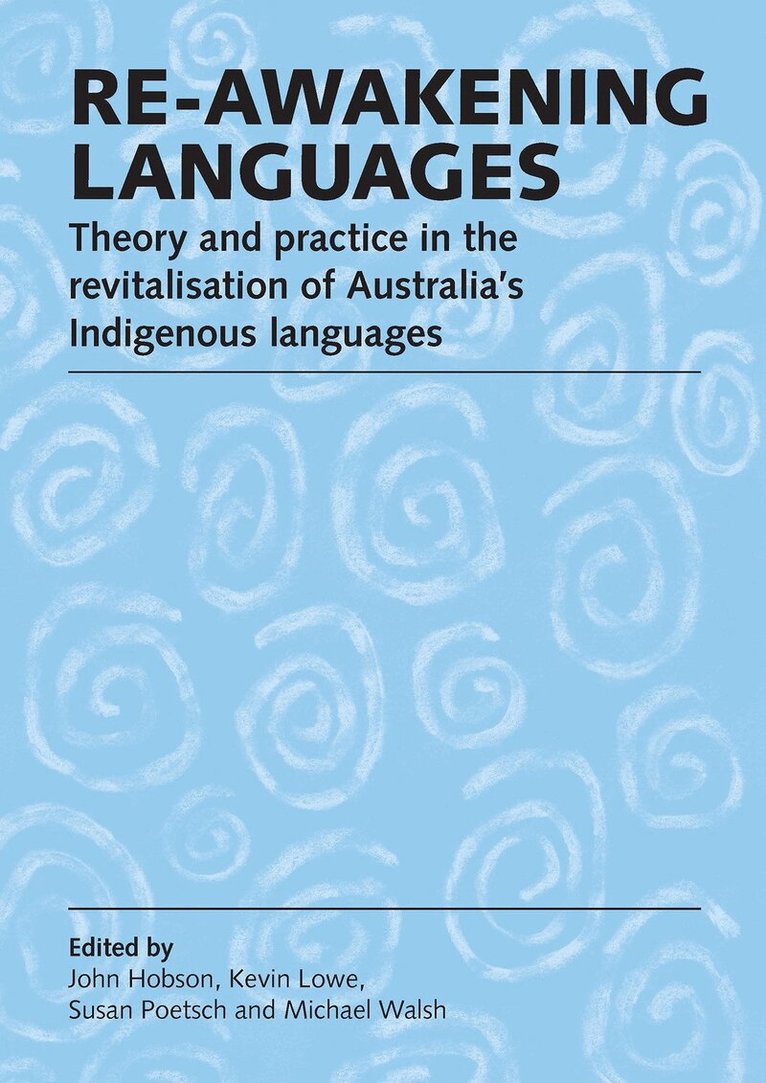
    Re-awakening Languages

    Theory and Practice in the Revitalisation of Australia's Indigenous Languages

    AvJohn Hobson,Kevin Lowe

    Häftad, Engelska, 2010

    490 kr

    Beställningsvara. Skickas inom 5-8 vardagar. Fri frakt över 249 kr.

    Beskrivning

    The Indigenous languages of Australia have been undergoing a renaissance over recent decades. Many languages that had long ceased to be heard in public and consequently deemed 'dead' or 'extinct', have begun to emerge.Geographically and linguistically isolated, revitalisers of Indigenous Australian languages have often struggled to find guidance for their circumstances, unaware of the others walking a similar path. In this context Re-awakening Languages seeks to provide the first comprehensive snapshot of the actions and aspirations of Indigenous people and their supporters for the revitalisation of Australian languages in the 21st century.The contributions to this volume describe the satisfactions and tensions of this ongoing struggle. They also draw attention to the need for effective planning and strong advocacy at the highest political and administrative levels, if language revitalisation in Australia is to be successful and people's efforts are to have longevity.

    Produktinformation

    • Utgivningsdatum:2010-11-15
    • Mått:176 x 250 x 34 mm
    • Vikt:725 g
    • Format:Häftad
    • Språk:Engelska
    • Antal sidor:488
    • Förlag:Sydney University Press
    • ISBN:9781920899554

    Utforska kategorier

    • Språkvetenskap och lingvistik inom Språk och ordböcker

    Mer om författaren

    About the editors:John Hobson is a lecturer in Indigenous education at the University of Sydney.Kevin Lowe is a post doctoral research fellow at Macquarie University.Susan Poetsch is a lecturer in Indigenous education at the University of Sydney.Michael Walsh is an honorary associate of linguistics at the University of Sydney.

    Recensioner i media

    'Re-awakening Languages has a very broad scope but it also has enough detail to be useful to many specific interests. It is an excellent introduction to the current issues around Australian Indigenous languages. It would be particularly valuable to managers in the various education systems who have too often demonstrated rather limited understanding of this area.'

    Innehållsförteckning

    • DedicationAcknowledgementsConventionsForewordJeannie BellAbout the authorsIntroduction: re-awakening Australian languagesJohn Hobson, Kevin Lowe, Susan Poetsch and Michael WalshPart 1: language policy and planningIntroduction: language policy and planningJohn Hobson1. Closing the policy-practice gap: making Indigenous language policy more than empty rhetoricAdriano Truscott and Ian Malcolm2. Why language revitalisation sometimes worksMichael Walsh3. Our ways of learning in Aboriginal languagesTyson Kaawoppa YunkaportaPart 2: languages in communitiesIntroduction: languages in communitiesKevin Lowe4. Monitoring the use of KaurnaRob Amery5. Introducing Wiradjuri language in ParkesGeoff Anderson6. Going public with language: involving the wider community in language revitalisationKnut J. Olawsky7. Ngapartji Ngapartji: Indigenous language in the artsBeth Sometimes and Alex Kelly8. Awakening or awareness: are we being honest about the retrieval and revival of Australia’s Aboriginal languages?Trevor StockleyPart 3: language centres and programsIntroduction: language centres and programsMichael Walsh9. Maam ngawaala: biindu ngaawa nyanggan bindaayili. Language centres: keeping language strongAnna Ash, Pauline Hooler, Gary Williams and Ken Walker10. Language centre as language revitalisation strategy: a case study from the PilbaraSally Dixon and Eleonora Deak11. Whose language centre is it anyway?Kimberley Language Resource Centre12. Revitalisation strategies for MiriwoongKnut J. Olawsky Part 4: language in educationIntroduction: language in educationSusan Poetsch and Kevin Lowe13. Using identical resources to teach young and adult language learnersUrsula Brown14. Aboriginal languages programs in TAFE NSW: delivery initiatives and strategiesJackie Cipollone15. Reclamation process for Dharug in Sydney using songRichard Green16. Developing the Dhurga Program at Vincentia High School: the language teacher’s perspectiveKaren Lane17. So you want to work with the community? Principles and strategies for school leaders affecting the establishment of Aboriginal language programsKevin Lowe and Peter Howard18. Establishing a school language program: the Parkes High School experienceStephen Maier19. Language revitalisation: community and school programs working togetherDiane McNaboe and Susan Poetsch20. The importance of understanding language ecologies for revitalisationFelicity Meakins21. The rebirth of Wergaia: a collaborative effortJulie Reid22. Strategies for doing the possible: supporting school Aboriginal language programs in NSWMari RhydwenPart 5: literacy and oracyIntroduction: literacy and oracyMichael Walsh23. Questions of fluency in Australian languages revitalisationJohn Hobson24. Sounds, spelling and learning to read an Aboriginal languageCaroline Jones, Paul Chandler and Kevin Lowe25. English influence on the pronunciation of re-awakened Aboriginal languagesNicholas ReidPart 6: language and technologyIntroduction: language and technologyJohn Hobson26. Increasing the accessibility of information on the Indigenous languages of VictoriaHeather Bowe, Julie Reid and Kathy Lynch27. Flexible IT resources for community language reclamation: using culturally appropriate contextsCat Kutay, George Fisher and Richard Green28. Electronic dictionaries for language reclamationAidan WilsonPart 7: language documentationIntroduction: language documentationMichael Walsh29. Libraries, languages and linking upFaith Baisden30. Yan-nhaŋu language documentation and revitalisationClaire Bowern and Bentley James31. A house already lived inChristina Eira and Lynnette Solomon-Dent32. Bringing the language home: the Ngarrindjeri dictionary projectMary-Anne Gale and Syd Sparrow33. The development of the Gamilaraay, Yuwaalaraay and Yuwaalayaay dictionaryJohn Giacon34. Emergency language documentation teams: the Cape York Peninsula experienceClair Hill and Patrick McConvellIndex